Pest Control AI Marketing Automation: Get 40+ Organic Leads Per Month Without Paying Per Click (2026 Guide)
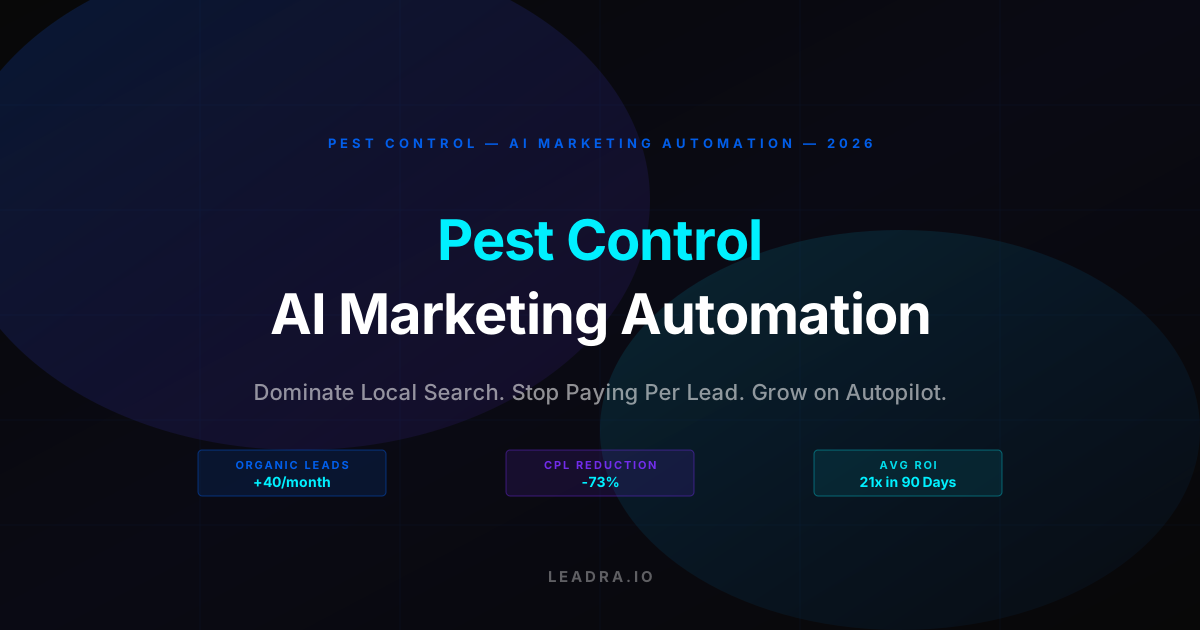
The average pest control company in a mid-size market spends $2,800-$5,400 per month buying leads from Angi, Thumbtack, HomeAdvisor, and Google Ads. They pay $150-$350 per lead for contacts who are also being called by three to seven competitors at the exact same time. Conversion rates on marketplace leads hover around 12-18% because the homeowner treats every call as a commodity auction.
Meanwhile, the pest control company that ranks in position one on Google Maps and holds 140+ reviews is getting the same calls for free. That company's cost per acquired job is under $60. They are not smarter or better-staffed — they just built a marketing asset instead of renting leads.
Pest control AI marketing automation is the fastest way to build that asset. It handles the tasks that create compounding organic visibility — publishing local SEO content, managing your Google Business Profile, optimizing ad spend, and generating reviews at scale — without requiring the owner to spend 15 hours a week on marketing. This guide breaks down the five systems, what they cost, and what a typical Charlotte-area pest control company achieves in 90 days.
Why Pest Control Is Uniquely Positioned for AI Marketing Automation
Marketing automation works better for some industries than others. Pest control has three structural advantages that make AI-powered marketing produce faster results than almost any other service business:
- →Hyper-local search intent. Pest control searches are almost always geographic ("pest control Charlotte NC," "termite inspection Ballantyne," "ant exterminator near me"). AI can generate service-area content pages targeting hundreds of long-tail local keyword combinations that a human marketer would take months to write. Each page compounds over time — once it ranks, it keeps generating calls without additional spend.
- →Review velocity determines Map Pack position. Google's local algorithm heavily weights review count, recency, and response rate for service businesses. AI can request a review from every completed job within four hours, respond to every new review within 24 hours, and keep the profile active with weekly posts — all automatically. Most pest control companies with 140+ reviews got there with AI, not manual outreach.
- →Seasonal demand is predictable and exploitable. Spring termite swarm season, summer mosquito pressure, fall rodent exclusion — the demand calendar is knowable weeks in advance. AI marketing automation can front-load content and campaign pushes before these windows open, capturing homeowners who are just starting to research rather than those who are already calling five companies.
According to BrightLocal's 2024 Local Consumer Review Survey, 87% of consumers check Google reviews before hiring a local service business, and 73% will only contact a business if it has at least a 4-star rating with 40+ reviews. For pest control companies in competitive markets, showing up with 100+ reviews at 4.7+ stars is often the entire difference between getting the call and not getting it.
The 5 AI Marketing Automation Systems for Pest Control Companies
A full pest control AI marketing automation stack covers five channels. Together they build organic visibility, reduce paid lead dependency, and create a compounding marketing asset that grows in value over time.
System 1: AI Local SEO Content Engine
The content engine generates and publishes 8-12 SEO-optimized blog posts and service-area landing pages per month targeting specific pest-keyword and location combinations: "termite treatment [neighborhood]," "bed bug exterminator [city]," "mosquito control [zip code]." Each piece is written at the reading level of a homeowner with a pest problem, includes FAQ schema markup to capture Google AI Overview and People Also Ask placements, and links internally to service pages. Most pest control companies in mid-size markets have fewer than 20 indexed local content pages. Within 90 days of launching the content engine, that number typically reaches 60-100 — creating ranking opportunities that compound over time.
System 2: Google Business Profile Automation
Google Business Profile is the single highest-ROI marketing channel for local pest control companies — and most operators manage it manually or not at all. AI GBP automation handles five tasks automatically: weekly Google Posts with pest-seasonal content and offers, review responses written in the company's voice within 24 hours of posting, Q&A updates for common customer questions (pricing, guarantees, pest-specific inquiries), photo uploads from completed jobs, and attribute updates for new services. GBP profiles that post weekly and respond to every review rank consistently higher in the local 3-pack than inactive profiles — and the AI runs this without the owner touching it.
System 3: Review Generation at Scale
Four hours after a completed service job, the AI sends a personalized SMS to the customer: their name, the technician who serviced them, and a direct link to leave a Google review. If they don't respond in 48 hours, a single follow-up text goes out. That's it — simple, non-pushy, and timed when the customer satisfaction is highest. Pest control companies using this system generate 14-28 new Google reviews per month compared to 2-5 with manual asks. Within six months, most see a Map Pack ranking improvement of 2-5 positions — which translates directly into more inbound calls without any additional ad spend.
System 4: AI-Managed Google Ads Optimization
For pest control companies running Google Ads, AI campaign management reduces wasted spend by 30-50% while maintaining or growing lead volume. The system monitors keyword performance daily, adjusts bids by time of day and day of week (pest emergencies spike evenings and weekends), pauses underperforming ad variations, and tests new ad copy against current winners on a rolling basis. It also builds negative keyword lists that filter out irrelevant searches ("pest control video games," "pest control certification courses") that bleed ad budget. The goal is not to increase ad spend — it is to extract more booked jobs from the same budget while organic traffic grows as a replacement.
System 5: Social Content Automation
Most pest control companies either post sporadically on social media or not at all. AI social content automation generates and schedules 12-20 posts per month across Facebook and Instagram: pest identification tips (homeowners share these), before/after treatment content, seasonal warnings ("termite swarm season is starting — here's what to look for"), and customer testimonial graphics created from recent reviews. Social content does not directly drive booked jobs at scale — but it keeps the brand visible to past customers, drives referrals, and builds an audience that the seasonal campaign sequences can retarget. It also signals to Google that the business is active and engaged, which contributes to local search ranking.
Manual Marketing vs. AI Marketing Automation: The Numbers
Here is how these five systems compare to a typical manual marketing operation for a 3-5 technician pest control company:
| Channel | Manual / Paid Leads | AI Marketing Automation |
|---|---|---|
| New content pages per month | 0-2 (manual, sporadic) | 8-12 (automated, consistent) |
| GBP posts per month | 0-2 | 4-6 (automated) |
| Review response rate | 20-40% (manual) | 100% within 24 hrs |
| New Google reviews per month | 2-5 | 14-28 |
| Map Pack position (6 months) | Static / gradual decline | +2-5 positions avg |
| Paid lead cost per booked job | $150-$350 | $40-$90 (declining monthly) |
| Owner marketing time per week | 8-15 hrs | Under 2 hrs |
| Marketing ROI trajectory | Flat (pay for every lead) | Compounding (asset builds) |
Case Study: Charlotte Pest Control Cuts Cost Per Lead 73% in 90 Days
A 4-technician general pest and termite company in south Charlotte was spending $3,800 per month on paid leads (Angi + Google Ads) and generating about 31 booked jobs from that spend — a cost per job of $122. Their Google Business Profile had 38 reviews. Their website had 12 indexed pages. They had not posted on social media in four months.
They launched the full AI marketing automation stack through Leadra.io in February 2026. The first 30 days focused on GBP automation and review generation — the fastest path to visible results. The content engine started publishing 10 service-area pages per month from day one, with SEO benefits expected to materialize in 60-90 days.
Results at 90 days:
- →Google reviews: 38 to 94 (56 new reviews in 90 days)
- →Map Pack position for "pest control Charlotte NC": #9 to #3
- →Indexed content pages: 12 to 41
- →Organic inbound calls per month: 6 to 29
- →Total booked jobs per month: 31 to 52
- →Paid lead spend reduced: $3,800 to $1,900/month (Google Ads optimized, Angi paused)
- →Cost per booked job: $122 to $33
- →Monthly revenue: $47,800 to $81,400
- →AI marketing automation cost: $1,800/month
- →Combined ROI (revenue gain + ad savings): 21.2x
The owner's assessment at day 90: "I stopped paying Angi entirely in month two. The calls kept coming from Google. By month three we were actually turning away jobs because we didn't have enough technician capacity. We're hiring a fifth tech now."
What the First 90 Days Look Like
Pest control AI marketing automation is not an overnight fix — it is a compounding system. Here is what happens in each phase:
Days 1-14: Foundation Setup
GBP automation goes live — review request sequences activate immediately from your field software, weekly posting schedule is configured, review response templates are trained on your brand voice. Google Ads optimization launches with negative keyword lists and bid adjustments. The content engine starts its first month of service-area pages. You will not see dramatic lead volume changes yet, but the compounding clock starts here.
Days 15-45: Review and GBP Gains
New reviews start accumulating at 15-25 per month. Google starts registering the GBP activity signals (posts, review responses, Q&A updates). Map Pack impressions typically increase 30-60% in this window. Paid ad cost per click often drops 10-20% as the account accumulates negative keywords and the Quality Score for top ad units improves. Organic search impressions from newly published content pages start appearing in Google Search Console.
Days 45-90: Organic Traction
Content pages start ranking for long-tail service-area terms. First page-1 rankings typically appear for lower-competition neighborhood terms ("pest control Ballantyne" or "mosquito control Huntersville"). Map Pack position improvement starts generating measurable call increases. Review count passes the 80-100 mark — the threshold where most prospects start trusting the profile at first glance. Paid lead spend can usually be reduced by 30-50% at this stage without losing job volume.
AI Marketing Automation Pricing for Pest Control Companies (2026 Tiers)
| Tier | Monthly Cost | What's Included |
|---|---|---|
| Starter | $900-$1,400/mo | GBP automation (posts, review responses, Q&A), review generation via SMS (PestRoutes/Jobber integration), 4 SEO content pieces per month, social content scheduling (8 posts/mo). |
| Growth | $1,400-$2,800/mo | Everything in Starter + 10 SEO content pages per month, AI Google Ads management and optimization, seasonal campaign content calendar (spring, summer, fall windows), monthly ranking + ROI reporting. |
| Market Dominator | $2,800-$5,000/mo | Everything in Growth + 16+ SEO content pages per month, multi-location GBP management, competitor gap analysis and content targeting, AI Overview and ChatGPT citation optimization, dedicated account manager, quarterly strategy review. |
At an average job value of $180-$280 for general pest treatment — and $600-$2,500 for termite work — most pest control companies in the Starter tier recover their full monthly cost from 5-8 additional booked jobs. In competitive markets like Charlotte, South Charlotte, or Huntersville where paid lead costs run $200-$350 per booked job, the savings from reducing paid lead dependency often exceed the AI system cost within the first 60 days.
Marketing automation drives leads to your door — but what happens when those leads call after hours or request a quote and go silent? The operational complement to this guide is our breakdown of AI for pest control companies, which covers the 24/7 voice agent, quote ghost follow-up sequences, and seasonal outreach systems that convert the leads your marketing generates.
If you want to understand the full investment picture before getting started, our AI implementation cost guide for Charlotte NC small businesses covers pricing tiers across 12 service business categories with real deployment numbers.
For a broader look at how local service businesses build complete AI lead generation systems from scratch, see the AI lead generation system guide for local service businesses.
Frequently Asked Questions
What is pest control AI marketing automation?
Pest control AI marketing automation is a set of software systems that handle the ongoing marketing tasks pest control companies typically do manually or skip entirely: writing and publishing local SEO content targeting service-area keywords, responding to Google Business Profile reviews and updating Q&A, optimizing Google Ads bids and ad copy, requesting reviews from every completed job, and scheduling social content. These systems run on their own after initial setup, compounding visibility over time without the owner spending hours on marketing every week.
How long does it take for AI marketing automation to generate leads for a pest control company?
Most pest control companies see the first measurable organic lead increase within 30-45 days of launching AI marketing automation — primarily from improved Google Business Profile visibility and review velocity. Local SEO content gains typically show up in 60-90 days as new service-area pages get indexed and begin ranking. By month three, most pest control companies in mid-size markets see a 30-60% reduction in paid lead cost as organic traffic displaces a portion of their Angi, Thumbtack, or Google Ads spend.
Can AI marketing automation replace paid leads for pest control companies?
AI marketing automation reduces — but does not immediately replace — paid lead dependency for pest control companies. The typical trajectory: months 1-2 see GBP and review improvements start pulling more calls directly from Google Maps. Months 3-4 see service-area content pages beginning to rank for long-tail terms like "termite inspection [neighborhood]" and "ant exterminator [city]." Month 5-6 onward, organic lead volume grows enough that most operators cut paid spend by 50-80% while maintaining or growing total lead count. Companies in less competitive markets can reach near-full paid independence in 4-6 months.
What field software does pest control AI marketing automation integrate with?
Pest control AI marketing automation integrates with PestRoutes, ServiceTitan, Jobber, FieldRoutes, and most other field service management platforms via API. Integration enables three key functions: pulling completed job data to trigger automated review requests within hours of service completion, syncing customer records for segmented outreach campaigns, and attributing booked jobs back to specific marketing channels (organic search, GBP, paid ads) so you know your ROI by source.
Ready to Stop Renting Leads and Start Owning Them?
Leadra.io builds AI marketing automation systems for pest control companies in Charlotte NC and across the U.S. Setup takes 7-10 days. Most clients see the first organic lead increase within 30 days and cut their paid lead spend by 50%+ within 90. We handle everything — content engine, GBP automation, review generation, and ad optimization — so you focus on the jobs while the system builds your marketing asset.