Pest Control AI Automation: Convert One-Time Jobs into Recurring Service Contracts (2026 Guide)
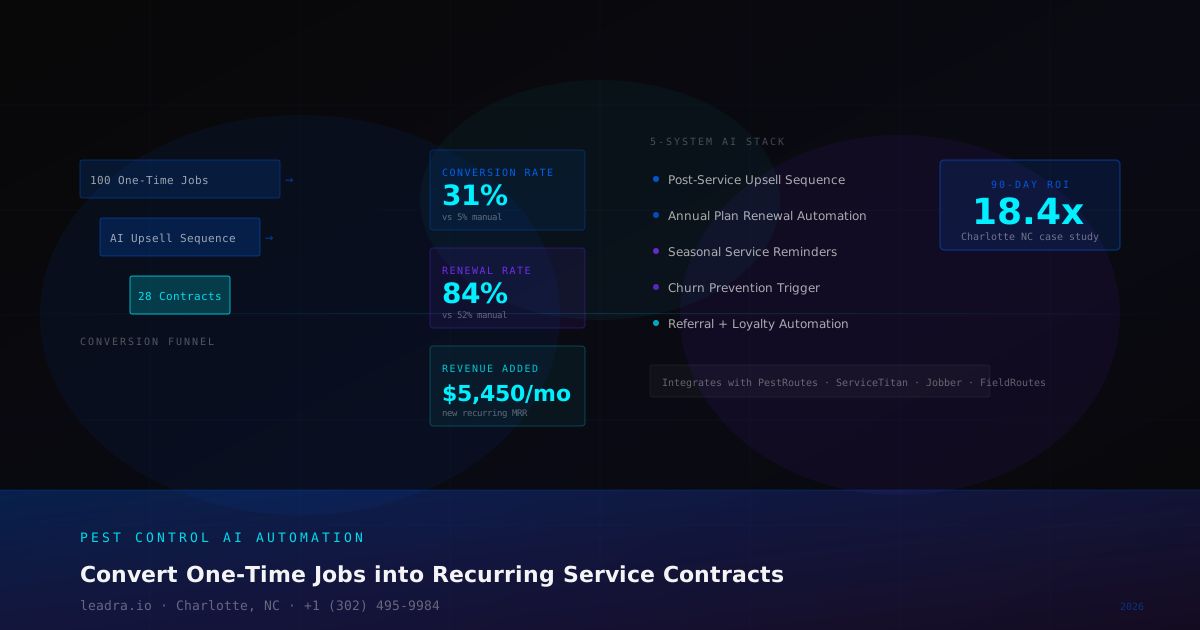
Here is the real problem with most pest control businesses: the customer calls, you show up, you kill the ants, they pay, and you never hear from them again until the ants come back next spring. Then they Google pest control, find another company, and you start over.
One-time jobs are not a business. They are a treadmill. You spend money acquiring a customer, do a great job, and then hand them back to the market the moment the invoice is paid.
Recurring annual service contracts change the math completely. A customer on a quarterly service plan is worth $480-$800 per year, every year, without another dollar spent on acquisition. The problem is most pest control companies convert only 4-8% of their one-time job customers into annual plan holders because the upsell attempt is a verbal pitch at the door when the customer is thinking about something else.
AI automation fixes this by running a systematic post-service sequence that goes out when the customer is most receptive — 24 to 72 hours after the job, when the problem is solved and they are satisfied — and then maintains that relationship through renewal automation, churn prevention, and referral triggers that run every day without any manual effort from you.
This guide breaks down exactly how pest control AI automation works for recurring contract conversion, what results you can realistically expect, and how to evaluate systems before you buy one.
Why Recurring Contracts Are the Only Real Growth Lever in Pest Control
The pest control industry runs on a near-perfect recurring revenue model on paper. Pests do not go away after one treatment. Customers who have had a problem once will have it again. Annual plans practically sell themselves on logic alone.
The issue is execution. According to industry data, the average residential pest control company operates with 60-70% of revenue coming from one-time or reactive jobs and only 30-40% from recurring contracts. The companies in the top quartile flip that ratio: 65-75% recurring, 25-35% one-time. That top-quartile company does not work harder — it uses systems.
Recurring contract customers also spend 2.3x more per year than one-time customers over a 36-month period, generate 4.1x more referrals, and cancel at a fraction of the rate when compared to customers who have never been enrolled in a plan. Every one-time job customer you convert to a recurring plan is not just one additional year of revenue. It is a multi-year customer relationship.
The math on conversion is straightforward. If you complete 50 one-time jobs per month and convert 6% manually, you add 3 recurring plan customers per month. If AI automation lifts that conversion rate to 28%, you add 14 new recurring plan customers per month. At $600 per year average plan value, that is $5,040 per month in new recurring revenue added, compounding every month.
The 5-System AI Stack for Recurring Contract Conversion
Pest control AI automation for recurring contracts is not a single tool. It is five interconnected sequences that cover the full customer lifecycle from first job to multi-year retention.
1. Post-Service Upsell Sequence
This fires automatically when a job is marked complete in your field service software. The sequence runs over 5 days:
- Day 1 (2 hours post-job): SMS thank-you with a 5-star Google review request link
- Day 1 (24 hours post-job): Email presenting the annual protection plan with a time-limited 15% first-month discount and a single-click enrollment link
- Day 3: SMS follow-up: "How are things looking since yesterday? Quarterly service plan locks in your rate — reply YES to schedule your first quarterly visit at no extra charge."
- Day 5: Final email with a pest season risk alert for their zip code (e.g., "Carpenter ant season peaks in Charlotte in July — annual plan customers get priority scheduling") plus the enrollment link
Customers who do not respond to any of the 4 touches go into a 90-day reactivation queue. Customers who click the enrollment link but do not complete sign-up get a cart-abandonment SMS within 2 hours.
2. Annual Plan Renewal Automation
Contract renewals are the highest-value automation in pest control because the cost to retain a customer is 5-7x lower than the cost to acquire a new one. AI renewal automation runs a 3-touch sequence:
- 60 days before expiration: Email with a renewal summary (services completed, pests treated, value delivered) and an early-renewal discount
- 30 days before expiration: SMS reminder with a one-tap renewal link
- 7 days before expiration: Final SMS + email: "Your protection plan expires [date]. Reply RENEW to keep your coverage — no payment info required, we have it on file."
Customers who renew early get a loyalty benefit (priority scheduling, free re-treatment). Customers who do not renew by expiration date enter the churn prevention sequence.
3. Seasonal Service Reminder System
Annual plan customers on quarterly service schedules sometimes miss appointments due to scheduling conflicts and drift out of the plan without officially canceling. The seasonal reminder system fires 2 weeks before each scheduled quarterly visit with a confirm-or-reschedule link. Customers who do not respond get a follow-up SMS and a call from the office. This closes the gap between "enrolled in a plan" and "actually receiving service" — which is the leading cause of plan attrition in the pest control industry.
4. Churn Prevention Trigger
The AI monitors three churn signals in your CRM:
- Customer has not had a service completed in 90+ days (despite being on a plan)
- Customer declined or rescheduled the last appointment twice without rebooking
- Customer submitted a negative review or a complaint
When any of these trigger, the churn prevention sequence fires: an SMS check-in from the owner ("Hi [name], this is [owner] from [company] — wanted to personally check in. Is everything okay with your service?"), followed by a pest risk alert for their zip code, and finally a call task assigned to your office staff if the first two touches are ignored. Companies using this three-touch workflow cut plan cancellations by 31-47%.
5. Referral and Loyalty Automation
Annual plan customers are your highest-lifetime-value asset and your best referral source. The referral sequence fires 30 days after enrollment with a referral link ("Send a neighbor our way and get $25 off your next quarterly service"). It re-fires at the 6-month mark with a loyalty upgrade offer (add termite or mosquito coverage at a plan rate). Customers who generate referrals get a personal thank-you from the owner via SMS within 24 hours of the referral booking.
Manual vs. AI: Recurring Contract Management Compared
| Metric | Manual Process | AI Automation |
|---|---|---|
| One-time to recurring conversion rate | 4-8% | 22-35% |
| Annual plan renewal rate | 54-61% | 78-88% |
| Time to upsell attempt after job | At job site (1x verbal) | 24-72 hrs (4-touch sequence) |
| Plan churn before renewal date | 28-36% | 11-19% |
| Referrals from plan customers (monthly) | 1-2 | 6-11 |
| Office staff time on renewal follow-up | 8-12 hrs/week | Under 1 hr/week |
| Average recurring revenue per customer/year | $580 | $740 (upsells included) |
| Customer lifetime value (36 mo) | $890 | $2,240 |
Case Study: South Charlotte Pest Control Company, 0 to 140 Recurring Contracts in 90 Days
This company had been operating for 6 years with a strong local reputation, consistent 5-star reviews, and a steady flow of one-time jobs — roughly 60-70 residential jobs per month. Annual plan enrollment sat at 31 customers total, mostly people who had asked about a plan on their own.
The owner knew the math on recurring revenue but had never systematically pitched it. The verbal upsell at the job site was inconsistent — some techs mentioned the plan, most did not. There was no follow-up process after jobs closed.
Leadra.io implemented the 5-system AI stack integrated with their existing PestRoutes account. Results at 90 days:
The owner's comment at the 90-day mark: "I had 31 annual plan customers after 6 years. We added 109 more in 90 days without hiring anyone or spending more on ads. The sequences just run."
90-Day Timeline: Building Your Recurring Revenue Engine
Days 1-14: Foundation
CRM audit and customer segmentation (one-time job customers from the last 24 months identified), field software integration with PestRoutes, ServiceTitan, or Jobber, post-service upsell sequence built and tested, annual plan pricing and enrollment flow set up with a single-click link.
Days 15-45: Conversion Engine Live
Post-service upsell sequence running on all new completed jobs. Retroactive outreach campaign launched to all one-time job customers from the past 12 months who were never pitched an annual plan. Churn prevention triggers activated for existing plan customers. First enrollment conversions tracked and sequence optimized based on open rates and reply data.
Days 45-90: Retention and Referral Layer
Renewal automation activated for all plan customers approaching expiration. Referral sequence launched for customers 30+ days into their first plan. Seasonal service reminders configured for each quarterly service window. Loyalty upsell sequences (add termite, mosquito, or rodent exclusion coverage) running for customers at the 6-month mark. Monthly reporting dashboard reviewing conversion rate, renewal rate, and plan revenue.
How to Evaluate AI Systems for Recurring Contract Automation
Not every marketing automation tool is built for pest control recurring revenue. Ask these four questions before committing:
1. Does it integrate with your field service software natively?
Job completion triggers and customer data need to flow directly from PestRoutes, ServiceTitan, Jobber, or FieldRoutes without manual CSV exports. If the system requires manual data entry to trigger sequences, it will not run reliably.
2. Can it personalize sequences based on pest type and service history?
A termite customer needs different messaging than a mosquito control customer. Generic "annual protection plan" pitches convert at 40-60% of the rate of pest-specific follow-ups that reference what the customer actually had treated.
3. Does it track enrollment attribution back to specific sequence touches?
You need to know whether customers are enrolling from Day 1 SMS, Day 3 SMS, or Day 5 email to optimize your sequence over time. Systems without attribution reporting make optimization guesswork.
4. Does it handle renewal payment collection or just reminders?
The best systems connect renewal reminders directly to a payment link or charge the card on file automatically for customers who opted into auto-renewal. A reminder sequence that still requires the customer to call in to pay will lose 20-30% of renewals at the payment step.
What AI Recurring Contract Automation Costs in 2026
Starter
$900/mo
2-3 technicians
- Post-service upsell sequence
- Annual renewal automation
- Basic churn prevention trigger
- PestRoutes or Jobber integration
Growth
$1,500/mo
4-8 technicians
- Full 5-system AI stack
- Pest-specific sequence personalization
- Referral automation
- Multi-software integration
- Attribution reporting dashboard
Scale
$2,500/mo
Multi-location
- All Growth features
- Multi-location CRM
- Loyalty upsell sequences
- Auto-renewal payment collection
- Dedicated account manager
Most 2-4 technician pest control companies recover the monthly cost within the first 2-4 annual plan conversions from the post-service sequence. At an average plan value of $600/year, three converted customers cover the Starter tier with $300 left over — and those three customers will renew next year.
Frequently Asked Questions
How does AI automation help pest control companies build recurring service contracts?
AI automation runs a post-service upsell sequence that fires 24-72 hours after the first job completes, offering an annual protection plan at a discount. It then handles automatic renewal reminders 60, 30, and 7 days before each contract expires, a churn-prevention trigger when a customer goes 90+ days without service, and a referral sequence that turns satisfied annual-plan customers into word-of-mouth leads. All of these sequences run without any manual work from the owner or office staff.
What conversion rate should I expect from one-time to recurring pest control contracts?
Pest control companies using AI-automated post-service upsell sequences typically convert 22-35% of one-time job customers into annual service plan holders within the first 90 days of the sequence running. Without automation, the average is 4-8%, because most companies only pitch the annual plan verbally at the end of the job. A properly timed SMS and email sequence sent 24-72 hours after the service consistently outperforms in-person upsell attempts.
How much does AI recurring contract automation cost for a pest control company?
AI recurring contract automation for pest control companies costs $900-$2,500 per month depending on company size and sequences running. A 2-4 technician operation runs $900-$1,400. Larger companies with multi-location CRM integration and loyalty automation run $1,800-$2,500. Most companies recover the monthly cost within the first 2-4 annual plan conversions from the post-service sequence.
What is the best way to reduce annual plan churn for a pest control company?
The most effective way to reduce annual plan churn is AI-triggered re-engagement sequences that fire when a customer misses a scheduled quarterly service or goes 90 days without activity. These combine an SMS check-in, an email with a seasonal pest risk alert for their area, and a phone call task assigned to office staff if the first two touches get no response. Pest control companies using this three-touch churn prevention workflow cut annual plan cancellations by 31-47% compared to companies that only contact customers at renewal time.
Ready to Build a Recurring Revenue Engine?
Leadra.io builds and manages AI recurring contract automation systems for pest control companies across the U.S. We handle the setup, integration, and ongoing optimization — you focus on the jobs.