Plumbing AI Dispatch Automation: Route More Jobs, Cut Drive Time, and Grow Revenue in 2026
Plumbing dispatch is a puzzle that resets every morning. You have technicians spread across different parts of the city, jobs with different skill requirements, customer urgency levels that shift mid-day, and a parts situation that determines whether a tech can close a job on the first visit or has to return. A dispatcher working the phone and a whiteboard can manage this — but only up to a point. Once you have 4+ technicians and 20+ daily jobs, manual dispatch starts leaving money on the table.
The gaps show up in predictable ways: a tech drives 47 minutes to a job that should have gone to the guy 9 minutes away. A same-day slot opens at 1:30 PM when a cancellation comes in, but no one notices until 4:45 PM and the slot is wasted. A leak repair gets sent to a tech who needed a drain specialist, leading to a callback and a second visit. A water heater job gets accepted without confirming parts availability, forcing a mid-job run to the supply house.
Plumbing AI dispatch automation fixes all four. It assigns the right technician to every job in under 60 seconds, continuously optimizes routes as the day changes, recovers same-day slots before they expire, and verifies parts before any tech is dispatched. This guide covers how it works, what results look like for a Charlotte plumbing company, how it connects to ServiceTitan and Housecall Pro, and what it costs.
How Plumbing AI Dispatch Automation Works: The 5-Component System
A purpose-built plumbing dispatch AI is not a scheduling tool — it is a decision-making layer that sits on top of your existing field software and makes assignment calls in real time. Here is what each component does:
1. Skill-Based Job Matching
The AI reads the incoming job type from your call intake or CRM — water heater replacement, drain cleaning, slab leak, sewer main backup, general service — and matches it against each technician's skill profile. The job goes to the qualified tech who is geographically closest with an available slot. No more sending a residential service tech to a commercial backflow job, and no more asking your drain specialist to run a routine faucet repair when he has three hydro-jetting jobs behind it.
2. Real-Time Route Optimization
Instead of locking each tech's day in the morning and hoping it holds, the AI continuously recalculates the optimal travel path as new jobs come in, cancellations happen, and job durations shift. When a tech finishes a job 40 minutes early, the system doesn't just move them to the next scheduled stop — it checks whether a closer job from the queue is a better routing decision. Most plumbing companies using this reduce drive time by 30-40% per technician per day, which translates directly to more completed jobs without more labor hours.
3. Same-Day Slot Recovery
When a job cancels or a tech finishes early, the AI scans the waiting job queue for the best unscheduled match, checks skill fit and proximity, and offers the slot to the waiting customer before a human dispatcher has a chance to notice the opening. Companies doing this manually recover 35-45% of same-day opportunities. With AI slot recovery, that number runs 85-90%. For a 5-tech shop, that is typically 3-6 additional jobs per week that would otherwise be lost to the next available date.
4. Parts Verification Before Dispatch
Before confirming any dispatch, the AI cross-references the job type against parts inventory in your field software. A water heater replacement flagged before the tech leaves the shop is a parts order. The same job discovered mid-job is a two-hour delay, a frustrated customer, and a callback. This single component eliminates most second-trip situations that come from accepting jobs without checking stock — a problem that costs plumbing companies 8-12 hours of billable capacity per week in wasted drive and wait time.
5. Automated Customer Communication
As dispatch updates happen throughout the day, the AI sends tech-en-route SMS to each customer — including the technician's name, photo, and a live ETA — and a post-job satisfaction prompt within 30 minutes of job close. No manual follow-up, no customer calling the office to ask "is my plumber still coming?". The communication runs on its own, and each touchpoint creates a review opportunity that most plumbing companies are currently leaving uncaptured.
Manual Dispatch vs. AI Dispatch Automation: How the Results Compare
Here is what each approach delivers across the metrics that matter most for a 4-8 tech plumbing operation:
| Factor | Manual Dispatch | AI Dispatch Automation |
|---|---|---|
| Job assignment time | 5-15 min per job | Under 60 seconds |
| Skill-match accuracy | Depends on dispatcher memory | Automated against tech profiles |
| Daily drive time per tech | 90-140 min | 55-80 min |
| Same-day slot recovery | 35-45% of open slots | 85-90% of open slots |
| Parts pre-verification | Inconsistent | Automatic before every dispatch |
| Customer ETA updates | Manual calls when remembered | Automated SMS on every job |
| Scales past 6 techs | Requires additional dispatcher | No added headcount |
| Peak season performance | Degrades under load | Consistent regardless of volume |
Case Study: Charlotte Plumbing Company Adds $22,400/Month Without Hiring
A Charlotte plumbing company running 5 technicians with a part-time office manager handling dispatch was hitting a common ceiling. On high-volume days — summer AC-adjacent plumbing calls, winter freeze events — the dispatcher couldn't keep pace. Three to four jobs per day were either dispatched to the wrong technician or pushed to the following morning because the slot wasn't spotted in time. Drive time averaged 127 minutes per tech per day.
They deployed plumbing AI dispatch automation through Leadra.io in March 2026. Integration with their Housecall Pro account took 6 days: 3 days mapping technician skill profiles and job categories, 2 days of test dispatching with side-by-side comparison against their existing process, and 1 day of live handoff with monitoring.
Results after 60 days:
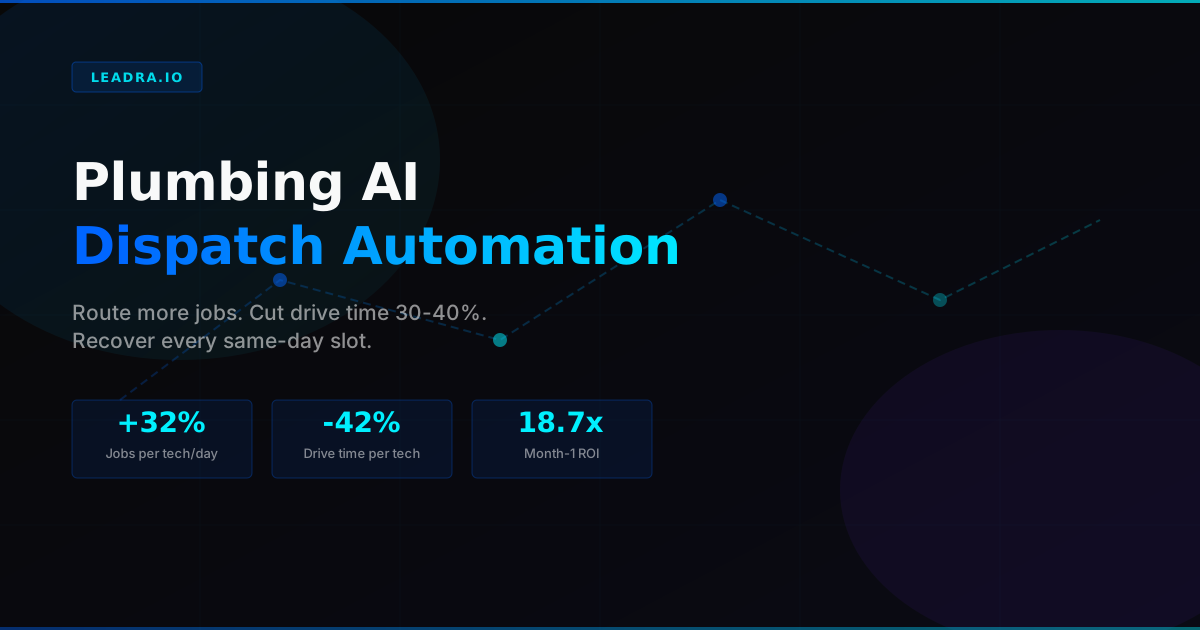
- →Daily jobs completed per technician: 4.1 to 5.4 (+32%)
- →Average drive time per tech per day: 127 minutes to 74 minutes (-42%)
- →Same-day slot recovery rate: 38% to 88%
- →Jobs dispatched to a mismatched skill tier: 14% to 2%
- →Second-trip callbacks from parts issues: 9/month to 2/month
- →Added monthly revenue without hiring: $22,400
- →Monthly system cost: $1,200
- →ROI in month 1: 18.7x
The dispatcher's role shifted from managing every job assignment to reviewing the AI's daily plan and handling escalations — roughly 20% of her previous dispatch workload. The freed time went to estimate follow-up and customer outreach, which added another $3,200/month in recovered jobs that previously went cold.
Integrates With ServiceTitan, Housecall Pro, and Jobber
Plumbing AI dispatch automation works by reading and writing to your existing field management software — not replacing it.
ServiceTitan
The integration pulls real-time technician location from GPS tracking, reads job type and priority from the booking record, and writes the dispatch assignment directly to the ServiceTitan dispatch board. When a job closes, ServiceTitan triggers the next assignment automatically. Parts inventory from ServiceTitan Pricebook is cross-referenced at the dispatch decision point so no tech is sent unprepared.
Housecall Pro
The AI maps technician availability from the Housecall Pro calendar, matches incoming jobs against skill tags on each employee profile, and sends dispatch assignments through Housecall Pro's notification system. Customer ETA texts pull from Housecall Pro's communication layer, keeping your existing customer-facing workflow intact while layering route optimization on top of it.
Jobber
API integration pulls job requests and technician schedules from Jobber, pushes optimized dispatch assignments back, and triggers the Jobber-native customer notification sequence on assignment. The AI handles the routing logic while Jobber stays the system of record — no platform migration required.
If you are not yet using field software, the AI dispatch layer works over a shared calendar as a starting point — though integration with one of these platforms delivers the highest ROI because job type, parts data, and technician location are already structured there.
When Should a Plumbing Company Deploy AI Dispatch Automation?
Four signals mean it's time to move:
- →Your dispatcher is a scheduling bottleneck on high-volume days. If jobs queue up and don't get assigned until mid-afternoon on busy days, you are losing revenue through delayed scheduling. AI dispatch processes every incoming job simultaneously — no queue, no lag, no dropped slots during peak call volume.
- →You have 4+ technicians with different specialties. The ROI on skill-based routing increases with team size and specialty differentiation. A 4-tech crew with a drain specialist, a water heater tech, a slab leak tech, and a general service tech gets far more value from automated matching than a 2-person shop where both handle everything.
- →Your techs are spending over 100 minutes per day driving. That is 1.7+ hours of labor going to windshield time every shift. Most Charlotte-area routes can be optimized under 75 minutes with AI routing. At $95/hour average billed labor, recovering 30 minutes per tech per day is $2,850/month per technician in recovered capacity — before adding a single new job.
- →You plan to grow from 4 techs to 7-8 in the next 18 months. Manual dispatch breaks at scale — the dispatcher who handled 4 techs well will struggle with 8 without adding staff. Deploying AI dispatch now means the system grows with your headcount. Adding a technician means updating a skill profile, not hiring another dispatcher.
AI Dispatch Automation Pricing for Plumbing Companies (2026)
| Tier | Monthly Cost | What's Included |
|---|---|---|
| Starter | $700-$1,000/mo | AI job routing, skill-based assignment, same-day slot recovery, automated customer ETA SMS. Best for 3-5 tech operations. |
| Growth | $1,000-$2,000/mo | Everything in Starter + field software integration (ServiceTitan, Housecall Pro, Jobber), real-time route optimization, parts pre-verification, call recordings and quality review, estimate follow-up automation. |
| Enterprise | $2,000-$4,500/mo | Everything in Growth + multi-location dispatch, live performance dashboards, custom escalation workflows, dedicated account manager, quarterly dispatch optimization reviews. |
For a 5-tech plumbing company doing $80k-$120k/month in revenue, the Growth tier typically adds $15,000-$25,000 in monthly revenue through more jobs per technician per day and better same-day slot recovery. ROI runs 12-20x in month one — and the system keeps compounding as techs build more territory density and the routing logic improves with more job history.
Compare this to the alternative: hiring a full-time dispatcher at $18-$24/hour costs $3,100-$4,200/month plus benefits — with no route optimization, no parts pre-verification, and no ability to scale past 6-7 technicians without a second hire.
AI dispatch automation handles the operational layer of your plumbing business. If you are also losing emergency jobs overnight to voicemail, read our guide on the best AI for plumbing companies handling emergency calls — it covers the after-hours triage and dispatch system that runs when your dispatcher is off the clock.
For a full picture of how to build a lead generation and operational automation system across all your service channels, see our AI lead generation system for local service businesses. And if you want specific cost and timeline data for deploying AI in Charlotte NC, the AI implementation cost breakdown for Charlotte small businesses covers three tiers with real numbers.
Frequently Asked Questions
What is plumbing AI dispatch automation?
Plumbing AI dispatch automation uses software intelligence to assign incoming jobs to the right technician based on skill match, current location, and schedule availability — in under 60 seconds. It integrates with field management platforms like ServiceTitan, Housecall Pro, and Jobber, reading live tech GPS data and job details to make the optimal assignment without a dispatcher manually working through each slot. For plumbing companies with 4+ technicians, it typically reduces drive time by 30-45%, increases daily jobs per tech by 20-35%, and recovers 85-90% of same-day slots that open from cancellations.
How does AI dispatch automation integrate with ServiceTitan for plumbing?
AI dispatch automation connects to ServiceTitan via API to pull real-time technician location from GPS, read job type and skill requirements from the booking record, and write the dispatch assignment directly to the ServiceTitan dispatch board. When a job closes, the system triggers the next assignment automatically without manual input. Parts inventory data from ServiceTitan is cross-referenced before dispatch so techs are not sent to jobs where critical parts are unavailable, eliminating the mid-job supply house run and second-trip callbacks.
How many more jobs can a plumbing company book with AI dispatch?
Most plumbing companies with 4-8 technicians see a 25-35% increase in daily jobs completed per technician after deploying AI dispatch automation. The gain comes from three places: shorter drive time (typically 30-45 minutes saved per tech per day), better same-day slot recovery (85-90% vs. 35-45% manually), and zero time wasted on mismatched dispatches requiring re-routing. For a 5-tech company completing 4 jobs per tech per day at an average ticket of $380, a 30% increase means 6 additional jobs per day — roughly $2,280 in added daily revenue.
Can a small plumbing company with 2-3 technicians benefit from AI dispatch?
Yes, though ROI is lower than for larger crews. For a 2-3 tech operation, the biggest gains come from same-day slot recovery and automated customer ETA updates rather than complex route optimization. A 2-tech shop typically sees a 15-20% increase in monthly jobs booked through faster same-day recovery and less time spent manually calling customers with updates. The breakeven point on a Starter-tier system is usually 2-3 additional jobs per month — a straightforward bar to clear for any plumbing company running consistent call volume.
Ready to Get More Jobs Out of the Technicians You Already Have?
Leadra.io deploys AI dispatch automation for plumbing companies in 7-10 days. Setup includes technician skill profiling, field software integration, and 30 days of live performance monitoring. Most plumbing companies with 4+ techs see positive ROI in the first billing month.