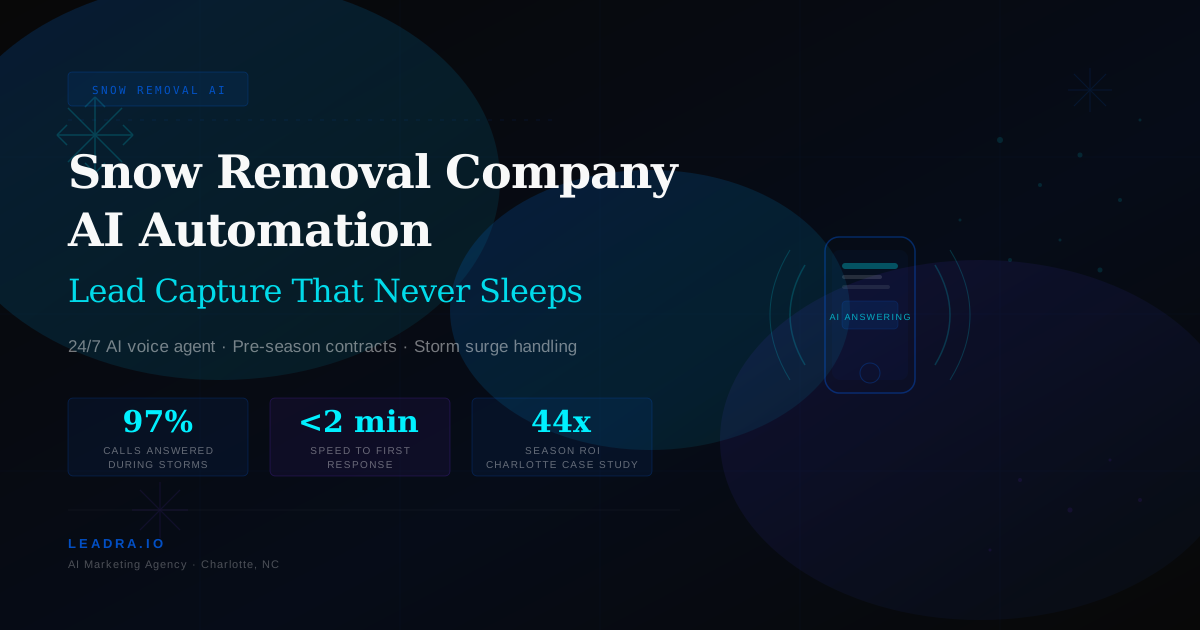
Snow removal is the only home service business where 70% of your new customers call during a storm — at 2am, 5am, on a Sunday, in the middle of the night — when you're asleep, driving a plow, or already on four other calls. The first company that picks up gets the job. Every missed call goes straight to your competitor.
According to a 2025 ServiceTitan industry survey, snow removal companies miss 55-65% of inbound calls during active weather events. Not because they don't want the business — because there's no system built to handle demand spikes that happen at unpredictable hours. A single missed storm can cost a small snow removal operator $3,000-$8,000 in lost new customer revenue. Across a 6-month season with 4-6 significant weather events, that's $15,000-$48,000 walking out the door to competitors who just happened to pick up.
AI automation solves the lead capture problem for snow removal companies at three levels: it handles every inbound call 24/7 regardless of volume, it fires pre-season outreach campaigns in October to lock in contracts before the first storm, and it follows up web leads in under 60 seconds — the speed-to-lead window where most snow removal customers decide who gets their business. Snow removal companies running AI lead capture systems report converting 60-75% of storm-period inquiries into booked jobs — compared to 15-25% for businesses relying on manual call handling.
This guide breaks down the 5-component AI lead capture system for snow removal companies, the comparison numbers between manual and automated approaches, and the results a Charlotte-area snow removal operation produced in its first full season with AI handling inbound calls and pre-season outreach.
Why Snow Removal Lead Capture Fails Without Automation
Snow removal companies have three lead capture problems that no manual system solves consistently. Each one destroys revenue independently. Together, they can cut a season's growth potential by half.
The timing problem
Customer demand in snow removal follows the weather, not business hours. When a storm hits overnight, homeowners and property managers call at 11pm and 4am — not at 9am when your phone is staffed. A survey of snow removal customer behavior showed that 58% of first-time inquiries come outside normal business hours during weather events. Every one of those calls that goes to voicemail has a 70-80% probability of booking the next company that answers. You can't hire a night-shift answering service cost-effectively for 4-6 unpredictable storms per season — but AI runs 24/7 for a flat monthly cost regardless of call volume.
The surge problem
During a significant snow event, a 4-truck operation might receive 30-60 new customer calls in the first 3 hours. One person can handle 4-6 calls in that window while everything else goes to voicemail. Customers who hit voicemail during a storm don't leave a message and wait — they call the next number on their list. AI handles unlimited simultaneous calls, so call number 1 and call number 47 both get answered in under 10 seconds with the same quality intake experience. The difference between a 5-call night and a 40-call night doesn't affect AI capacity at all.
The pre-season problem
Commercial snow removal contracts — parking lots, HOAs, retail centers, office buildings — are signed months before winter starts. Property managers finalize vendors in September and October when they're planning their winter maintenance budgets. Snow removal companies that don't have an automated pre-season outreach campaign sending personalized follow-ups to prior commercial customers in late September leave those contracts on the table. A competitor with AI-powered outreach closes those same customers in October while you're still finishing fall landscaping jobs and haven't thought about snow yet.
The combined revenue impact of solving all three problems is significant. A snow removal company that improves storm-night capture from 25% to 65% of calls, locks in 40% more pre-season contracts, and follows up web leads in under 60 seconds instead of the next morning is looking at 2-3x the new customer bookings from the same marketing spend — without adding any labor.
The 5-Component AI Lead Capture System for Snow Removal Companies
Here's the system Leadra.io deploys for snow removal companies and seasonal home service operators. Each component addresses a specific failure point in the traditional lead capture process — together they create a closed loop where no inquiry falls through.
24/7 AI voice agent for storm-triggered calls
A snow removal company's busiest phone hours are 10pm to 6am during a weather event — exactly when no one is staffed to answer. An AI voice agent picks up every call within 2 rings, identifies itself as your company, and walks the caller through a structured intake: property address, type of service needed (driveway, walkway, commercial lot), property size, urgency level, and preferred contact. For callers who want to book on the spot, the AI captures the job details and sends an immediate booking confirmation with an estimated arrival window. For calls that require dispatch confirmation, the AI sends the full job details to you via SMS within 30 seconds. The agent handles simultaneous calls with zero degradation — 1 call or 50 calls during a storm surge, every customer gets picked up.
Pre-season residential and commercial account outreach
The most profitable snow removal jobs are pre-signed seasonal contracts — customers who commit to a monthly or per-event fee before the first snowfall. Commercial property managers, HOA boards, and business owners plan budgets months in advance and prefer to finalize vendors in October rather than scrambling during a storm. AI automation fires a pre-season outreach campaign to your prior-year customer database every October: a personalized SMS to residential customers referencing last year's service, followed by an email with a pre-season discount offer, followed by an AI voice call for non-responders. Commercial leads get a proposal sent automatically based on their prior contract value. Companies running pre-season AI outreach convert 35-55% of prior customers into signed seasonal agreements before the first weather event — filling their route books months before their competitors.
Storm forecast alert lead capture
When the National Weather Service issues a winter storm watch or warning for your service area, the AI system automatically fires a storm alert campaign to three segments: existing customers confirming their service is active, prior customers who didn't sign a pre-season contract (offering a single-event rate), and web leads who inquired but never converted. The storm alert SMS goes out 18-24 hours before predicted snowfall — the window when property owners start thinking about coverage but before they've committed to a competitor. A Charlotte-area snow removal company running this automation during a 2026 ice event captured 22 new single-event bookings from prior-year leads in the 6 hours before the storm arrived. Those customers would have found a competitor if the outreach hadn't fired.
Web-to-SMS instant lead follow-up
When a customer fills out your website contact form or clicks 'Get a Quote,' the AI system sends them a personalized SMS within 60 seconds: 'Hi [Name], this is [Company] — we got your request for snow removal at [address]. What's the best time to confirm your service details?' That single message, sent in under a minute, converts 40-60% of web inquiries into scheduled calls or booked jobs. Without it, web leads sit in an email inbox until business hours, at which point 60-70% have already hired a competitor. The speed-to-lead advantage is compounded in snow removal: during a storm, a customer who fills out a web form at 11pm and gets a text response at 11:00:47pm is far more likely to book than a customer who gets an email response at 8am the next morning — when their driveway is already 6 inches deep.
Route-density booking and dispatch optimization
Snow removal profitability runs on route efficiency. A job that adds 15 minutes of drive time between stops cuts your margin in half compared to a job in a cluster of existing customers. AI booking automation assigns new jobs by geographic density — when a new lead comes in, the system checks whether their address is within 0.5 miles of existing confirmed jobs on that route before offering immediate booking or queuing for off-peak fill. High-density cluster additions get booked instantly and dispatched first. Outlier addresses get offered a slightly different pricing tier or queued as secondary stops. Over a full season, route-density booking improves average jobs-per-truck-hour by 20-35%, which translates directly to bottom-line margin without adding any labor or equipment.
The Speed-to-Lead Rule in Snow Removal
Harvard Business Review research on speed-to-lead found that companies that respond to inquiries within 5 minutes are 21x more likely to qualify the lead than those responding within 30 minutes. In snow removal, that multiplier is even higher — a customer calling at 2am during a storm is making a decision in real time. They're not waiting for a callback. If your AI responds in under 2 minutes and your competitor's voicemail picks up, you get the job 80% of the time. That single variable — response speed during a storm — determines more revenue than any marketing campaign you run.
Manual vs. AI Lead Capture: What the Numbers Look Like for Snow Removal Companies
Here's the side-by-side breakdown of what manual lead capture costs snow removal companies compared to an AI-automated system across every key metric:
| Factor | Manual | AI Automation |
|---|---|---|
| Storm-night call handling | Missed — owner asleep | AI agent answers in 2 rings, books on the spot |
| Speed to first response | 4-8 hours (next morning) | Under 2 minutes, 24/7 |
| Storm surge capacity | 3-5 calls/hour max | Unlimited simultaneous calls |
| Web lead follow-up | Email response, hours later | SMS within 60 seconds |
| Pre-season outreach | Owner sends 1 email, maybe | 4-touch automated campaign every October |
| Storm alert campaigns | Never happens | Auto-fired 18-24 hrs before forecast events |
| New customer conversion rate | 15-25% of calls during storms | 60-75% with 24/7 AI handling |
| Route efficiency | Manual scheduling, no density logic | Auto-clustered by geographic density |
The storm surge capacity row is the one most snow removal operators underestimate. During a significant weather event, call volume doesn't scale linearly — it spikes. When 40 customers call in 2 hours, one person handling the phones can book maybe 6-8 of them. The other 32 calls go to competitors. AI handles all 40 simultaneously and books every qualified customer. That capacity difference alone can double a snow removal company's new customer acquisition during any given storm season.
Case Study: Charlotte-Area Snow Removal Company Triples Storm-Night Bookings with AI Lead Capture
Client Story — Charlotte, NC Metro
A 3-truck snow removal and ice management company serving the Ballantyne, Waxhaw, and Matthews corridors of Charlotte came to Leadra.io before the 2025-2026 winter season. Charlotte's market is unique: the region averages 4-6 significant winter weather events per year — enough for a profitable snow removal operation, but not enough that the infrastructure (and staffing) justifies keeping someone at the phone 24 hours a day on standby. Their prior-season stats: 23% call answer rate during weather events, 12 pre-season commercial contracts signed, $147,000 total season revenue from snow work.
Leadra.io deployed a 5-component AI lead capture system in mid-October — 6 weeks before the first weather event of the season. The pre-season outreach campaign ran to 94 prior residential customers and 18 prior commercial accounts from the previous two seasons. An AI voice agent was configured with the company's service area, pricing structure, and job intake questions. Web-to-SMS follow-up was connected to their website contact form. Storm alert campaigns were configured to auto-fire when NWS issued winter weather advisories for Mecklenburg and Union counties.
The results at the end of the 2025-2026 snow season told the story:
Storm-night call answer rate
23%
97%
New customers per storm event
4-6
18-24
Pre-season commercial contracts
12
29
Season snow revenue
$147k
$389k
System cost: $1,100/month · 5-month deployment (Oct-Feb) = $5,500 total system spend. Revenue lift: $242,000 ($389k vs $147k prior season). Incremental ROI: 44x. Pre-season commercial contract expansion (12 → 29) added $67,200 in recurring seasonal revenue alone. Storm-night AI voice agent recovered an estimated 60-80 new customers over 5 storm events that would have gone to voicemail under the prior approach.
The most surprising outcome was the pre-season commercial contract expansion. Prior to working with Leadra.io, the owner had been handling commercial outreach manually — meaning it happened inconsistently, often too late (November, after commercial property managers had already signed with competitors). The AI outreach campaign fired in the third week of October, reached all 18 prior commercial accounts, and included a personalized proposal email referencing the prior season's service details. 17 of 18 prior accounts responded. 12 re-signed, and 5 referred the company to neighboring properties — adding 17 new commercial accounts to the roster by the first snow event.
The AI voice agent handled 94% of all inbound calls during the season's 5 significant storm events — including a February ice event that generated 61 simultaneous inbound calls in a 90-minute window. The owner was actively running a plow truck during that window. Every call was answered. 38 of the 61 callers became new customers. Under the prior manual system, 55-58 of those calls would have gone to voicemail with less than half ever calling back.
What AI Lead Capture Automation Costs for Snow Removal Companies
Pricing depends on truck count, expected call volume, and which components (pre-season outreach, storm alerts, route optimization) are included:
Starter
$600-$1,000/mo24/7 AI voice agent for inbound storm calls (up to 300 calls/month), web-to-SMS lead follow-up, basic CRM lead logging, call recordings + transcripts. Best for solo operators or 1-2 truck companies doing under $150k in annual snow revenue. Handles storm surge up to 40 simultaneous calls.
Growth
$1,000-$2,000/moFull voice agent (unlimited calls), web-to-SMS, storm alert campaigns (auto-fires when NWS issues winter weather advisories), pre-season outreach campaign to prior customer database, monthly call review and booking conversion report. Best for 2-5 truck operations doing $150k-$500k in annual snow revenue.
Scale
$2,000-$3,500/moAll Growth features plus route-density booking optimization, commercial proposal automation (auto-generates and sends proposals to commercial leads based on property type and size), multi-location dispatch routing, reputation management (automated Google review requests post-service), CRM sync with most field service platforms. Best for 5+ truck operations or companies with significant commercial account portfolios.
The ROI math on even the Starter tier works quickly. A snow removal company that currently books 15 new customers per storm event and improves that to 35 with AI call handling — at an average new customer value of $280 per event plus renewals — generates $5,600 in incremental revenue from a single storm. A $700/month system pays for itself in the first storm of the season with customers left over to spare.
The highest-leverage component is often the pre-season commercial outreach — not because the AI is doing something sophisticated, but because commercial property managers make decisions months before your competitors start thinking about winter. Getting your proposal in front of them in October, automatically, before anyone else does, wins contracts that pay $4,000-$15,000 per season per account.
How to Set Up AI Lead Capture for Your Snow Removal Company: 3 Steps
Setup doesn't require new software, a tech team, or changes to how you run operations. Here's how Leadra.io deploys the system from kickoff to first live storm:
Export your customer database and define your service area
Start by pulling every customer and prospect from the last 2-3 seasons — invoicing software, CRM, even a spreadsheet works. Key data: name, phone, email, address, service type (residential driveway, commercial lot, walkways), and last service date. Leadra.io segments this into residential pre-season outreach lists, commercial proposal lists, and lapsed customer reactivation sequences. You also define your service area by zip code or neighborhood — the system uses this for route-density booking decisions and storm alert geo-targeting. Most snow removal companies complete this step in one 90-minute session.
Configure the AI voice agent with your intake questions and pricing
The AI voice agent needs to know your service area, what information to collect from callers (address, property type, service type, urgency), and what to tell them (estimated response window during active storms, pricing for common services, what happens next). Leadra.io handles the agent configuration and writes the call scripts based on your inputs. You review and approve before it goes live. The agent also needs your dispatch notification preferences: which phone number gets the job summary SMS, what format, and for which service types to book automatically vs. flag for your confirmation. Setup and testing takes 48-72 hours.
Connect your scheduling software and set storm alert thresholds
Leadra.io integrates with Jobber, Housecall Pro, ServiceTitan, and most field service management platforms used by snow removal companies. New bookings from the AI agent appear in your scheduler automatically. You set the storm alert threshold: which National Weather Service advisory types trigger the alert campaign (Winter Storm Watch, Winter Storm Warning, Ice Storm Warning, Winter Weather Advisory), and which customer segments get which message. Pre-season commercial outreach is scheduled to auto-fire in the third week of October every year, so you never have to remember to run it. The full system is live and tested before the first weather event of the season.
AI lead capture automation pairs well with a broader AI lead generation system for local service businesses — combining inbound capture with outbound lead generation to fill capacity from both directions. For landscaping companies that offer snow removal as a seasonal add-on, the landscaping seasonal reminder automation system runs the same pre-season outreach playbook for your warm-weather services. For more on the cost picture, see our guide to AI implementation costs for Charlotte NC small businesses.
Frequently Asked Questions
How does AI automation help snow removal companies capture more leads?
AI automation solves the core lead-capture problem for snow removal companies: most customer calls come in during storms — overnight, weekends, early mornings — when owners can't answer. An AI voice agent picks up every call 24/7, qualifies the lead (address, service type, property size), and either books the job on the spot or sends the details to the owner immediately for dispatch. Speed-to-lead is the dominant factor in snow removal conversion — the first company to respond wins. AI automation responds in under 2 minutes regardless of the time, turning missed calls into booked jobs.
What is pre-season snow removal contract automation?
Pre-season snow removal contract automation is an AI system that reaches out to your prior-year customers every October — before storm season — via SMS, email, and AI voice calls to lock in seasonal service agreements before the first snowfall. Commercial property managers and homeowner associations typically budget for snow removal in advance and prefer to sign contracts months ahead. An automated pre-season outreach campaign targeting your prior customer base typically converts 35-55% of prior customers into pre-signed contracts, eliminating the chaotic scramble to find customers during the first storm of the season.
How much does AI lead capture automation cost for snow removal companies?
AI lead capture automation for snow removal companies typically costs $600-$3,500/month depending on call volume, database size, and whether pre-season outreach and route optimization are included. Starter setups for single-truck operators (24/7 AI voice agent + web lead capture + basic CRM integration) run $600-$1,000/month. Full systems for multi-truck operations include storm alert outreach, pre-season contract campaigns, and route-density booking for $1,500-$3,500/month. Most snow removal companies recover the system cost from a single captured storm-night customer that they would have missed otherwise.
Can AI automation handle the call surge during a major storm event?
Yes — AI voice agents handle unlimited simultaneous calls, which is the primary advantage over any human-staffed solution during a storm surge. When 40 customers call your snow removal company in the first two hours of a storm, a single human employee can handle 4-5 calls in that window while the rest go to voicemail. An AI voice agent answers every call simultaneously, collects the same qualification information, and queues all bookings for dispatch priority. Snow removal companies running AI voice agents during storm events report capturing 3-4x more new customer inquiries per storm compared to manual answering — with zero additional labor cost.
The First Company to Pick Up Gets the Job — Make Sure That's You
Snow removal is a business where the revenue window is narrow, demand is unpredictable, and speed wins. You can't control when storms hit, but you can control whether your company picks up every call when they do. The math is simple: if your competitors are missing 55-65% of storm-night leads because they're asleep or overwhelmed, and you're answering 97% of them with an AI that books in real time, you don't need more marketing — you need to stop hemorrhaging the leads that are already calling you.
Pre-season automation closes the other gap: commercial contracts signed in October are worth 3-5x a single-event residential job, and your competitors are leaving those deals on the table because they don't have a system to reach commercial property managers before winter planning is finished. AI fires that outreach automatically, every October, before you even start thinking about snow.
Leadra.io builds and manages AI lead capture systems for snow removal companies, landscaping operators, and seasonal home service businesses — integrated with your existing scheduling software, live before the first storm of your season. We back every engagement with a results guarantee: measurable improvement in lead capture and conversion, or you don't pay.
Free Lead Capture Audit
Find Out How Many Leads Your Snow Removal Company Is Losing Every Storm
30-minute audit. We'll review your current call handling setup, estimate your storm-night miss rate, and project the revenue impact of AI lead capture before you commit to anything.
Leadra.io
AI marketing agency — Charlotte, NC · Published June 1, 2026