Solar Installer AI Proposal Follow-Up: Close 3X More Deals on Proposals You Already Sent
Your reps did the site visit. They built a custom proposal. They emailed it. Then nothing. For most solar installers, 60-70% of proposals die in silence — not because the homeowner said no, but because nobody followed up enough times, the right way, at the right moment.
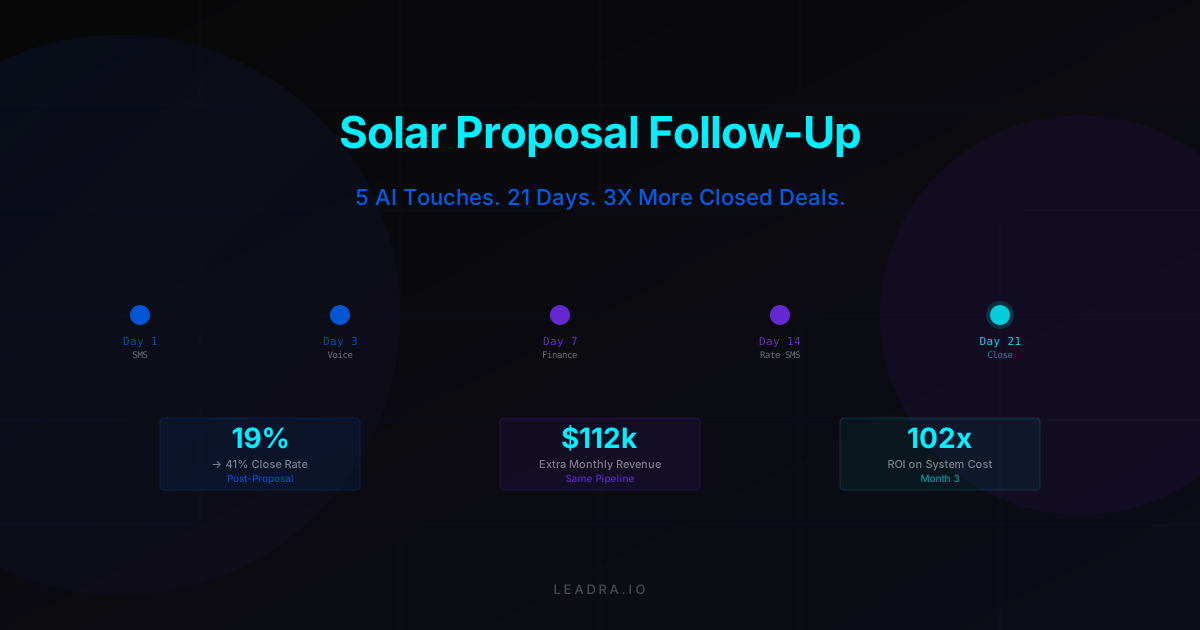
A solar installer in Ballantyne ran 26 site visits in April. His reps sent 26 custom proposals. By end of May, 5 had signed. That's a 19% post-proposal close rate — which costs him roughly $420,000 in potential monthly revenue sitting in his inbox, marked unread.
The other 21 homeowners didn't say no. They just went quiet. A few were comparing quotes. A few had a spouse who hadn't seen the numbers. A few had sticker shock on the upfront cost even though financing was available. And a few were genuinely interested — waiting for someone to answer the question they were too embarrassed to ask.
His reps followed up once or twice and moved on. That's the real problem. Research in residential solar shows the average closed deal requires 5-8 follow-up touches. The average sales rep stops at 2. AI closes that gap — automatically, on every proposal, on a precise timing sequence — so no deal dies from neglect.
The Proposal Graveyard: Why Solar Deals Die After the Site Visit
The site visit is expensive. A rep drives out, spends 1-2 hours on-site, runs a satellite analysis, builds a custom proposal with system sizing, financing options, and payback projections. That appointment costs $150-$300 in labor and overhead. When 70% of those proposals go cold, solar companies are burning $3,000-$6,000 per month on work that never closes.
The reasons proposals die fall into four categories, and all four are solvable with systematic follow-up:
None of these are lost deals. They're delayed decisions waiting for the right nudge at the right time. AI handles all four systematically — for every proposal, every time, with no rep attention required until the homeowner signals they're ready to move. See how AI qualification prevents weak proposals from being sent in the first place.
The 5-Touch AI Follow-Up Sequence for Solar Proposals
This is the sequence Leadra.io deploys for residential solar installers. Each touch is personalized to the homeowner's name, address, estimated system size, monthly savings figure, and financing option from the original proposal. No generic check-ins.
Immediately after the rep submits the proposal to your CRM, the AI sends a short SMS: 'Hi [Name], [Rep name] just sent your solar proposal to [email]. It includes your [X kW] system estimate, [Y%] bill reduction, and financing options starting at $0 down. Here's a quick link to view it: [link]. Any questions, reply here or call us at +1 (864) 721-8384.' This single touch doubles proposal open rates because it reaches the homeowner on their phone — where they actually are — not buried in email.
An AI voice agent calls the homeowner on day 3. Script: 'Hi [Name], this is Sarah from [Company Name] — I'm following up on the solar proposal [Rep] sent you on [day]. I wanted to make sure you received it and ask if you had any questions about the system sizing or financing options. If you'd like to go over the numbers together, I can get [Rep] on a call with you this week — what works best for you?' This is conversational, not pushy. It serves a dual purpose: confirming receipt and opening the door for a closing call.
At day 7, the AI sends a tailored email with three financing scenarios side-by-side: cash purchase, solar loan (with estimated monthly payment vs. current electric bill), and any lease options if applicable. The email also includes the current federal ITC (30% through 2032) applied to their specific system cost, and a note on any NC state incentives. This is the touch that breaks sticker shock — most homeowners who went quiet at day 1 re-engage here when they see the $0-down payment next to their current monthly bill.
Two weeks in, urgency becomes the lever. The AI sends a 2-sentence SMS with a real urgency hook: 'Quick update on your proposal — Duke Energy filed for a rate increase this quarter. Your estimated savings in year 1 just went up about $[X] based on the new projection. Want me to send you the updated numbers?' This is hyperlocal, data-backed, and non-pushy. It positions you as the expert who's watching out for them — not the rep chasing a commission.
The final active follow-up touch is an AI voice call offering a 15-minute virtual Q&A with the homeowner and any second decision-makers. 'I know solar is a big decision and you may have questions you didn't get to ask during the site visit. We'd love to do a quick 15-minute call — no pressure, just answers. I can get you with [Rep] any day this week. What time works best for both you and your partner?' After day 21, the lead moves to a 90-day passive nurture sequence — quarterly check-ins with rate update emails — until they close or opt out.
Every touch is triggered automatically when the CRM records the proposal as 'sent.' Your rep does nothing after submitting the proposal — the AI runs the entire sequence, logs every interaction back to the CRM, and alerts the rep the moment the homeowner signals readiness (replies to an SMS, answers a call and expresses interest, or clicks to schedule a call). The rep closes. The AI does everything before that.
Manual vs AI Proposal Follow-Up: What the Numbers Look Like
Here's how the two approaches compare for a solar installer doing 20-35 site visits per month:
| Factor | Manual Follow-Up | AI Follow-Up System |
|---|---|---|
| Average touches per proposal | 1.8 (industry average) | 5 touches over 21 days |
| Same-day proposal confirmation | Rarely — email only, no SMS | Instant SMS with proposal link |
| Post-proposal close rate | 18 – 24% industry average | 35 – 48% with AI follow-up |
| Rep time per proposal follow-up | 45 – 90 min across 1.8 attempts | 0 until homeowner signals readiness |
| Financing objection handling | If rep remembers to send breakdown | Automated at day 7, every proposal |
| Urgency leveraged | Ad-hoc, inconsistent | Rate data + incentive deadlines at day 14 |
| Dead proposal recovery (30-90 days) | Near zero — leads forgotten | 90-day passive nurture sequence |
| Revenue per 25 site visits/month | ~$110k (5 closed at $22k avg) | ~$220k (10 closed at $22k avg) |
The revenue-per-site-visit doubling is the headline number — but the more important shift is what it does to unit economics. When you recover 5 more closed deals from the same 25 site visits, your cost per acquisition drops by 50% without touching ad spend or headcount. The margin improvement on recovered proposals is nearly 100% because the site visit cost is already sunk.
Case Study: Ballantyne Solar Company Goes from 19% to 41% Post-Proposal Close Rate
A 4-rep residential solar installer in the Ballantyne area of Charlotte was running 22-28 site visits per month. Average proposal value: $23,400. Close rate on proposals sent: 19%. Monthly revenue: $97,000-$125,000. The owner knew his site-visit quality was good — his reps gave strong presentations — but proposals were disappearing into silence.
Before AI Follow-Up — Q1 2026
- —24 site visits/month (average)
- —24 proposals sent post-visit
- —4-5 closed contracts (19-21% post-proposal close rate)
- —$23,400 average system contract value
- —$107k average monthly revenue
- —Reps averaging 1.6 follow-up touches per proposal before giving up
Leadra.io deployed the 5-touch AI proposal follow-up system connected to their CRM (HubSpot). When a rep marked a proposal 'sent,' the sequence triggered automatically: same-day SMS, day 3 voice call, day 7 financing email, day 14 utility rate SMS, day 21 Q&A call offer.
In month one, the AI ran 24 full sequences. Seven homeowners re-engaged after going cold — 3 from the day 7 financing email, 2 from the day 14 rate SMS, and 2 from the day 21 voice call. Of those 7, 5 closed. Combined with the 4 who closed organically, that's 9 closed contracts in month one — up from the prior 4-5.
By month three, the system was recovering an average of 5-6 additional closed contracts per month from proposals that would have been written off. The 90-day passive nurture sequence also recovered 2 contracts from proposals originally sent in Q1 that re-engaged after a Duke Energy rate announcement in June.
Post-proposal close rate
Contracts signed/month
Monthly revenue
Cost per acquisition
The revenue jump from $107k to $219k happened with the same number of site visits, the same ad spend, and the same rep team. The AI system cost $1,100/month. The additional $112k in monthly revenue represents a 102x ROI on the system cost.
The owner's assessment: "I thought my reps were doing fine on follow-up. Turns out they were sending one email and calling it done. The AI is running 5 personalized touches I never would have tracked manually. Three months in, I'm closing more deals without running a single additional site visit."
What AI Proposal Follow-Up Costs for Solar Installers
Pricing scales with proposal volume, CRM complexity, and whether you need the system standalone or as part of a full post-visit automation stack:
- —5-touch automated follow-up sequence (SMS + email + voice)
- —Personalized to homeowner name, system size, savings, financing
- —CRM trigger on 'proposal sent' status change
- —90-day passive nurture for unresponsive proposals
- —Rep alert when homeowner signals readiness
- —Up to 50 active proposal sequences per month
Best for: Established solar companies with existing CRM who want follow-up automation added without changing anything else
- —5-touch proposal follow-up sequence
- —No-show recovery: AI outreach to reschedule cancelled site visits
- —Financing objection handling module (day 7 breakdown call)
- —Referral request automation for closed customers (30 days post-install)
- —Second decision-maker outreach sequence
- —CRM integration (HubSpot, Salesforce, JobNimbus, or custom)
- —Up to 150 active sequences per month
Best for: Growing solar companies running 20-60 site visits per month focused on maximizing close rate on the pipeline they already have
- —AI lead qualification before booking site visits
- —Full post-visit proposal follow-up system
- —Dead proposal reactivation (proposals 60-180 days old)
- —Outbound AI calling for aged lead database
- —Monthly close rate analytics by rep, lead source, and proposal tier
- —NC/SC solar incentive and rate change alerts integrated into follow-up
- —Unlimited active sequences
Best for: Solar companies at $400k+/month revenue focused on end-to-end AI automation from lead intake through closed contract
At a $22,000 average residential solar contract, recovering one additional closed deal per month from an otherwise-dead proposal covers 3-6 months of system cost. Most Leadra.io solar clients close their first recovered deal within 45 days of going live.
See the full AI marketing system for solar companies in Charlotte if you want to understand how follow-up fits into a complete lead-to-close automation stack.
How to Set Up AI Proposal Follow-Up for Your Solar Company
Setup takes 7-10 business days from kickoff to first live sequence. Here's the standard implementation path:
1. CRM audit and trigger mapping.
We review your current CRM (HubSpot, Salesforce, JobNimbus, or spreadsheet-based) and identify the exact status change or action that signals a proposal has been sent. This becomes the automation trigger. If your team doesn't use a CRM consistently, we set up a lightweight tracking sheet that your reps update in 30 seconds after each proposal — that's enough to trigger the sequence reliably.
2. Proposal personalization data mapping.
Every touch in the sequence references the homeowner's specific proposal — system size, estimated annual savings, financing option, and rep name. We map your proposal fields to the AI's personalization engine. If your proposals are sent as PDFs, we build a simple intake form your reps fill out at proposal submission: homeowner name, email, phone, system size (kW), estimated savings, and primary financing option shown. Takes 90 seconds per proposal.
3. Sequence calibration to your market.
The utility rate context in touch 4 is pulled from your local utility's most recent rate filing and IRP (Integrated Resource Plan). For Charlotte-area installers, we reference Duke Energy's current rate trajectory and NC Net Energy Metering policy. If you operate in SC, we pull Dominion Energy SC or Santee Cooper data instead. This localization is what separates the sequence from a generic drip — it reads like your rep did their homework.
4. Second decision-maker workflow setup.
We build a branch in the sequence for proposals where the site visit notes indicate a second decision-maker is in the household. If the homeowner answers the day 3 voice call and mentions their spouse hasn't seen the proposal, the AI branches to a spouse-inclusion flow: offers to re-send the proposal summary to a second email address, or proposes a joint 20-minute video call walkthrough with the rep. This catches the single biggest objection category in residential solar.
5. Live test and rep onboarding.
Before going live, we run 10 test proposals through the full sequence and verify that every touch sends correctly, every CRM record updates with interaction data, and every rep receives the right alert when a homeowner engages. Rep training is a 20-minute walkthrough: how to submit a proposal to trigger the sequence, how to read the CRM engagement log, and what to say when the AI flags a ready-to-close lead. The system does the work — your reps just need to know when to step in.
The system runs on your existing phone number and email domain so every touch looks like it's coming from your company. Homeowners never know it's automated — it reads like your rep remembered to follow up. Which is exactly the point. See full AI implementation costs for service businesses in Charlotte.
Frequently Asked Questions
Why do solar proposals go cold after the site visit?
Solar proposals go cold for four main reasons: the homeowner is comparing multiple quotes and needs time, a second decision-maker wasn't at the visit and hasn't seen the proposal, sticker shock on the upfront cost caused them to pause even if financing is available, or the sales rep followed up once and then stopped, letting a competitor fill the silence. The average residential solar sale requires 5-8 follow-up touches after the proposal — most sales reps give up after 2. An AI follow-up system runs all 5-8 touches automatically, hitting every channel (email, SMS, voice) over 21 days so no proposal dies from neglect.
What does an AI solar proposal follow-up sequence look like?
An AI solar proposal follow-up sequence runs 5 touches over 21 days: Day 1 (same-day SMS with proposal link), Day 3 (AI voice check-in call), Day 7 (financing breakdown email with ITC and NC incentives applied to their specific system), Day 14 (utility rate context SMS referencing their local utility's rate trajectory), and Day 21 (AI voice call offering a joint Q&A with their rep and any second decision-makers). Each touch is personalized to the homeowner's name, system size, estimated savings, and financing option. After day 21, unresponsive proposals enter a 90-day passive nurture sequence.
How much does AI proposal follow-up cost for solar companies?
AI proposal follow-up for solar companies costs $400-$700/month as a standalone follow-up layer, or $1,200-$2,500/month as part of a full post-visit automation system. At a $22,000 average residential solar contract, recovering one additional deal per month from an otherwise-lost proposal covers 3-6 months of system cost. Most Leadra.io solar clients recover their first additional deal within 45 days of going live.
What is the best follow-up timing for solar proposals?
The best follow-up timing for solar proposals is front-loaded: same day (proposal summary SMS), day 3 (first live check-in), day 7 (financing and incentive urgency), day 14 (utility rate context and savings reinforcement), and day 21 (final Q&A offer). Research in residential solar sales shows 73% of closed proposals from follow-up close by day 21. Touches beyond day 30 have under 4% close rate and are better served by a long-term nurture sequence. Front-loading beats a slow drip because solar decisions peak in the first two weeks after the site visit.
The solar companies closing 40%+ of their proposals in 2026 aren't sending better proposals — they're following up better. Five personalized touches over 21 days, with the right message at the right moment, recover deals that manual follow-up writes off after two attempts. That's the entire difference between a 19% close rate and a 41% close rate on the same pipeline.
At Leadra.io, we build AI proposal follow-up systems for solar installers and home service companies across Charlotte and the Carolinas. Setup takes 7-10 business days. The system runs on your existing phone number and CRM. First recovered deal typically comes within 45 days.
Built for Solar Installers in the Carolinas
Stop Letting Good Proposals Go Cold
We'll set up your AI proposal follow-up system in 7-10 days. Five personalized touches per proposal. Every homeowner contacted the same day, at day 3, day 7, day 14, and day 21. Your reps step in only when the homeowner signals they're ready to sign.