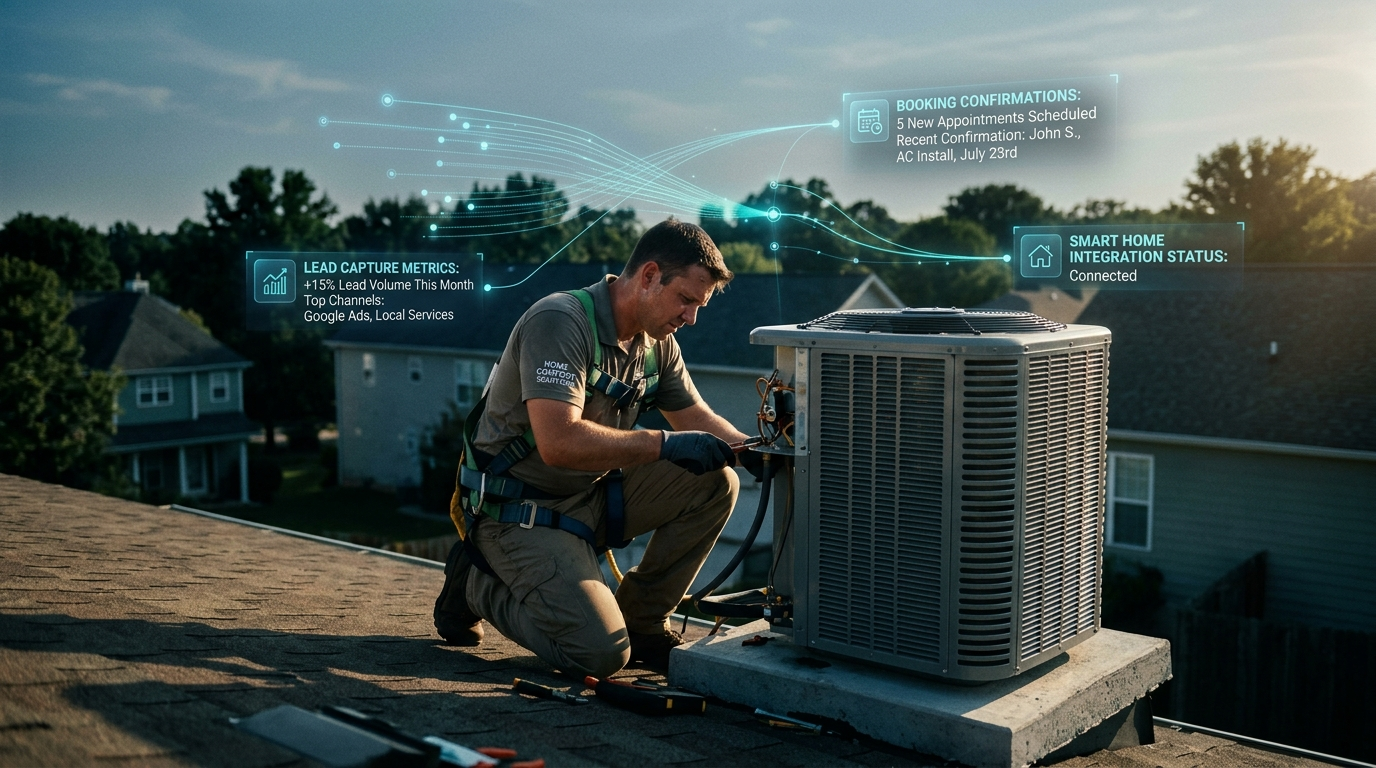
Summer is the best and worst time to run an HVAC company. The demand is real — every homeowner with a failing AC unit is motivated, urgent, and ready to pay. The problem is that demand hits all at once, your team is already stretched across six jobs a day, and your phone is ringing with leads you physically cannot answer.
The average HVAC company captures only 55-65% of the leads it generates during peak AC season. The other 35-45% hit voicemail, fill out a web form that nobody follows up on within the hour, or send a chat message to a widget that shows a little green dot even though nobody is actually watching it. Those leads do not wait. They call the next company on Google and book.
AI lead capture for summer AC season fixes that gap without adding office staff. The system responds to every lead in under 90 seconds — web forms, phone calls, chat messages, Google Business Profile inquiries — qualifies them automatically, and books jobs directly into your calendar. Your techs show up to confirmed appointments. You stop losing $30,000-$50,000 per month to competitors who simply respond faster.
Why Summer AC Season Is the Hardest Time to Capture HVAC Leads
Peak AC season is not a staffing problem. It is a response-speed problem that staffing cannot solve. Here is exactly what goes wrong:
1. Demand compresses into narrow weather windows.
The biggest HVAC call days cluster around heat index spikes — 95+ degree days in late June and July. On those days, your call volume can triple overnight. The week before was fine. This week, your phone rings 60 times and you answer 28. Those 32 callers are not waiting for the heat to break before calling someone else.
2. Web form leads die in under an hour.
MIT research published in 2011 — still cited today because nothing has changed — found that leads contacted within 5 minutes of form submission were 21x more likely to convert than leads contacted after 30 minutes. HVAC companies with busy summer schedules often follow up with web form leads the next morning. At that point, the customer is 18 hours and probably 3 competitors past that form submission.
3. Your Google Ads spend evaporates without fast follow-up.
Running Google Ads during summer to capture AC repair and replacement leads is one of the highest-ROI moves in HVAC marketing — when those leads get followed up within minutes. When they sit in a CRM until the afternoon, you are paying $40-$120 per click for leads that convert at 6% instead of 28%. Slow follow-up is the most expensive mistake in HVAC paid search.
4. Competitors who respond first win almost every time.
A 2023 Lead Connect study found that 78% of customers buy from the vendor that responds to their inquiry first — regardless of price. HVAC is a trust-first category where customers often go with whoever picks up or texts back. Being second by 8 minutes during a heat wave costs you a job. Being second by 8 hours costs you a customer for life.
The math is straightforward. If you generate 80 leads in July and capture 52 of them, you are leaving 28 AC jobs on the table. At an average summer service ticket of $380 and equipment install of $6,800, those 28 leads are worth somewhere between $10,640 and $190,400 in revenue — depending on how many needed new units. AI lead capture systematically closes that gap. See how missed-call capture specifically works for HVAC phone leads.
The 5-Part AI Lead Capture System for Summer AC Season
A complete summer lead capture system covers every channel where a potential customer reaches out — not just the phone. Each part runs independently and feeds into the same scheduling calendar.
AI chatbot on your website — captures web visitors 24/7.
Most HVAC websites still rely on static contact forms that generate an email nobody reads until the next morning. An AI chatbot replaces that with a live conversation: it asks the homeowner what is happening with their system, how urgent it is, their address and availability, then offers to book a time slot directly. Responses happen in seconds. Conversion rate on AI chatbot-handled inquiries during summer averages 34-42% — roughly 3x the rate of a static form with next-day follow-up.
Instant web form follow-up — reaches leads before they move on.
If someone submits a traditional contact form, an AI-powered follow-up triggers within 90 seconds: an SMS that references their inquiry, acknowledges their issue, and includes a booking link. If they do not click within 30 minutes, a second SMS goes out with a direct phone number. Email follow-up goes out at 2 hours. The sequence continues for 5 touchpoints over 72 hours and stops the moment they book. HVAC companies using this approach see 47-61% of web form leads convert — compared to 12-18% with manual next-day follow-up.
Missed-call text-back — turns every unanswered ring into a conversation.
When your office line is tied up and a call goes unanswered, an automated SMS fires within 60 seconds: 'Hey, this is [Company Name] — sorry we missed you! AC giving you trouble? Reply with what is happening and we can get you on the schedule today.' This single touchpoint recovers 55-70% of calls that would otherwise go silent. Combined with an AI voice agent for calls that come in after hours or during overflow, you effectively answer every call even when your team cannot.
Google Business Profile lead response — automates your fastest-converting channel.
Google Business Profile (formerly Google My Business) message leads and call leads are among the highest-intent inquiries your business receives — these people searched for HVAC near them, found your listing, and chose to contact you. Response time on GBP leads correlates directly with ranking. AI automation triggers instant replies to GBP messages and captures call leads from your GBP call button in the same missed-call text-back flow. Most HVAC operators do not realize their GBP is generating 10-20 leads per month that are going unanswered.
Scheduling integration — pushes booked jobs directly to your calendar.
Lead capture only works if the booking actually lands somewhere your tech sees it. AI booking integrations connect to Jobber, ServiceTitan, Housecall Pro, or a shared Google Calendar and push confirmed appointments with job details automatically. Your tech's morning schedule is populated with jobs the AI booked overnight — no phone tag, no manual data entry, no double-bookings. The AI handles the conversation; the human handles the job.
Parts 1 and 2 cover web traffic. Part 3 covers phone traffic. Part 4 covers Google search intent. Part 5 ensures nothing falls through the scheduling gap. Run all five during summer peak and your team shows up to a full calendar — not a voicemail queue. See how AI dispatching works once those jobs are booked.
What Happens to Each Lead Type Without AI vs. With AI
| Lead Type | No AI | With AI Capture |
|---|---|---|
| Web form submission | Email sits until tomorrow AM; lead already booked elsewhere | SMS fires in 90s, booking link sent, appointment confirmed same hour |
| Website chat inquiry | Static form or offline widget — no response for hours | AI chatbot answers in seconds, qualifies, books slot |
| Missed phone call | Voicemail; lead calls 2 competitors while waiting | Text-back in 60s; 60% reply and book without calling back |
| After-hours emergency call | Voicemail; customer panics and calls 911 or another company | AI voice agent answers, triage, escalates to on-call tech |
| Google Business Profile message | Seen next morning; competitor replied 4 hours ago | Auto-reply in 2 minutes with booking link |
| Google Ads call lead | Missed call; $80 click wasted; no follow-up | Text-back captures lead; $80 click converts |
| Overall summer lead capture rate | 55-65% | 82-92% |
Case Study: Charlotte HVAC Company Captures 31 More Jobs in June Using AI
Client Story
A Charlotte HVAC company with 5 technicians had strong summer demand but was leaving money on the table in ways they could not see clearly. Running Google Ads at $3,200/month and getting solid traffic, they averaged 68 inbound leads in June — calls, web forms, and Google Business Profile messages combined. When Leadra.io ran a lead capture audit in May, the actual contact rate was 54%: 37 leads converted, 31 never received a meaningful response within the first 60 minutes.
We deployed all 5 capture layers in 11 days before peak season hit. AI chatbot installed on their website with AC-specific intake questions. Web form follow-up sequence triggering within 90 seconds. Missed-call text-back on all 3 phone lines. Google Business Profile auto-response wired to the same follow-up workflow. Jobber integration so every AI-booked appointment populated the dispatch board directly.
June results: 72 total leads (slight traffic increase from one additional blog post), 66 contacted within 90 minutes, 61 converted to booked appointments — an 85% capture rate, up from 54%. The 31 additional jobs averaged $490 for service calls and $7,200 for equipment installs. Total additional revenue in June: approximately $87,000 on the same ad spend, same team, same territory.
Lead capture rate
Additional jobs/mo
June revenue
ROI on system
The owner's comment after the first month: "We thought our June was good. It was not good — it was half of what June should have been. The AI system basically doubled our summer without a single new ad dollar."
Summer AC Demand in Charlotte NC: What the Data Looks Like Locally
Charlotte summers are aggressive. The city averages 38 days above 90 degrees per year, with heat index values regularly hitting 100-105 in July and August. The metro area has added over 150,000 residents since 2020, and new construction in Steele Creek, Ballantyne, and Mooresville continues to expand the addressable market.
That growth translates directly to HVAC demand — but it also means more competition. Charlotte has seen a 22% increase in HVAC companies since 2022, according to Charlotte Chamber data. More companies competing for the same summer leads means response speed matters more, not less. The lead that called three companies in 2019 and waited for a callback now calls three companies and books with the first one that texts back within 10 minutes.
For HVAC companies in the SouthPark, Matthews, and University City corridors — where dense neighborhoods of single-family homes turn over AC units every 15-18 years — summer peak is when a full year of equipment margins can be earned in 90 days. Losing 30% of those leads to slow follow-up is not just a June problem. It is a year-end revenue problem. See the full AI marketing playbook for Charlotte HVAC contractors.
How to Set Up AI Lead Capture Before Summer Peak: 4-Step Rollout
The system takes 10-14 days to deploy. Set it up in late April or early May so it is fully tuned when the first real heat arrives.
Audit your current lead sources and response gaps.
Pull 60 days of data from Google Ads, your website analytics, and whatever CRM or phone system you use. Count the total leads that came in, the leads you actually spoke to, and the average time between lead submission and first contact. Most HVAC companies doing this for the first time are surprised: they discover 30-40% of leads never received any contact within 24 hours. That number is your baseline and your opportunity.
Install AI chatbot and instant web form follow-up first.
Web capture is the highest-volume and most time-sensitive gap for most HVAC companies. Install an AI chatbot on your site that handles AC-specific intake (system age, issue type, urgency level, address, preferred time). Wire your web forms to trigger an SMS follow-up within 90 seconds of submission. These two changes alone typically improve lead capture rate by 15-25 percentage points before you touch the phone side.
Set up missed-call text-back and AI voice agent.
Configure missed-call text-back on every phone line your business uses. Write the SMS to match your brand voice and include a direct booking link. If your call volume during peak exceeds what your office staff can handle (most HVAC companies hit this threshold within the first week of a heat wave), add an AI voice agent that answers overflow calls and routes emergency calls to your on-call tech. Test both by calling your own number during and outside business hours.
Connect booking to your dispatch calendar.
Route all confirmed bookings from the AI chatbot, follow-up sequences, and voice agent directly into your scheduling software. Whether you use Jobber, ServiceTitan, Housecall Pro, or a shared Google Calendar, the integration should push job details automatically with no manual data entry required. Do a full end-to-end test: submit a form, watch the AI follow up, click the booking link, confirm the appointment shows in your calendar. Then do the same with a phone call. Only go live once the full flow works clean.
Once the system is live, monitor the lead capture dashboard daily for the first two weeks. Look for channels where leads are falling through — a high contact rate on web forms but low rate on GBP messages means you need to tune the GBP automation. Each adjustment compounds: 5% better capture rate across 70 monthly leads is 3-4 additional jobs per month at zero incremental cost. See how seasonal reminder automation keeps your calendar full before and after peak.
Frequently Asked Questions
What is AI lead capture for HVAC companies during summer AC season?
AI lead capture for HVAC during summer AC season is a set of automated tools that collect, qualify, and book inbound leads when your team cannot respond fast enough. This includes AI chatbots on your website, automated web form follow-up sequences, missed-call text-back systems, and AI voice agents that answer overflow calls. The goal is to ensure every lead that reaches your business during peak summer demand gets an immediate response — not a voicemail — and books an appointment before calling a competitor.
How much does AI lead capture cost for an HVAC company?
AI lead capture for HVAC typically costs $600-$2,000 per month depending on the tools deployed. A basic web form follow-up and missed-call text-back system runs $600-$900/month. A full stack — AI chatbot, voice agent, call tracking, multi-touch sequences, and scheduling integration — runs $1,200-$2,000/month. Most HVAC companies recover the full cost within the first 2-3 booked AC jobs from leads that would otherwise have been lost to a competitor.
When should HVAC companies set up AI lead capture for summer?
HVAC companies should set up AI lead capture at least 4-6 weeks before peak season begins — typically by mid-April to early May if you serve a warm-weather market. Setup, testing, and integration with your scheduling software takes 1-2 weeks. You want the system fully tuned before the first heat wave hits and your phones go from manageable to buried. Setting it up in June, after peak has started, means missing the highest-demand weeks of the year.
Can AI book HVAC appointments without a human involved?
Yes. AI systems can handle the full booking flow without human involvement: an AI chatbot on your site collects the customer's name, address, issue description, and preferred time, then pushes a confirmed appointment directly to your scheduling software (Jobber, ServiceTitan, Housecall Pro, or Google Calendar). For calls, an AI voice agent handles the same conversation over the phone. Your tech sees a booked job on their calendar — they never knew an AI booked it.
Summer AC season is finite. You get roughly 90 days where homeowners are motivated, AC failures are daily, and equipment margins are at their annual peak. Every lead you do not capture in that window is revenue that does not compound into a maintenance contract, a referral, or a replacement job next summer.
At Leadra.io, we build AI lead capture systems for HVAC companies across Charlotte and nationwide. Setup takes 10-14 days. Most companies see the first AI-captured job within 48 hours of going live — and by week 3, the system is running full peak-season coverage with zero additional staff.
Built for HVAC Peak Season
Find Out How Many Summer Leads You Are Losing Right Now
We run a free lead capture audit that shows your current contact rate by channel, how fast leads are being followed up, and the estimated revenue leaving your business each month. No commitment. Just the number.
Last updated: June 25, 2026 | Leadra.io — AI Marketing Agency, Charlotte NC