Therapists shopping for AI get the same runaround as everyone else — vague pricing pages, “contact us for a quote,” and comparison tables that compare features nobody asked about. What you actually want to know is simple: what does AI cost for a therapy practice like mine, what does it do, and will it pay for itself?
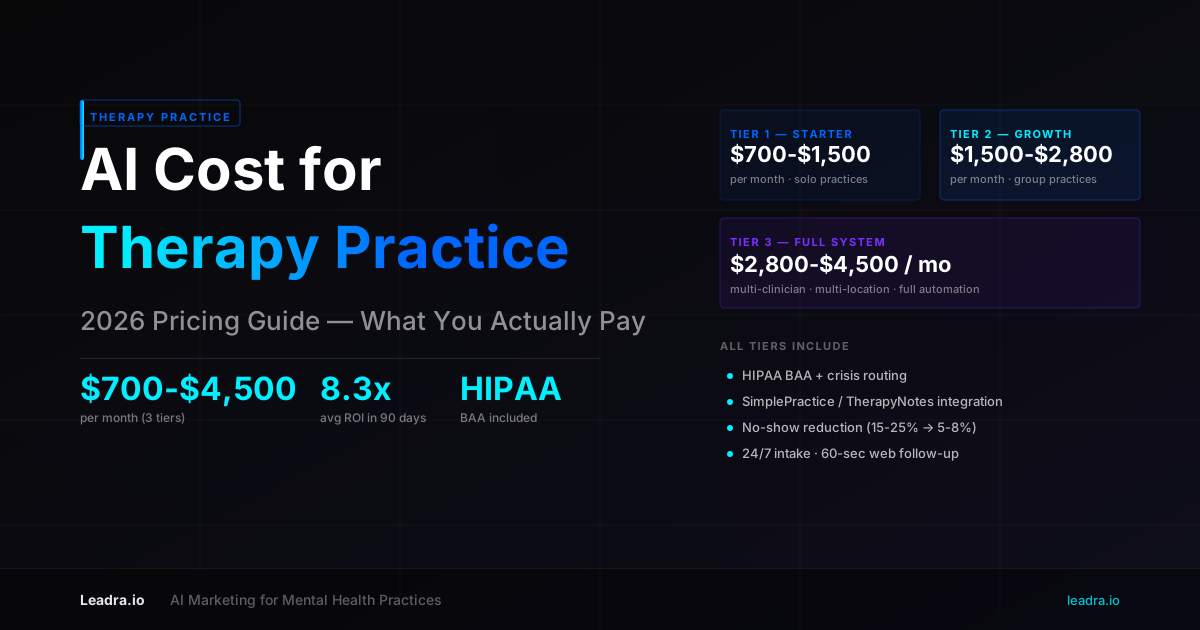
The AI cost for therapy practice business systems follows a predictable 3-tier structure in 2026. Every tier includes a HIPAA Business Associate Agreement (BAA) — because any AI that touches client names, appointment data, or clinical communications is a business associate under HIPAA, full stop. The pricing ranges below reflect that compliance layer. Generic AI tools that skip the BAA are cheaper, but they expose your practice to $10,000-$50,000 in HIPAA fines per violation. That is not a trade-off worth making.
This guide breaks down exact pricing by tier, what you get at each level, the AI-vs-hiring cost comparison, and a real Charlotte therapy practice case study. No ranges without context. No features without ROI math.
Why AI Pricing for Therapy Practices Looks Different
AI for therapy practices costs more than AI for retail businesses or general service contractors — and the reason is straightforward. You are operating in a regulated healthcare environment with three cost layers that other industries do not carry.
HIPAA compliance infrastructure ($100-$200/mo premium)
HIPAA-compliant AI requires encrypted voice channels, secure data storage, audit logging, and a signed Business Associate Agreement. This infrastructure costs vendors $100-$200/month per client to maintain. Reputable providers build it into the base price. If a vendor quotes you significantly below the ranges in this guide, ask to see their BAA before signing anything.
Crisis language detection and routing (built into every tier)
Therapy practices cannot use a generic AI voice agent that treats “I'm thinking about ending things” the same as “I need to reschedule my appointment.” Mental health-specific AI includes crisis language detection that routes to 988, sends an on-call SMS to the supervising clinician, and never disconnects a caller in acute distress without a warm handoff. This capability is not available in off-the-shelf chatbot tools.
EHR integration with SimplePractice, TherapyNotes, and Jane App
Therapy practice AI that cannot write appointment data back to your EHR creates more work than it saves — staff still have to manually enter bookings. Real integration with SimplePractice, TherapyNotes, or Jane App (the three dominant platforms) costs $150-$300/month in development and maintenance. Practices on Carelogic, Valant, or TheraNest may face a one-time custom integration fee of $500-$1,500.
These three layers explain the pricing premium over generic AI. They also explain why the ROI math still works: a therapy practice with a 20% no-show rate and 30 weekly session slots leaves $900-$1,200/week in unbilled revenue on the table every week. AI that costs $1,500/month and reduces no-shows to 7% recovers more revenue in two weeks than the system costs in a month.
The 3 AI Cost Tiers for Therapy Practices
Most therapy practices fall into one of three tiers based on practice size, session volume, and whether they accept insurance. Here is what each tier includes and what it costs in 2026.
Best for solo therapists and 2-3 clinician practices doing under 80 sessions per week who want to stop losing clients to voicemail and cut their no-show rate without hiring an admin.
HIPAA-Compliant AI Intake Voice Agent — answers all inbound calls 24/7 during session blocks and after hours. Handles new client intake, scheduling, insurance questions, and appointment changes. Includes BAA and crisis language detection with automatic 988 routing and on-call clinician SMS alert.
60-Second Web Inquiry Follow-Up — when a prospect fills out your contact form, an AI sends a personalized SMS within 60 seconds and begins a 5-touch booking sequence. Practices that respond within 5 minutes book 9x more appointments than those that respond the next business day. This automates that response window at 3 AM or 3 PM.
No-Show Prevention Sequence — automated reminders at 48 hours, 24 hours, and 2 hours before each session with a one-tap confirmation link. Same-day no-shows trigger an immediate AI recovery outreach with a rescheduling offer. Reduces no-show rate from 15-25% to 5-8% within 60 days.
Google Review Automation — post-session review request sequences sent at the right moment. Moves practices from a 3.8 to 4.6+ star average within 90 days, improving organic search visibility for therapy keywords in your area.
Best for group practices with 4-10 clinicians, insurance-based practices, and practices actively trying to grow their caseload or reduce dependence on Psychology Today and insurance referral directories. This is the most common tier for group practices because the lapsed client reactivation component alone typically covers the monthly cost.
Everything in Starter, plus:
Lapsed Client Reactivation — automated check-in sequences at 60, 90, and 180 days for clients who ended treatment or went inactive. The outreach is warm and clinically appropriate — not a sales pitch. Practices typically recover 15-25% of lapsed clients with AI-assisted reactivation, generating $3,000-$8,000/month in recovered revenue from clients who already trust the practice.
Referral Source Automation — acknowledgment sequences for psychiatrists, primary care physicians, EAP coordinators, and other referral partners after each new client they send. Quarterly touchpoint campaigns keep your practice top-of-mind. Practices that automate referral relationship management typically see a 20-35% increase in referral volume within 6 months.
AI Local SEO Content Engine — 4 therapy-focused blog posts per month targeting local keywords (“therapist near me,” “anxiety therapist Charlotte NC,” specialty searches for your modalities). Builds organic search visibility that reduces dependence on paid directories over 3-6 months.
New Client Intake Automation — pre-session intake forms, consent documents, and insurance information collection sent automatically after booking confirmation. Integrates with SimplePractice, TherapyNotes, and Jane App to eliminate manual data entry.
Best for large group practices with 10+ therapists, practices with multiple locations or specialties, and practices that want a fully autonomous client acquisition and retention system requiring minimal staff involvement. This tier is also the right fit for practices building toward a DSO-style expansion model.
Everything in Growth, plus:
Waitlist Management Automation — when a client cancels, AI immediately contacts the next person on the waitlist and fills the slot within minutes. Reduces same-day cancellation revenue loss by 65-80% in practices with active waitlists.
Insurance Eligibility Automation — AI checks insurance eligibility for new clients before the first session and flags coverage issues, reducing claim denials and reducing the administrative burden on front desk staff in insurance-based practices.
Performance Analytics Dashboard — monthly reporting on cost per new client, no-show rate by clinician, caseload utilization, revenue per session, and AI system revenue attribution. The data you need to make staffing and expansion decisions without running manual reports.
Multi-Location Coordination — unified AI system across all locations with per-location performance reporting, coordinated waitlist management, and centralized intake routing to match clients with available clinicians by specialty, location, and schedule.
AI Cost vs. Hiring: The Numbers Side by Side
The most common budget question therapy practice owners ask is how AI cost compares to hiring an administrative employee. Here is the honest comparison for a group practice considering a full-time admin or the Growth tier AI system.
| Factor | AI (Growth Tier) | Full-Time Admin |
|---|---|---|
| Monthly cost | $1,500-$2,800 | $3,800-$5,500 |
| Hours of coverage | 24/7 (8,760 hrs/yr) | 40 hrs/wk (2,080 hrs/yr) |
| HIPAA BAA included | Yes (standard) | N/A (requires HIPAA training) |
| Crisis language routing | Automated (988 + SMS) | Dependent on training |
| Simultaneous calls handled | Unlimited | 1 at a time |
| No-show reduction system | Automated (60-70% reduction) | Manual reminders only |
| Turnover risk | None | High (admin turnover 25-35%) |
| Performance reporting | Automated monthly | Not available |
The critical gap is after-hours coverage. A therapist who finishes their last session at 7 PM still has people calling and submitting contact forms at 9 PM after talking to their partner about “finally trying therapy.” An admin who left at 5 PM captures none of those leads. AI captures all of them. For group practices filling multiple clinician caseloads, the after-hours intake capability alone is worth the monthly investment.
Case Study: Charlotte Group Practice, 90 Days at Growth Tier ($2,100/month)
A 5-therapist group practice in Charlotte's University City area deployed Leadra.io's Growth tier system in March 2026. The practice included two LCSWs, one LPC, one LMFT, and one licensed psychologist — serving a mix of individual adults, couples, and adolescents. Their intake was primarily web-based through Psychology Today, with average inquiry-to-first-session time of 3.2 business days. Their no-show rate was running at 18%, and their collective caseload sat at 70% of capacity.
The two core problems were response speed and no-show volume. Web inquiries submitted after 5 PM or on weekends sat unanswered until the next business day, by which time 40-50% of those prospects had already booked with another practice. And at 18% no-shows across 5 clinicians doing 20 sessions each per week, the practice was losing 18 sessions worth of revenue weekly — roughly $2,300/week at their blended rate of $130/session.
90-Day Results at $2,100/month:
70% → 91%
Caseload utilization across all 5 clinicians
18% → 6%
No-show rate reduction (from 18 to 6 sessions/week)
8.3x ROI
Return on $2,100/month AI investment by day 90
42 sec
Average web inquiry response time (was 3.2 business days)
Revenue moved from $35,800/month (301 attended sessions at $130 blended rate after applying 18% no-show loss) to $53,200/month (409 attended sessions at 6% no-show rate) — a $17,400/month increase against a $2,100 monthly investment. The no-show reduction alone accounted for $7,800/month of that gain. The caseload growth from 70% to 91% — driven by faster intake response and lapsed client reactivation — contributed the remaining $9,600/month.
The lapsed client reactivation sequences ran against 94 clients who had gone inactive in the prior 12 months. Twenty-one scheduled sessions within 30 days — a 22% reactivation rate that generated $2,730 in first-month recovered revenue from clients who already had an established relationship with a clinician. No Psychology Today fees. No ad spend. No cold outreach.
Build Your Own ROI Estimate in 3 Steps
Before choosing a tier, run this calculation against your own practice numbers. It takes under 2 minutes and tells you which tier makes sense.
Step 1 — Calculate your weekly no-show revenue loss
Take your current no-show rate (most therapy practices are between 12-25%). Multiply your weekly session count by that rate to get the number of no-shows per week. Multiply by your average session rate. That is the weekly revenue loss AI will reduce by 60-70%. For a 30-session-per-week practice at $145/session and 18% no-show rate: 30 × 0.18 × $145 = $783/week in no-show loss — $3,132/month. AI that costs $1,500/month and recovers 65% of that loss breaks even in less than two weeks.
Step 2 — Estimate your missed web inquiry revenue
Check your website contact form or Psychology Today message log. Count inquiries from the past 30 days. Estimate what percentage went unanswered for more than 4 hours. Industry data shows 35-50% of mental health seekers contact multiple practices simultaneously — the first one to respond books the client. If you receive 20 inquiries per month and respond slowly to 10 of them, you are likely losing 4-5 clients per month to faster-responding practices. At $145/session and an average 12-session engagement, each lost client represents $1,740 in missed revenue.
Step 3 — Count your inactive clients
Pull your EHR report for clients with no sessions in the past 60-180 days. Most group practices have 50-200 inactive clients who terminated or paused treatment. AI reactivation sequences recover 15-25% of those clients. At a 20% reactivation rate on 100 inactive clients, that is 20 clients returning for an average of 6-10 additional sessions — $17,400-$29,000 in recovered revenue from people who already trust your practice. This is typically the highest-ROI component of the Growth tier.
Related Guides for Therapy Practices
Best AI for Therapy Practices in 2026 — what each component does and how to evaluate vendors
AI Receptionist for Therapy Practices — deep dive on the intake voice agent and crisis routing protocol
AI Marketing for Therapy Practices in Charlotte NC — local market strategy and neighborhood targeting
Frequently Asked Questions
How much does AI cost for a therapy practice?
AI cost for a therapy practice business runs $700-$4,500 per month in 2026 depending on practice size and scope. A Starter setup (AI intake voice agent + no-show prevention + review automation) costs $700-$1,500/month and is right for solo and small group practices. A Growth setup adds lapsed client reactivation, referral automation, and local SEO content for $1,500-$2,800/month. A Full system for large group or multi-location practices costs $2,800-$4,500/month. All tiers include a HIPAA Business Associate Agreement (BAA) and crisis language detection.
Is AI worth the cost for a therapy practice?
Yes — for most therapy practices the ROI is 5x-12x within 90 days. The two biggest revenue drivers are no-show reduction (typically from 15-25% down to 5-8%) and faster new client intake response (from hours to seconds). For a group practice billing $130/session with 30 weekly slots and a 20% no-show rate, eliminating 12 percentage points of no-shows recovers $2,340/month in previously lost revenue. AI that costs $1,500/month and produces $2,340/month in recovered no-show revenue alone is a 1.6x return before counting new client growth.
Does AI for therapy practices need to be HIPAA compliant?
Yes, without exception. Any AI that handles client names, appointment information, or any communication related to mental health treatment is handling protected health information (PHI) and must operate under a signed HIPAA Business Associate Agreement (BAA). Generic chatbots and AI voice tools without a BAA are not compliant for therapy practice use. Beyond legal risk, non-compliant tools cannot access your SimplePractice, TherapyNotes, or Jane App data — meaning they cannot book appointments, send intake forms, or pull client history, which eliminates most of their value.
What is the cheapest way for a therapist to start using AI?
The lowest-cost, highest-ROI entry point is an AI intake voice agent with a no-show prevention sequence, starting at $700-$900/month. For a solo therapist billing $150/session with a 20% no-show rate on 20 weekly sessions, AI that cuts no-shows to 7% recovers 2.6 sessions per week — $390/week or $1,560/month in recovered revenue — against a $750/month investment. That is a 2x return in the first month from the no-show component alone, before counting new clients captured by after-hours intake.
Want the exact AI cost for your therapy practice?
Leadra.io builds HIPAA-compliant AI systems for therapy and mental health practices with transparent pricing. Schedule a 20-minute call and we'll run the ROI estimate against your actual no-show rate, caseload capacity, and session volume.