Charlotte's demand for mental health services has never been higher. The Charlotte metro added more than 200,000 residents between 2020 and 2025, and therapist shortages have left Psychology Today directories flooded with hundreds of listings that prospective clients have to sort through on their own. If your therapy practice isn't showing up in Google's first results when someone in NoDa or Ballantyne searches for a therapist near them, you're invisible — no matter how good you are.
AI marketing for therapy practices in Charlotte NC solves a specific problem: getting in front of the right clients at the moment they're ready to reach out, then making sure their first contact with your practice doesn't go unanswered. The practices building consistent private-pay caseloads in 2026 aren't running expensive ads or hoping Psychology Today sends enough referrals. They're using AI systems that work while they're in session.
This guide breaks down exactly how AI marketing works for Charlotte therapy practices — what channels to use, what results to expect, and how to deploy the system without adding administrative overhead.
Why Therapy Practice Marketing in Charlotte Is Uniquely Challenging
Therapy marketing operates under constraints that don't apply to most other local service businesses. Three of them are particularly acute in the Charlotte market:
The 60-second window problem.
Research consistently shows that service providers who respond to an inquiry within 60 seconds are 9x more likely to convert that lead than those who respond within 5 minutes — and 78x more likely than those who wait 30 minutes or longer. For therapists, who are in session most of the day, the average response time to a new client inquiry is 4-8 hours. Most prospective clients have already contacted someone else by then.
Psychology Today dependency.
Most Charlotte therapists rely on Psychology Today as their primary discovery channel. The problem: Psychology Today listings are algorithmically ranked, expensive ($30/month per clinician), and provide no competitive advantage. Every therapist in Charlotte is paying for the same directory placement. Practices that rank in Google directly — especially in AI Overviews — get inquiries at a fraction of the cost with far higher intent.
Private pay conversion pressure.
Insurance reimbursements in North Carolina have been flat for years while practice costs have risen. More therapists are moving toward private pay or hybrid models — but private-pay clients are also the most research-intensive. They read Google reviews, compare specialties, check website content, and expect professional online presence before they ever pick up the phone. An AI marketing system that builds this presence systematically gives private-pay practices a decisive edge.
According to the American Psychological Association, 65% of people searching for a therapist contact only the first 2-3 providers they find. In Charlotte's competitive market, showing up in those top results — and responding instantly — determines whether a prospective client books with you or someone else. AI marketing systems address both problems simultaneously.
The 5-Channel AI Marketing System for Charlotte Therapy Practices
Effective AI marketing for a therapy practice isn't a single tool — it's five channels that compound on each other. Here's the complete system:
AI local SEO content engine.
The system publishes 8-12 blog posts and service pages per month targeting Charlotte therapy keywords at the neighborhood and specialty level. Posts are structured for Google's AI Overviews — FAQ schemas, answer-first formatting, LocalBusiness markup — so they appear when someone in Dilworth searches 'therapist for anxiety near me' or a parent in Ballantyne searches 'child therapist Charlotte NC'. Over 90 days, this builds 30-40 indexed pages that establish topical authority competitors can't replicate quickly.
Google Business Profile automation.
Your GBP is the single most important ranking factor for local therapy searches in Charlotte. The AI system posts to it 4-5x per week with mental health content (stress management tips, what to expect in a first session, specialty spotlights), responds to reviews within hours, and optimizes your service area across Charlotte neighborhoods. Practices with active, consistently posting GBPs rank significantly higher in the local 3-pack — the map results that appear before the organic listings.
AI intake agent for 24/7 inquiry response.
This is the highest-ROI component for most therapy practices. When a prospective client submits a contact form or calls your practice at 9 PM on a Sunday, the AI intake agent responds within 60 seconds via SMS — acknowledging their inquiry, asking about their preferred session times and insurance status, and offering to schedule a free 15-minute consultation. This single component typically converts 40-60% more inquiries into booked consultations compared to practices that respond the next business day.
Review generation and reputation automation.
Private-pay clients in Charlotte read Google reviews before choosing a therapist — often more carefully than any other factor. The AI system sends a review request to clients after the 3rd session (the optimal timing that avoids feeling intrusive) with a direct link to your Google Business Profile. Practices using this system generate 6-10 new Google reviews per month without ever manually asking a client. More reviews drive higher GBP rankings and higher conversion rates from profile views.
Multi-touch follow-up sequences for non-bookers.
Only 30-40% of people who inquire about therapy book immediately. The rest need time, reminders, or a different framing. The AI system puts every non-booking inquiry into a 14-day follow-up sequence: a check-in SMS at 48 hours, an email at day 5 with a resource about your specialty area, and a final outreach at day 14 offering a specific open slot. Practices using this system recover 15-25% of inquiries that would otherwise be lost.
These channels don't operate in isolation. The SEO content drives discovery. The GBP keeps you visible in map searches. The intake agent converts inquiries before they go cold. The review system builds the credibility that makes private-pay clients choose you. The follow-up sequences recover everyone who wasn't ready to book immediately. See a full breakdown of the AI tools therapy practices use in 2026.
How AI Marketing Targets Charlotte's Therapy Search Landscape
Prospective therapy clients in Charlotte don't search generically — they search by location, specialty, and often insurance type. A properly configured AI marketing system targets all of these combinations:
| Charlotte Neighborhood | Client Profile | High-Value Search Targets |
|---|---|---|
| SouthPark / Sharon Road | Corporate professionals, couples, executive stress | "therapist SouthPark Charlotte", "anxiety therapy Charlotte NC" |
| Dilworth / South End | Young professionals, relationship issues, career transitions | "therapist Dilworth NC", "relationship therapist Charlotte" |
| Ballantyne / Waxhaw | Families, parenting, children and adolescent therapy | "child therapist Ballantyne NC", "family counseling Charlotte" |
| NoDa / Plaza Midwood | Artists, LGBTQ+, trauma, alternative therapy seekers | "LGBTQ therapist Charlotte NC", "trauma therapy NoDa" |
| University City / Concord | Students, young adults, first-time therapy clients | "therapist near UNCC", "anxiety therapist Concord NC" |
| Huntersville / Lake Norman | Suburban families, postpartum, teen therapy | "therapist Huntersville NC", "postpartum therapist Charlotte" |
Charlotte's neighborhoods have distinct mental health demographics. A therapy practice in SouthPark serving corporate professionals needs different content than one in Ballantyne serving families with children. AI marketing systems can publish neighborhood-specific content at scale — something that's impossible to maintain manually while also running a full caseload.
Google's AI Overviews are particularly valuable for therapy practices because prospective clients ask process-oriented questions: "How do I find a therapist in Charlotte NC who takes Aetna?" or "What should I expect in my first therapy session in Charlotte?" Practices with structured FAQ content and LocalBusiness schema appear in these AI-generated answer boxes — capturing clicks before the user even sees the traditional search results.
Case Study: Charlotte Group Practice Goes from 60% to Full Caseload in 78 Days
Client Story
A 3-clinician private-pay group practice in Charlotte's Dilworth neighborhood was operating at roughly 60% caseload capacity — about 18 of 30 available weekly slots filled. They were spending $90/month on Psychology Today listings, had 11 Google reviews, and responded to new inquiries within 6-8 hours on average. Their GBP hadn't been updated in 4 months.
Leadra.io deployed a full AI marketing system in 12 days: an AI content engine publishing 10 posts per month targeting Charlotte therapy keywords across Dilworth, South End, NoDa, and Plaza Midwood; GBP automation posting 5x per week with mental health content and specialty spotlights; an AI intake agent responding to all contact form submissions and calls within 60 seconds, 24/7; a post-session review request SMS at session 3; and a 14-day follow-up sequence for non-booking inquiries.
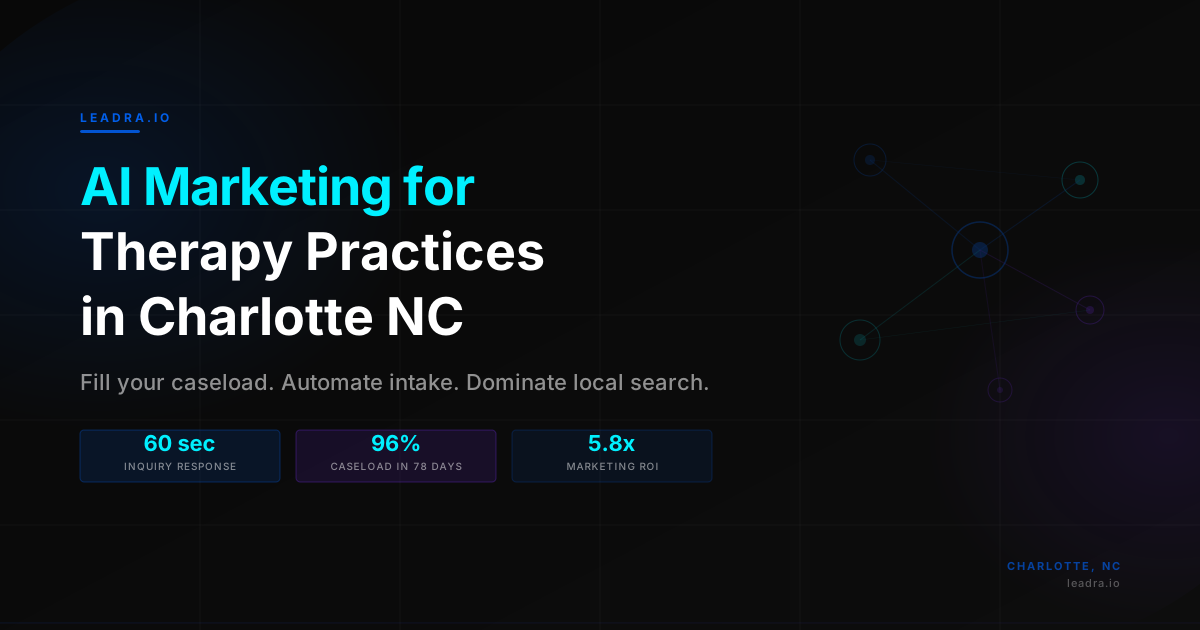
At day 78, the practice had 29 of 30 weekly slots filled — 96% capacity. The AI intake agent had converted 23 after-hours inquiries into booked consultations that previously went unanswered until the next morning. Google reviews grew from 11 to 47, pushing their GBP into the local 3-pack for "therapist Dilworth Charlotte" and "anxiety therapist Charlotte NC." Monthly revenue grew from $14,400 to $24,800.
Caseload filled
Google reviews
Inquiry response
Monthly revenue
The AI marketing system cost $1,800/month. Revenue increase in month 3 was $10,400 over baseline — a 5.8x return on the marketing investment. The practice has since added a fourth clinician to handle demand.
The fastest ROI driver was the intake agent. In the first 30 days alone, it captured 11 inquiries that previously went unanswered until the following business day — 7 of them booked. At $165/session private pay, that's $1,155 in recovered monthly revenue from one component alone. See how to build a complete AI lead generation system for local service businesses.
What AI Marketing for a Therapy Practice Costs in Charlotte in 2026
Pricing depends on whether you're a solo therapist building a private-pay caseload or a group practice competing for visibility across multiple specialties. Here's how most Charlotte therapy practices structure the investment:
- —AI content engine: 6-8 posts/month targeting Charlotte therapy keywords
- —Google Business Profile automation (4x/week posting + review responses)
- —AI intake agent: 60-second inquiry response, 24/7
- —Post-session review request SMS automation
- —Monthly SEO performance report
Best for: Solo therapists transitioning to private pay or filling a new practice location
- —Everything in Solo Starter
- —12 posts/month covering specialty and neighborhood keyword clusters
- —14-day multi-touch follow-up for non-booking inquiries
- —EHR integration (SimplePractice, TherapyNotes, Jane App)
- —Insurance-specific content targeting (Aetna, BCBS, United HC)
- —Quarterly content strategy review and keyword audit
Best for: Solo therapists with high private-pay rates or group practices with 2-3 clinicians
- —Everything in Full Practice Stack
- —16-20 posts/month across multiple specialties and locations
- —Separate GBP optimization for each clinician or location
- —Multi-clinician intake routing based on specialty and availability
- —Referral source tracking and referring provider outreach automation
- —Custom analytics dashboard with conversion attribution
Best for: Group practices with 4+ clinicians or multi-location practices across greater Charlotte
The question most therapists ask is: "What's the fastest path to ROI?" The honest answer is the AI intake agent. For a solo therapist charging $165/session private pay with 15 available weekly slots, capturing even 3 additional weekly clients means $2,475/week in added revenue — more than enough to cover the entire system cost within the first month.
SEO content takes longer — typically 60-90 days to see meaningful ranking movement — but it compounds. A post ranking for "therapist Ballantyne NC" today will still drive inquiries two years from now. See the full AI implementation cost breakdown for Charlotte small businesses.
How to Start AI Marketing for Your Charlotte Therapy Practice
The fastest path from where you are now to a full caseload follows a specific implementation sequence:
1. Audit your inquiry response time.
Before adding any new marketing, find out how fast you currently respond to new client inquiries. Send a test contact form on a Friday evening and measure when you (or your admin) respond. For most Charlotte therapy practices, this is Monday morning — 60-72 hours later. The AI intake agent fixes this immediately, often recovering 30-40% more inquiries within the first 30 days of deployment.
2. Check your Google Business Profile.
Search your practice name in Google. Look at your GBP: when did you last post? Do you have fewer than 20 reviews? Is your specialty list complete and current? An incomplete or dormant GBP is the most common reason Charlotte therapy practices don't appear in local 3-pack results — and it's the fastest thing to fix. The AI system can optimize and activate your GBP in the first week.
3. Identify your 3 highest-value specialty keywords.
Pick the 3 specialties you most want to be known for in Charlotte — anxiety, trauma, couples therapy, LGBTQ+ affirming, child and adolescent, perinatal, or others. These become the primary SEO targets. The AI content system builds topical clusters around each one, targeting neighborhood + specialty combinations ('trauma therapist NoDa Charlotte', 'couples therapist SouthPark NC') that your ideal clients are already searching for.
4. Connect your EHR for intake automation.
AI intake agents work best when connected directly to your scheduling system. SimplePractice, TherapyNotes, and Jane App all have API integrations that allow the AI to check availability and offer specific time slots in real-time — rather than just taking a message. This removes the scheduling back-and-forth that kills conversion rates between inquiry and booked session.
5. Measure cost per new client acquired.
Don't track Psychology Today spend, Google impressions, or website traffic in isolation. Track total marketing spend divided by new clients who complete a first session. For most Charlotte therapy practices before AI marketing, this number is $180-$350 per new client when you factor in directory fees, website costs, and time spent on admin. The target with a full AI marketing system is $35-$80 per new client.
Frequently Asked Questions
How does AI marketing help therapy practices in Charlotte NC get more clients?
AI marketing helps Charlotte therapy practices get more clients through four channels: local SEO content that ranks for neighborhood-specific mental health searches, Google Business Profile automation that keeps your listing active and visible, an AI intake agent that responds to inquiries within 60 seconds (the window where most prospective clients choose who to contact), and automated follow-up sequences for people who inquire but don't book. Together, these channels drive a consistent pipeline of private-pay client inquiries without relying on Psychology Today alone.
What does AI marketing for a therapy practice in Charlotte NC cost?
AI marketing for therapy practices in Charlotte NC typically runs $800-$3,500/month depending on practice size and scope. A solo therapist focused on filling a private-pay caseload can typically start at $800-$1,400/month. Group practices with 3+ clinicians typically invest $2,000-$3,500/month. Most practices see positive ROI within 60 days when the intake automation alone captures clients that previously went unanswered.
Does AI marketing work for therapy practices that only take private pay?
Yes — AI marketing is especially effective for private-pay therapy practices in Charlotte because the target client is actively searching online and comparing providers before choosing. Private-pay clients read Google reviews, visit practice websites, and expect fast responses. An AI system that publishes authoritative local content, maintains a strong review profile, and responds to inquiries within 60 seconds consistently converts private-pay inquiries at a higher rate than practices relying on Psychology Today listings or slow email response cycles.
How long does it take for AI marketing to fill a therapy caseload in Charlotte?
AI intake automation typically shows results within the first 30 days — capturing inquiries that previously went unanswered after hours or over the weekend. Local SEO content typically produces page-1 rankings for 3-5 neighborhood-specific mental health keywords within 60-90 days. Most solo therapists reach a full private-pay caseload within 90 days of deploying a complete AI marketing system. Group practices typically add 2-4 new weekly clients per clinician within the same window.
Charlotte's therapy market is only getting more competitive. Demand is rising, new practices are opening every month, and directory listings alone don't differentiate you anymore. The practices filling their caseloads consistently in 2026 are the ones that show up first in Google, respond to inquiries in under a minute, and build the review volume that makes private-pay clients confident in their choice.
At Leadra.io, we build AI marketing systems for therapy practices across Charlotte and the Carolinas. Setup takes 10-14 days. Most practices recover the system cost within the first month from inquiries the intake agent captures while you're in session.
Built for Charlotte Therapy Practices
Find Out How Many Clients You're Currently Missing
We'll audit your current inquiry response time, Google rankings, and review velocity — then show you exactly what an AI marketing system would add to your monthly caseload and revenue. Free assessment, no commitment.