AI Cost for Trucking Company Business: Full Pricing Guide, ROI Math, and What You'll Actually Get Back
Trucking company owners ask the wrong question when they look at AI. They want to know what it costs per month. The right question is what the absence of AI is already costing them — because that number is almost always three to five times larger, and it never shows up on a P&L.
A 5-truck fleet running 12 loads per truck per month at a 20% broker margin is paying approximately $4,200–$6,000 per month in load board fees alone — fees for finding freight that a direct shipper relationship would eliminate. Add missed after-hours load inquiries that went unanswered while the owner was driving, cold freight quotes that never got a follow-up call, and a dispatcher spending 60% of their day on routine call handling instead of building shipper relationships — and the real monthly revenue leak for a typical 5-truck carrier is $8,000 to $17,000. None of it appears as a line item. It shows up as a load board dependency that never gets better and margins that stay thin no matter how hard the owner works.
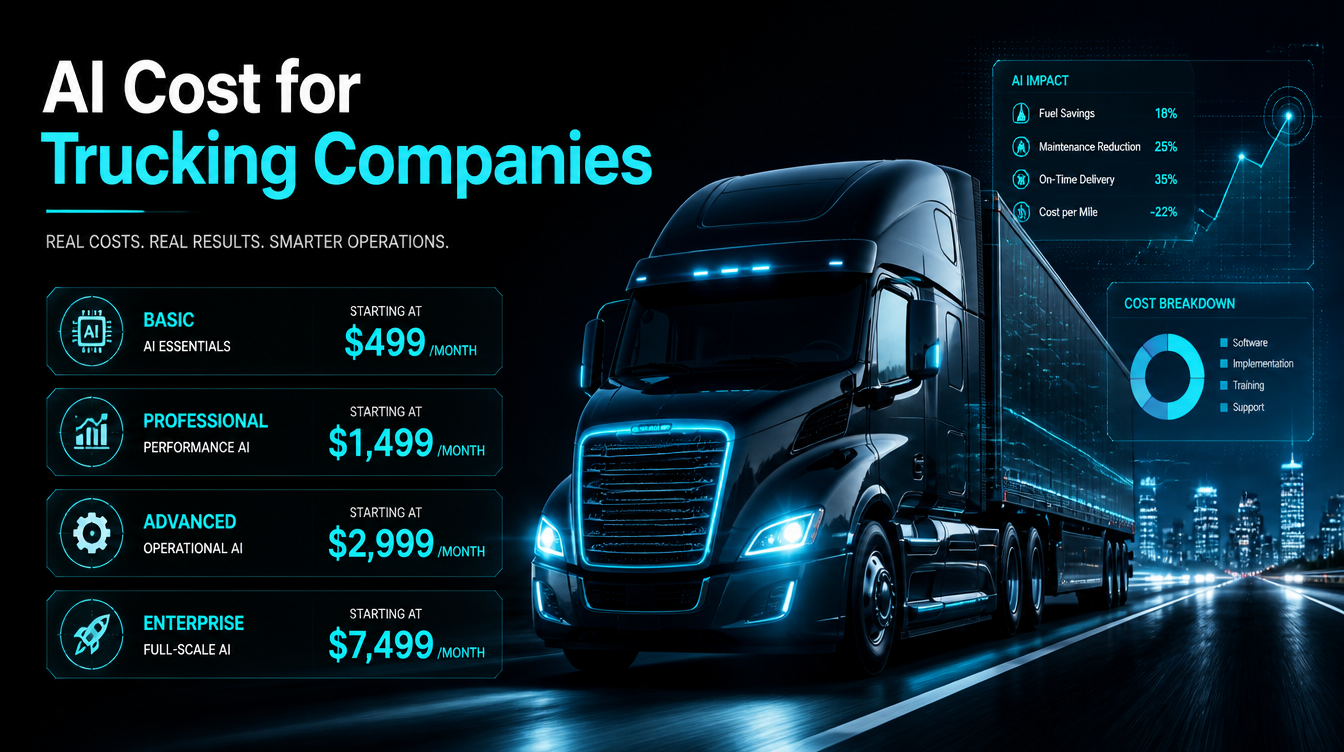
AI for trucking companies costs between $300 and $4,500 per month depending on fleet size, what you automate, and how aggressively you want to build direct freight relationships. This guide covers every pricing tier with what it actually includes, ROI math for a real 5-truck operation, setup fees you should expect, what red flags to watch for when evaluating vendors, and how to decide which tier is the right entry point for your fleet.
What Drives AI Cost for a Trucking Company
Trucking AI pricing varies because the work varies. Vendors price based on five core variables:
- 01.Fleet size and call volume. A 2-truck owner-operator receives 20–40 load inquiries per month. A 15-truck fleet with a dedicated dispatcher handles 200–400. AI systems priced per call minute or per active contact can multiply the headline rate significantly at real fleet volumes — always get a quote tied to your actual monthly call volume, not a base plan that scales expensive once you start using it.
- 02.Voice vs. SMS-only coverage. An AI that only sends texts cannot answer a broker who calls at 11 PM with a load that picks up at 6 AM. Voice capability — inbound answering and outbound calling — is what captures after-hours freight before it goes to the next carrier on the list. For any fleet moving more than $30k/mo in freight, voice coverage is not optional.
- 03.TMS integration depth. Sending a rate confirmation PDF in an email is not AI dispatch automation — it is an attachment. Real integration reads your available capacity from the TMS, matches it to incoming load inquiries, and confirms or declines in real time. That two-way sync is what makes load qualification and after-hours booking actually functional. Vendors who skip it will show a clean demo and deliver a manual process with a chatbot in front of it.
- 04.Shipper acquisition scope. The difference between a Tier 1 and Tier 3 system is largely the proactive component. Tier 1 handles inbound calls you already get. Tier 3 reaches out to manufacturers and distributors along your lanes, qualifies them as potential direct freight sources, and builds the shipper relationship through automated outreach sequences before a human sales call ever happens. That outbound work takes more build time and ongoing management — which is why the price difference between tiers is real.
- 05.Reporting and lane intelligence. Basic AI systems answer calls and follow up on quotes. Full-stack systems generate weekly lane rate analysis, shipper activity reports, and ROI dashboards that show exactly how much revenue each automation produced. That reporting layer adds cost but also removes the guesswork around where to focus the next month of outreach.
Why Trucking Has Unique AI Economics
The trucking business model has three characteristics that make AI both more valuable and more specific than in most industries:
Load board dependency is a margin tax that compounds.
Every load moved through DAT or Truckstop costs 15–25% of gross revenue in broker margin. A 5-truck fleet moving $90k/mo in freight pays $13,500–$22,500 per month to brokers for access to shippers they could reach directly. AI shipper acquisition — identifying and approaching manufacturers and distributors along your existing lanes — converts those load board loads to direct freight over 6–12 months. The math is not subtle: a carrier that moves 30% of loads to direct in year one recovers $4,000–$7,000/mo in broker margin alone. That is the financial case for Tier 3 spending.
After-hours load availability is the highest-value time window.
Brokers post loads at all hours. The carrier who responds first to a rate confirmation request at 9 PM captures that load. Carriers who go dark after 5 PM are ceding a significant share of available freight to competitors with better coverage. An AI voice agent that answers dispatch calls 24/7, qualifies the load against current capacity, and confirms a rate in under 3 minutes keeps a fleet competitive around the clock without requiring an overnight dispatcher.
Dispatcher time is the scarcest resource in a growing fleet.
A skilled dispatcher is worth $55,000–$75,000 per year. They add the most value building direct shipper relationships, optimizing lane coverage, and solving problems that need human judgment. They add the least value answering the same carrier packet request for the fifth time this week, chasing a broker follow-up that went cold, or explaining insurance certificates to a new contact. AI handling the routine call volume — industry estimates put 60–70% of inbound dispatch calls as routine and repeatable — frees 12–20 hours per week for the high-value work that actually grows a fleet.
AI Pricing Tiers for Trucking Companies
Here is how the market breaks down across three tiers. Most fleets move from Tier 1 to Tier 2 within 60 days once they see how much revenue Tier 1 leaves unconverted.
Basic Dispatch AI
- ✓24/7 AI voice agent for inbound dispatch calls and load inquiries
- ✓After-hours call answering — no missed load opportunities overnight
- ✓Automated driver check-in and ETA update SMS
- ✓Carrier packet and insurance certificate auto-response
- ✓Basic missed call follow-up within 5 minutes
Best for
Owner-operators and 1–3 truck fleets where the owner also dispatches
ROI timeline
30–45 days from missed call recovery and after-hours load capture
Standard AI Stack
- ✓Everything in Tier 1
- ✓Freight quote follow-up automation (24h / 72h / 7-day sequence)
- ✓Direct shipper outreach along your existing lanes
- ✓Load inquiry qualification — filters broker spam before it reaches your dispatcher
- ✓Broker rate negotiation email sequences
- ✓CRM integration with TMS platforms (Axele, Truck Logics, McLeod)
- ✓Weekly load opportunity digest and lane analysis
Best for
3–10 truck fleets ready to reduce load board dependency
ROI timeline
20–35 days — direct shipper rate improvement and load board fee reduction pay fast
Full Revenue Engine
- ✓Everything in Tier 2
- ✓AI-powered direct shipper acquisition (manufacturers, distributors on your lanes)
- ✓Dormant shipper reactivation campaigns (30/60/90-day segments)
- ✓Driver recruitment AI — automated outreach and screening
- ✓Google review generation for shipper credibility
- ✓Custom rate intelligence reports per lane
- ✓Dedicated account manager and monthly optimization reviews
Best for
10+ truck fleets or owner-operators aggressively scaling to direct freight
ROI timeline
15–25 days — multiple revenue streams fire simultaneously at launch
Setup Fees and Onboarding Costs
Every real AI system requires upfront configuration work. Here is what to budget beyond the monthly subscription:
| Tier | Setup fee range | What it covers |
|---|---|---|
| Basic | $0 – $400 | Voice agent configuration, carrier packet templates, call routing setup, dispatcher training |
| Standard | $600 – $1,500 | TMS integration, quote follow-up sequence build, lane analysis configuration, shipper outreach list setup |
| Full Stack | $1,500 – $3,000 | Full CRM build, shipper acquisition workflow, custom lane rate intelligence setup, driver recruitment configuration, reporting dashboard |
Annual contracts regularly waive or reduce setup fees. Monthly contracts run 15–25% higher per month but give you flexibility to exit if results do not materialize. Any vendor quoting zero setup on a Tier 2 or Tier 3 system without explanation is cutting corners somewhere — the TMS integration and shipper outreach build is real work, and if it is not being charged upfront, it is being skipped or delivered poorly.
ROI Breakdown for a 5-Truck Fleet
This is what a 5-truck fleet averaging 11,000 miles per truck per month at a $2.80–$3.20/mile blended rate typically recovers with a full AI stack in the first 90 days. These numbers are conservative — most carriers report faster results in load board fee reduction and after-hours load capture.
| Revenue category | Assumption | Monthly recovery |
|---|---|---|
| Load board fee reduction | 5 trucks, 12 loads/truck/mo at 20% broker margin, shifting 4 loads/truck to direct | $2,000 – $4,500 |
| Rate improvement — direct vs. spot board | 5 trucks, 11k mi/mo each, +$0.40–$0.90/mi on direct freight vs. board rate | $2,800 – $5,600 |
| Dispatcher labor savings | AI handles 60–70% of routine dispatch calls — saves 15–25 hrs/wk at $20–$28/hr | $1,200 – $2,400 |
| After-hours load inquiry capture | 35% of load inquiries arrive outside business hours — AI captures 6–10 loads/mo | $900 – $2,000 |
| Dormant shipper reactivation | 40 lapsed shipper contacts, 12% reactivate at 3 loads/mo avg, $350 gross/load | $800 – $1,800 |
| Total monthly recovery | Conservative blended estimate — 5-truck fleet | $8,300 – $17,100 |
A full-stack plan at $2,500–$3,500/mo against $8,300–$17,100/mo in recovered revenue is a 2.4x to 6.8x monthly return. The rate improvement category deserves attention: shifting 4 loads per truck per month from load board spot rates to direct shipper rates typically adds $0.40–$0.90 per mile. On a 5-truck fleet running 11,000 miles each, that is $22,000–$49,500 in additional monthly gross revenue from the same miles already being driven — just at a higher rate because a shipper is paying the carrier instead of a broker.
The most underestimated category is dormant shipper reactivation. Most carriers have a list of shippers they quoted once, moved a couple of loads for, and then lost contact with. A properly segmented reactivation campaign — a personal-sounding outreach acknowledging the gap and offering a rate update on lanes you know they ship — typically reactivates 10–15% of dormant contacts within 45 days. At $350 gross per load and 3 loads per reactivated shipper per month, recovering even 5 accounts from a list of 40 adds $5,250/mo in new direct freight from relationships that already trusted you once.
The Trucking Revenue Leaks That AI Closes
Trucking companies have specific revenue leak patterns that general business automation tools miss. AI built for the carrier model closes all of them:
The after-hours load inquiry with no answer.
A broker calls at 10:30 PM with a load that picks up in 7 hours. The carrier does not answer. By 11 PM, three other carriers have confirmed. The load is gone. This happens to carriers running on owner-operator or small dispatcher setups every week. An AI voice agent that answers after hours, confirms available capacity against the TMS, and sends a rate confirmation email to the broker captures freight that would otherwise leave the fleet.
The cold freight quote that never got a follow-up.
A carrier quotes a new shipper on a lane. The shipper says they will circle back. The dispatcher gets buried in the day's loads and never follows up. Two weeks later, the shipper uses a different carrier. An automated freight quote follow-up sequence — a call at 24 hours, an email at 72 hours, and a final check-in at 7 days — converts 25–40% of cold quotes that would otherwise die in the owner's inbox. On a fleet quoting 20 new shippers per month, that is 5–8 additional direct freight relationships per month from outreach that happens automatically.
The carrier packet request that takes 4 hours.
A new shipper asks for a carrier packet, insurance certificate, and operating authority. It takes a dispatcher 45 minutes to compile and 3 hours to hear back from the shipper who received it. An AI system that has the carrier packet pre-built and sends it automatically within 2 minutes of the request — with a follow-up call scheduled at 48 hours — converts shipper inquiries 3x faster than manual handling and signals professionalism that wins freight from shippers comparing multiple carriers.
The dispatcher drowning in routine calls instead of building shippers.
Load status calls, ETA updates, detention notifications, broker check-calls — these are the calls that consume 60–70% of a dispatcher's time and produce zero new revenue. An AI system that handles routine call types automatically, escalates anything requiring a human decision, and logs everything in the TMS gives dispatchers back 12–20 hours per week for the outreach work that actually expands the fleet's freight base.
What to Watch Out For When Comparing AI Vendors
The transportation AI market has grown quickly, and several vendors are selling automation theater — demos that work and live products that do not. These are the red flags to screen for:
No real TMS integration — just email attachments.
If the vendor cannot show you a live two-way connection to your TMS that reads available capacity and writes confirmed loads directly — it is not an AI dispatch system. It is a better-looking email auto-responder. Ask for a live demo of capacity matching. If they cannot show it live against a real TMS environment, the integration does not work the way the demo implies.
SMS-only with no voice capability.
An AI that only texts cannot capture a broker who calls at midnight. Freight moves on phone calls — especially time-sensitive spot freight and same-day loads. Confirm that the system handles inbound phone calls with a real AI voice agent that can answer load questions, confirm rates, and schedule pickups verbally. If they only have a missed-call text-back feature, that is not voice AI.
Flat monthly pricing that ignores volume.
Some vendors quote a flat $500/mo for "unlimited calls." Understand what unlimited actually means — per-minute call costs, per-contact caps, or platform throttles that slow response time when volume gets high. Always ask for pricing at 2x your current call volume. A plan that looks affordable at 30 calls/mo can become expensive at 300.
No measurable benchmarks in the contract.
Any vendor confident in their product should commit to measurable outcomes within 60–90 days. Ask for a written performance benchmark: minimum reduction in after-hours missed calls, minimum quote follow-up conversion rate, minimum number of new direct shipper contacts activated. If they decline to put outcomes in writing, they are not confident the product delivers them.
Which Tier Is Right for Your Fleet?
A direct decision guide based on fleet size and current freight source mix:
If: 1–3 trucks, owner-operator dispatching, over 80% load board freight
→ Start with Tier 1. Protect every after-hours load opportunity and eliminate missed calls. One captured overnight load per week at $400 gross pays for Tier 1 twice over. Upgrade to Tier 2 when you want to start building direct shippers — typically within 45–60 days once you see what after-hours coverage recovers.
If: 3–10 trucks, dedicated dispatcher, 50–80% load board dependency
→ Tier 2 is the right entry point. Freight quote follow-up and direct shipper outreach along your existing lanes produce measurable results within 30 days. Most fleets in this range report 3–6 new direct shipper relationships per month from the outbound sequences alone. The load board fee reduction from even 3 direct relationships typically covers the monthly cost.
If: 10+ trucks or aggressively scaling toward direct freight
→ Tier 3. At this fleet size, shipper acquisition at scale and dormant account reactivation compound the returns. A fleet that shifts 40% of loads to direct over 12 months at a $0.50/mile rate improvement on 50,000 monthly miles adds $25,000/mo in gross revenue at the same operating cost. The Tier 3 system is what makes that shift systematic instead of ad hoc.
How Leadra.io Builds AI Systems for Trucking Companies
Leadra.io builds AI revenue systems for trucking companies, transportation businesses, and local service operations. Our pricing is based on what moves freight and grows your shipper base — not a generic SaaS subscription that charges for features a carrier never uses.
Every engagement starts with a 30-minute audit where we calculate the exact monthly revenue your fleet is losing to unanswered after-hours loads, cold quote attrition, load board fees, and dispatcher time spent on routine call handling. If the math does not show a clear path to ROI-positive within 60 days, we say that before you spend anything.
We build real TMS integration — not link-in-email workarounds. We build outbound AI voice capability that can call a shipper contact, deliver a lane rate update, and handle objections. We do not lock carriers into 12-month contracts when the freight numbers do not move in the first 90 days.
According to industry data from the American Trucking Associations, the average carrier still generates 70–75% of freight through brokers and load boards. The carriers shifting to direct are capturing $0.40–$1.20/mile more on the same routes, with the same fuel costs and the same trucks. That gap is where Leadra.io works. Read more about our full AI tools for trucking companies, see how our AI receptionist for trucking handles dispatch calls, or explore our trucking company marketing automation guide for the full direct shipper acquisition playbook.
Frequently Asked Questions
How much does AI cost for a trucking company?
AI for a trucking company typically costs $300 to $4,500 per month. A basic Tier 1 setup with 24/7 AI voice dispatch and after-hours load inquiry coverage runs $300–$700/mo. A standard Tier 2 system adding freight quote follow-up, direct shipper outreach, and TMS integration runs $800–$1,800/mo. A full Tier 3 revenue stack with shipper acquisition, dormant account reactivation, and analytics runs $2,000–$4,500/mo. Setup fees range from $0 to $3,000 depending on integration depth.
What is the ROI of AI for a trucking business?
For a 5-truck fleet averaging 11,000 miles per truck per month, a full AI stack typically recovers $8,300 to $17,100 per month across five categories: load board fee reduction from shifting to direct freight ($2,000–$4,500/mo), rate improvement on direct versus spot board freight ($2,800–$5,600/mo), dispatcher labor savings ($1,200–$2,400/mo), after-hours load capture ($900–$2,000/mo), and dormant shipper reactivation ($800–$1,800/mo). Against a full-stack cost of $2,500–$3,500/mo, most 5-truck fleets see 3x to 6x monthly ROI.
What does AI for a trucking company actually include?
A trucking AI system typically includes a 24/7 AI voice agent for inbound dispatch and load inquiries, automated carrier packet and insurance certificate responses, freight quote follow-up sequences at 24h, 72h, and 7 days, direct shipper outreach campaigns along your existing lanes, dormant shipper reactivation for accounts that went quiet, and Google review automation for carrier credibility. Higher-tier systems add TMS integration, shipper acquisition workflows, driver recruitment automation, and lane rate intelligence reporting.
Is AI worth it for a small trucking company with 3–5 trucks?
Yes — a 3-truck operation running 80% load board freight pays $2,500–$4,000/mo in broker margins on loads a direct shipper relationship would eliminate. A basic AI voice agent at $300–$500/mo that captures after-hours load inquiries and responds within 5 minutes instead of the next morning protects revenue that currently leaks daily. A Tier 2 system adding direct shipper outreach can shift 2–3 loads per week from load board to direct within 60 days, saving $800–$1,500/mo in broker fees alone while adding $0.40–$0.90/mile in rate improvement on those converted loads.
See the exact ROI number for your fleet
We run a free 30-minute audit and calculate exactly how much your fleet is losing monthly to after-hours missed loads, cold quote attrition, load board fees, and dispatcher time spent on routine calls — before you spend a dollar.