A long-time client's auto policy renews in 45 days. The carrier is raising their premium by 19%. Your agency doesn't reach out until the renewal notice arrives in their mailbox. The client calls a competitor the same afternoon, gets a quote $340 cheaper, and moves the account — taking their home policy with it. You lost a $2,100-per-year account because you were the third call they made instead of the first one they received.
This scenario plays out in independent insurance agencies every day. The industry average retention rate sits at 77-82% for personal lines — which means the typical agency loses nearly one in five clients every year, mostly silently. They don't call to complain. They don't give you a chance to remark. They just find a cheaper rate somewhere else and let the policy expire.
The National Association of Professional Insurance Agents reports that acquiring a new personal lines client costs $200-$600 in marketing and producer time. Retaining an existing client costs $20-$40. Every retained client is worth 10-15 new clients in acquisition cost terms — yet most agencies spend the majority of their marketing budget on new business while letting 18-25% of their existing book walk out the door every renewal cycle.
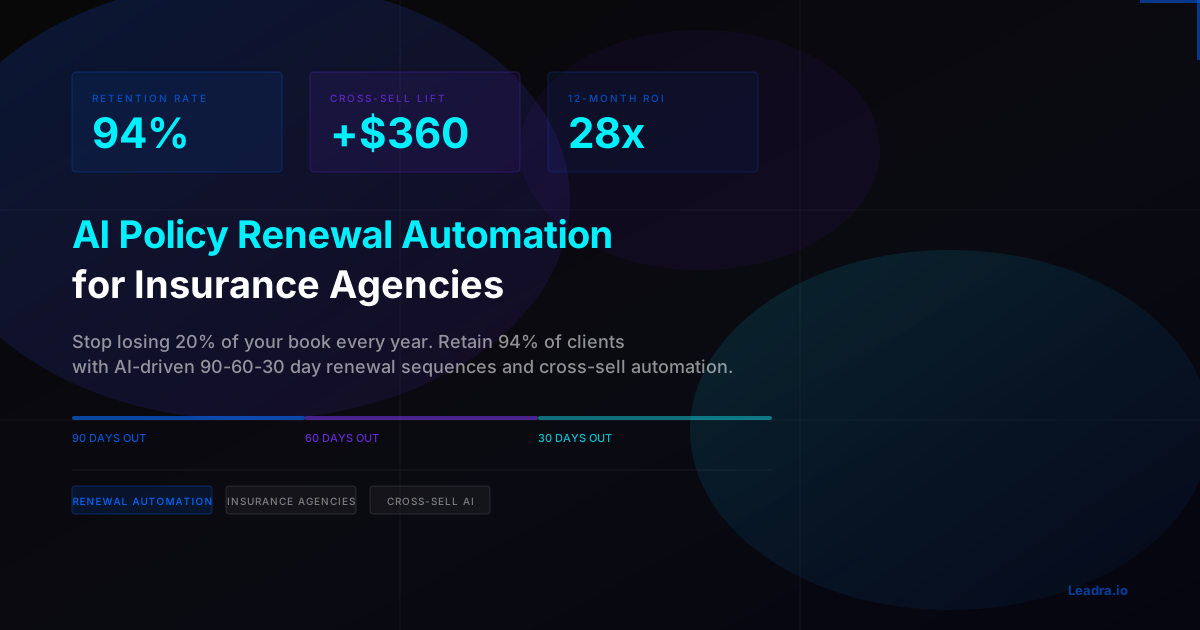
AI renewal automation fixes this. It contacts every client proactively at 90, 60, and 30 days before expiration — by name, by policy, by carrier. It handles rate increase conversations before the client shops. It cross-sells adjacent coverage during renewal conversations when the client is already engaged. And it runs win-back sequences for lapsed accounts that most agencies permanently write off. This guide covers how the system works, what it produces in measurable results, and how a Charlotte P&C agency implemented it across a 600-client book.
Why Insurance Agencies Lose 20% of Their Book Every Year
Retention failure in insurance agencies almost never happens because of bad service. It happens because of timing. Three specific breakdowns cause the majority of preventable lapses:
Reactive renewal outreach arrives after the client is already shopping
Most agencies don't reach out until 30 days before renewal — which is when the carrier notice arrives. By then, the client has already received the carrier's notice, experienced sticker shock from a rate increase, and possibly started comparing alternatives. A proactive call at 90 days — before the renewal notice — intercepts the conversation before competitors do. Agencies that shift from 30-day reactive outreach to 90-day proactive sequences see retention lift by 8-14 percentage points on rate-increase renewals, which are the highest-risk accounts in any book.
Producer bandwidth limits consistent outreach across the full book
A producer managing 400 personal lines clients cannot personally contact every client at renewal — not at 90 days, not at 60, not at 30. Most prioritize their largest accounts and hope the smaller ones auto-renew. The problem is that smaller accounts don't auto-renew at the same rate as large ones — they're more price-sensitive and less relationship-driven. The accounts most likely to lapse quietly are the mid-tier clients ($1,200-$2,400 annual premium) who never complain but never received a single proactive renewal call. AI automation reaches every client in the renewal window at the right time, regardless of account size, without requiring additional producer headcount.
Rate increases trigger shopping because agencies don't get ahead of them
Carrier rate increases of 10-20% are now routine across most personal lines markets. When a client gets a renewal notice showing a $340 jump in their auto premium, the most common response is to call three competitors and shop. If your agency calls the client two weeks before that notice with a proactive message — 'Your premium is going up this cycle. We've already checked six carriers and found you three options cheaper than what's coming. Want to see them?' — the client has no reason to shop elsewhere. The proactive outreach converts at 2.4x the rate of reactive retention calls and eliminates the competitor comparison window entirely.
AI renewal automation addresses all three failures with a single system. It monitors your full renewal calendar and reaches out to every account at 90-60-30 days without requiring producer time. It gets ahead of rate increases before the notice arrives. And it turns renewal conversations into cross-sell opportunities — adding revenue from clients the agency was already going to contact anyway.
How AI Renewal Automation Works for Insurance Agencies — 5 Components
Here's the five-component system Leadra.io deploys for independent insurance agencies. Each component connects — from AMS integration to renewal retention to cross-sell revenue and win-back.
AMS integration and renewal pipeline monitoring
The system connects to your agency management software and reads the full renewal calendar 120 days out. Every policy with an upcoming expiration date enters a prioritized queue — sorted by account size, product line, and days to renewal. The AI surfaces renewals your producers may not have touched yet, flags accounts that lapsed quietly in prior years (high re-lapse risk), and identifies multi-policy households where a rate increase on one policy could trigger a full account move to a competitor. Most agencies running manual renewal processes discover that 15-25% of their renewal book receives zero proactive outreach before the carrier sends a renewal notice — those accounts are the most vulnerable to shopping and lapse.
90-60-30 day automated outreach sequence by policy type
The AI triggers a three-touch outreach sequence calibrated to insurance buying behavior. At 90 days out, a personalized SMS or email opens the conversation: 'Hi [Name], your [Policy Type] policy with [Carrier] renews on [Date] at approximately [Premium]. We're already shopping your options — any changes to your [property / vehicles / business] we should know about?' At 60 days, if no response, an AI voice call follows. At 30 days, a final urgency message references the specific renewal date and prompts the client to confirm they want to renew or discuss options. Each message is personalized to the policy type — auto renewals reference vehicles and drivers, home renewals reference the property address, commercial renewals reference the business name. Generic renewal emails generate 12-18% open rates. Personalized, policy-specific messages hit 47-63%.
Rate increase handling and carrier remarketing automation
Rate increases are the primary trigger for client shopping and lapse. When your AMS shows a renewal premium that's more than 8% above the expiring premium, the AI flags the account for proactive outreach — before the renewal notice hits the client's mailbox. The outreach acknowledges the increase directly: 'Your [Policy] is renewing at [New Premium], which is [Amount] more than last year. We've already run your information through [X] markets and have options starting at [Lower Rate] — want to see the comparison?' This proactive, transparent approach converts retained clients at 2.4x the rate of waiting for clients to call in after receiving a shocking renewal notice. It also positions your agency as an advisor rather than just an order-taker, which is the single strongest predictor of long-term client retention.
Cross-sell sequencing by coverage gap and life event
Every renewal conversation is also a cross-sell opportunity — but most agencies miss it because producers are focused on retaining the expiring policy, not expanding the account. The AI runs a parallel cross-sell analysis on every renewing client, checking their coverage profile against product rules configured for your book: auto clients without umbrella, homeowners without flood or jewelry riders, business owners without cyber liability, personal lines clients without life coverage. For clients in the renewal outreach window who have an identified gap, the AI adds a single, specific cross-sell message to the sequence — not a product menu, one targeted product. 'We noticed your home policy doesn't include flood coverage. Your neighborhood saw two flood events in 2024. Want a quote?' Cross-sell messages triggered during renewal conversations close at 18-27% — 3-4x the rate of stand-alone marketing campaigns.
Lapsed client reactivation and win-back automation
When a client lapses — either by not renewing or by moving their policy to a direct carrier — the AI starts a 6-touch, 90-day win-back sequence. The first message goes out 3 days after lapse: 'Hi [Name], we noticed your [Policy] wasn't renewed. If you found a better rate, we'd love to know what we're up against — we can often beat it with another carrier. If life got busy and coverage lapsed, let's get you protected again quickly.' This non-defensive, value-forward approach reactivates 12-19% of lapsed clients who would otherwise remain with a competitor or go uninsured. For agencies with 500+ clients in their book, recovering 50-80 lapsed accounts per year at an average commission of $380 per account adds $19,000-$30,400 in annual commission income — most of it from accounts the agency had written off.
Key Insight
The most underutilized component in most agency renewal systems is the rate increase intercept at 90 days. Agencies that implement this single touchpoint — proactively calling or texting clients whose renewal premium will increase by more than 8% before the carrier notice mails — retain 91% of those accounts versus 61% for agencies that wait for the client to call in after receiving the notice. The difference is entirely about who controls the conversation. When you call first with a solution already in hand, the client has no reason to shop. When they call you after getting the notice, they're already comparison shopping.
Manual Renewal Process vs. AI Automation: The Performance Gap
The gap between manual renewal management and AI-driven automation isn't just about retention rate. It compounds across revenue per client, producer time, and the cost of replacing lapsed accounts with new business:
| Factor | Manual Process | AI Automation |
|---|---|---|
| Renewal outreach timing | 30-day notice from carrier | 90-60-30 day proactive sequence |
| Accounts with zero proactive contact | 15-25% of book | 0% — every account in sequence |
| Rate increase handling | Reactive after client calls | Proactive before notice arrives |
| Cross-sell per renewal conversation | Occasional mention | Automated gap analysis + targeted offer |
| Lapsed client win-back | Rare, informal outreach | 6-touch 90-day automated sequence |
| Client retention rate | 77-82% industry average | 91-94% with automation |
| Revenue per client (annual) | $580-$740 avg commission | $920-$1,180 with cross-sell |
| Producer time on renewals | 8-14 hrs/week on outreach | 2 hrs/week reviewing AI activity |
The revenue per client row is worth expanding. An agency with 600 personal lines clients at an average commission of $660 per year generates $396,000 in annual commission. Moving average revenue per client from $660 to $1,050 through cross-sell automation — without adding a single new account — adds $234,000 in annual commission income. That number is achievable because the cross-sell opportunities are already in the book: clients with auto but no umbrella, home clients without flood, business owners without cyber. The coverage gaps exist. The automation identifies and addresses them at the moment of highest client engagement — renewal time.
Case Study: Charlotte P&C Agency Lifts Retention from 79% to 93% in Two Renewal Cycles
Client Story — Charlotte, NC
A 4-producer independent P&C agency in south Charlotte — writing personal lines, commercial, and small group health across a 580-client book — came to Leadra.io in early 2026 with a retention problem they had stopped measuring because the number was discouraging. Their annual retention rate was running at 79%, meaning they were losing roughly 120 clients per year to lapses and competitor moves. The owners were spending $4,200 per month on Google Ads and referral partnerships to replace that lost volume — essentially paying to run in place while their book slowly shrank on a risk-adjusted basis.
Leadra.io integrated with their Applied Epic AMS over a 7-day setup window. The AI began monitoring their renewal calendar 120 days out and immediately flagged 47 accounts in the 90-day renewal window that had received no proactive outreach. Eleven of those accounts had rate increases of more than 12% pending. The AI deployed the 90-60-30 sequence for all 47 accounts in week one. For the 11 rate-increase accounts, it added the proactive rate increase intercept message at 90 days with carrier remarketing options already prepared by the team. Eight of the eleven retained — three of them moved to new carriers within the agency, keeping the commission in-house. Three accounts the agency had written off as likely non-renewals ended up staying because the outreach made them feel valued enough to call and discuss options.
In the first full renewal cycle (six months of data), the agency's retention rate moved from 79% to 91%. In month seven through twelve — as cross-sell sequences activated for retained clients — average commission per client grew from $680 to $1,040. The agency reduced their Google Ads spend from $4,200 to $1,800 per month because they needed fewer new clients to offset lapse volume. By month twelve, their book had grown by 8% without any increase in new client acquisition activity — just from retaining more of what they already had.
Client retention rate
79%
93%
Avg commission/client
$680/yr
$1,040/yr
Monthly ad spend needed
$4,200
$1,800
Book growth (12 months)
Flat
+8%
System cost: $1,200/month · Retained commission from 14-point retention lift on 580-client book: ~$57,000 added annual commission · Cross-sell revenue uplift: $208,000 annual commission (from $680 to $1,040 avg per client) · Reduced acquisition spend savings: $2,400/month. 12-month net ROI: 28x.
The producers' daily workflow changed materially. They stopped spending 8-10 hours per week on outbound renewal calls and started spending 90 minutes per week reviewing the AI's activity log, handling escalated conversations, and closing cross-sell quotes the AI had pre-qualified. The time freed up went to commercial lines prospecting — which added 14 new commercial accounts in the back half of the year, each worth $1,800-$3,200 in annual commission.
The agency owner summarized the result in their 12-month review: the system didn't just stop the bleeding — it turned the book into a growth engine without hiring another producer. Every dollar they had been spending to replace lapsed clients now went toward expanding accounts they already had.
How to Deploy AI Renewal Automation at Your Insurance Agency: 4 Steps
Getting the system live doesn't require new software or changes to how your producers work. Here's how Leadra.io implements AI renewal automation for independent agencies:
Audit your current retention rate and renewal outreach process
Before configuring the automation, measure your baseline. Pull a 12-month report from your AMS showing total policies at renewal and total policies retained. Calculate your actual retention rate by product line — personal auto, homeowners, umbrella, commercial. Most agencies are surprised to find that their commercial lines retention runs 88-92% while personal auto sits at 74-79%. That gap tells you where the automation priority is. The audit also reveals how many accounts in the current renewal window have received zero proactive outreach — that number, typically 15-25% of the book, represents immediate revenue the system can recover in the first 30 days.
Connect your AMS and configure renewal sequences by product line
Leadra.io integrates with Applied Epic, AMS360, Hawksoft, EZLynx, QQ Catalyst, and AgencyZoom via API or scheduled export. The integration reads upcoming renewal dates, policy types, current premiums, and carrier placements — then writes interaction logs back to the client record after every touchpoint. You configure the renewal sequence cadence (we recommend 90-60-30 for personal lines, 120-60-30 for commercial), the message tone, and the rate increase threshold that triggers the proactive intercept sequence. Setup takes 5-7 business days. No changes to your existing AMS workflows are required.
Define cross-sell product rules for your book composition
The cross-sell engine is only as good as the product rules you configure. For a personal lines-heavy book, standard rules include: auto clients without umbrella (typically 60-70% of personal lines accounts), homeowners without flood endorsement, and home/auto clients without an identity theft rider. For agencies writing commercial, add: BOP clients without cyber liability, contractors without professional liability, and employer clients without EPLI. Leadra.io provides a template rule set based on your book composition and helps calibrate the outreach timing so cross-sell messages reach clients during renewal conversations rather than as standalone cold outreach. Cross-sell messages in a renewal context convert at 18-27%; standalone cross-sell campaigns convert at 4-8%.
Launch the lapsed client win-back sequence for the past 24 months
Before focusing entirely on the forward-looking renewal calendar, run the lapsed client win-back sequence on every account that didn't renew in the past 24 months. The AI contacts them with a personal, non-defensive message acknowledging the lapse and presenting a fresh rate comparison. For agencies with 500+ clients in their book, a 24-month lapse list typically contains 150-300 accounts. Recovering 12-19% of them — 18-57 accounts — adds $7,000-$22,000 in annual commission from clients who were already in your AMS with no additional lead generation cost. This is almost always the fastest-payback component of the system.
For more on the full AI lead generation system for insurance agencies, see how AI generates 30+ qualified prospects per month for insurance agencies and the AI lead generation system framework for local service businesses.
The ROI Math: What a 10-Point Retention Lift Is Worth to Your Agency
For insurance agencies, retention improvement has a compounding financial effect because commissions recur annually. Every client retained is a client you don't need to replace with a new acquisition — and new acquisitions cost 10-15x more than retention outreach. The math stacks fast:
ROI Calculation — 500-Client Personal Lines Book
The cross-sell number in that calculation deserves attention. $360 of added annual commission per client sounds aggressive, but it's the result of a single umbrella policy ($220-$280 annual commission) or a cyber liability endorsement ($180-$320 annual commission) cross-sold during a renewal conversation. You don't need to cross-sell every client — a 35-40% cross-sell attach rate on a 500-client book with an average added commission of $290 per policy generates $50,750 in incremental annual commission. That alone covers the system cost 3.5x over.
Insurance agencies carrying 400+ clients in their book are sitting on the most underutilized revenue asset in the business: their existing renewal calendar. The clients are already there. The renewal conversations are already scheduled by the policy cycle. AI automation turns those scheduled conversations into retention wins, cross-sell opportunities, and a book that grows without requiring more acquisition spend.
Frequently Asked Questions
How does AI policy renewal automation work for insurance agencies?
AI policy renewal automation for insurance agencies works by monitoring your AMS for upcoming renewals and triggering a personalized outreach sequence at 90, 60, and 30 days before each policy expires. The AI sends personalized messages referencing the client's specific policy, renewal date, and estimated premium, then follows up by phone if there's no response within 72 hours. For clients facing rate increases, the system reaches out proactively before the carrier notice arrives — presenting remarketing options from your carrier markets. The system routes hot conversations to your licensed producer and logs every interaction back to the AMS. Most agencies see retention rates move from 77-82% to 91-94% within the first two renewal cycles.
How much revenue does a 10% retention improvement add to an insurance agency?
A 10-percentage-point retention improvement has a compounding effect on agency revenue because commissions recur annually. For an agency with a $2M book of business at an average 12% commission rate, a 10% retention lift — from 80% to 90% — means retaining an additional $200,000 in annual premium, generating $24,000 in retained commission income per year. That doesn't include avoided acquisition costs (typically $200-$600 per new personal lines client) or cross-sell revenue from retained clients. Most agencies find that improving retention is 3-5x more cost-effective per dollar of revenue than new client acquisition through paid channels.
How does AI cross-sell automation increase revenue per client in an insurance agency?
AI cross-sell automation analyzes each client's existing coverage profile against product rules — auto client without umbrella, homeowner without flood, business owner without cyber liability — and triggers targeted outreach when a gap is identified. The AI reaches out with a specific, personalized message referencing the client's actual situation during the renewal window, when engagement is highest. This approach converts at 18-27% — 3-4x the rate of standalone marketing campaigns — because the message is relevant, timed to a moment of natural engagement, and specific to the client's actual coverage profile rather than a generic product push.
What AMS platforms does AI renewal automation integrate with?
AI renewal automation from Leadra.io integrates with Applied Epic, Hawksoft, Vertafore AMS360, EZLynx, QQ Catalyst, AgencyZoom, and most major independent agency management systems via API or scheduled data export. The integration reads upcoming renewal dates, policy types, and client contact information from your AMS, and writes interaction logs and call recordings back to the client record after every automated touchpoint. For agencies on Applied Epic or AMS360, the integration also reads carrier market placements so the AI can reference your specific carrier options in renewal conversations. Setup takes 5-7 business days with no changes to your existing AMS workflows.
Your Book Is Bigger Than You Think — You Just Need to Stop Losing It
Most insurance agencies measure growth by new policies written. The more useful number is net book growth — new policies minus lapses. An agency writing 80 new personal lines accounts per year while losing 90 to lapse isn't growing. It's running on a treadmill at an increasing pace. AI renewal automation stops that treadmill by making the lapse rate manageable without adding producer headcount or increasing acquisition spend.
The system works because the information needed to retain every client is already in your AMS: renewal date, policy type, current premium, carrier. It just needs to be acted on at the right time — 90 days out, not 30. With a proactive message in their name, about their specific policy, before a competitor has a chance to quote them.
Leadra.io deploys AI renewal automation and cross-sell systems for independent insurance agencies across the U.S. See what AI implementation costs for small businesses — or call us to walk through your specific book size and retention rate before committing to anything.
Free Retention Audit
See Exactly How Many Clients Your Agency Is Losing — and What They're Worth
30-minute audit. We'll review your current retention rate by product line, identify the accounts at highest lapse risk in the next 90 days, and project the revenue impact of AI renewal automation on your specific book size before you commit to anything.
Leadra.io
AI marketing agency — Charlotte, NC · Published July 3, 2026