A roofing contractor in Concord, NC gets an insurance claim approved for a homeowner they inspected 11 days ago. The adjuster signs off on a full replacement — $16,400 scope. The homeowner gets the approval letter on a Tuesday morning. By Thursday afternoon, three other roofing companies have already been to the house and left estimates. By the following Monday, the homeowner signs with someone else.
This is the approved claim gap. It's the most expensive window in insurance roofing — not because contractors lose the inspection, but because they lose the contract after the claim clears. The homeowner has money coming in, the job is real, and whoever reaches them first with the right follow-up sequence wins.
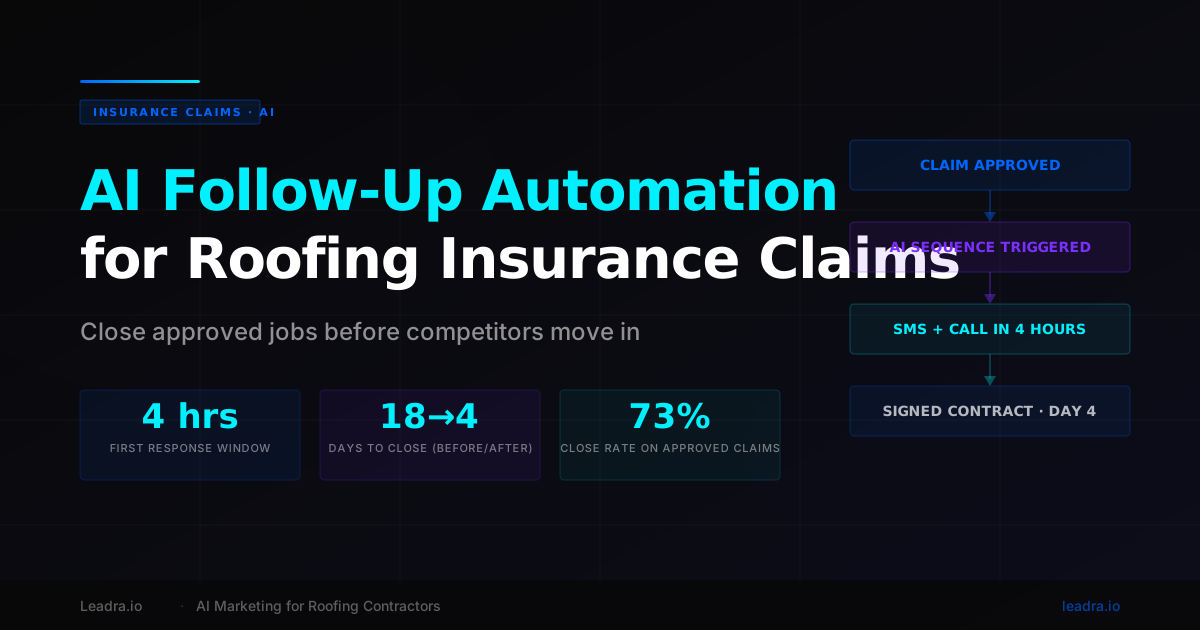
AI follow-up automation for roofing insurance claims closes that gap. It detects approval signals, triggers a multi-touch outreach sequence within hours, and handles booking, reminders, and objection follow-up automatically — so the contract lands before a competing estimator even schedules their visit. This guide covers how the system works, what signals it monitors, the 5-stage follow-up sequence, and the results roofing contractors in Charlotte and the Carolinas are seeing in 2026.
Why Approved Claims Sit — and Why Roofing Contractors Lose Jobs They Already Earned
After an adjuster approves a roof replacement claim, most homeowners don't call their roofing contractor immediately. They receive an approval letter or email, skim it, and set it aside. Life continues. They intend to call but don't. According to data from storm restoration contractors across the Carolinas, the average time from claim approval to signed contract — without active follow-up — is 14-21 days. During that window, the homeowner receives an average of 3-4 competing estimates.
The contractor who did the original inspection and helped the homeowner file the claim has no inherent advantage unless they follow up first. Homeowners in the post-approval window are comparison shopping, not loyal. They tend to sign with whoever makes the process feel easiest — and that's usually the contractor who reached out most recently, not the one who showed up first. See how AI qualifies roofing leads by claim viability before the inspection.
The Approved Claim Window
Avg. days approval to signature
14-21
Without active follow-up
Competing estimates received
3-4
During the approval window
Close rate with 4-hr AI follow-up
73%
On confirmed approved claims
4 Approval Signals AI Follow-Up Systems Monitor
The challenge with post-approval follow-up is knowing when the approval happened. Most roofing CRMs don't have a direct line to the carrier — so the signal has to come from other sources. AI follow-up systems monitor four channels simultaneously:
Homeowner return call — claim outcome captured on first sentence.
The most direct signal is a return call from the homeowner. AI voice agents are trained to open return calls with a claim status check: 'Have you heard back from your insurance company about your claim?' If the homeowner confirms approval, the AI captures the approval amount, the adjuster's scope notes, and the check issue date — and immediately flags the record in the CRM for the follow-up sequence to trigger. This is the fastest and most reliable signal: the homeowner is already on the phone, already in the mindset of moving forward.
Public adjuster partnership referrals.
Many roofing contractors in storm markets maintain relationships with independent public adjusters (PAs) who manage the claim negotiation on behalf of homeowners. When a PA closes a negotiation and the carrier issues a final approval, they notify their contractor network. AI follow-up systems accept these referral signals via a simple intake form or API and trigger the same sequence as a homeowner return call — with the added advantage that the PA often provides the exact approval amount and check issue date.
Field canvassing data — adjuster visit date logged.
During storm canvassing, field reps often note when an adjuster is scheduled or has recently visited a property. The AI follow-up system monitors these canvassing records and triggers a check-in call 7-10 days after the logged adjuster visit date. The check-in call script confirms claim status — approved, pending, or denied. Approved claims immediately enter the follow-up sequence. This converts raw canvassing activity into a structured post-approval pipeline without any additional field effort.
CRM lead aging — time-triggered check-in on stalled inspection leads.
Qualified leads who went through an inspection but haven't signed in 10-14 days are statistically in the post-approval consideration window. The AI triggers an automatic check-in on day 12 of silence: 'Hi [name], this is [company] — we wanted to follow up on your roof inspection. Have you received any update from your insurance company?' The call routes to a human if the homeowner confirms approval, or logs a return callback request if they're still waiting. This prevents approved leads from aging out of the pipeline undetected.
The 5-Stage AI Follow-Up Sequence for Approved Roofing Claims
Once an approval signal fires, the sequence runs on a defined schedule — no manual intervention needed. Here's how it works across a 7-day window:
Hour 0-4: Outbound SMS immediately after signal fires
The system sends a personalized SMS within 4 hours of the approval signal: 'Hi [name], we heard back about your insurance claim — congrats on the approval. We'd love to get you on the schedule before the busy season fills up. Want to pick a time this week?' The message is conversational, not corporate. It includes a direct calendar booking link to reduce friction. Homeowners who click and book skip the rest of the sequence — the job is on the calendar.
Hour 4-6: AI outbound call if no SMS response
If no booking link is clicked within 4 hours of the SMS, the AI places an outbound call. The call script is warm and specific: it references the inspection, the storm date, and the approval. It asks whether the homeowner wants to schedule the contract signing appointment this week or next. If the homeowner answers, the AI handles the appointment booking directly and confirms via SMS. If no answer, the AI leaves a concise voicemail and logs the attempt.
Day 2: Second SMS with social proof
If no appointment is booked after the day-1 attempts, the system sends a second SMS on day 2: 'We've wrapped up 14 insurance jobs in [neighborhood/city] since the storm — happy to walk you through what the process looks like from here. It's usually 2-3 days from signing to crew scheduling.' The social proof element (14 jobs completed nearby) builds confidence and reduces the homeowner's perceived risk of moving forward.
Day 4: AI call — estimate appointment focus
The day-4 call pivots from check-in to scheduling. The AI presents two specific appointment windows: 'I have time Thursday at 10am or Friday at 2pm — which works better?' Presenting two options instead of asking 'when works for you?' consistently improves booking rates. If the homeowner raises an objection — 'I'm getting other estimates' or 'I'm not sure yet' — the AI has trained responses that address each objection without pressure.
Day 7: Final SMS — urgency without pressure
The day-7 message is the last automated touchpoint before the lead enters a manual sales handoff queue: 'Last check-in from us — if you'd like to move forward with your approved claim before crew availability tightens up, just reply or call [number]. We'll take it from there. No pressure either way.' This message works because it is honest, non-pushy, and creates mild urgency without manufactured scarcity. It leaves the relationship intact even if the homeowner doesn't book.
Manual Follow-Up vs. AI Automation on Approved Insurance Claims
Most roofing companies handle post-approval follow-up the same way: the estimator or office manager calls the homeowner once, leaves a message, and waits. Here's what that approach costs compared to a structured AI sequence:
| Metric | Manual Follow-Up | AI Follow-Up Sequence |
|---|---|---|
| Time to first contact after approval | 1-5 days (if remembered) | Under 4 hours (automatic trigger) |
| Number of follow-up attempts | 1-2 (staff bandwidth limit) | 5 across 7 days (voice + SMS) |
| Objection handling | Depends on staff skill | Trained scripts for top 6 objections |
| Leads lost to competitor during window | High — unmonitored approval gap | Low — first contact within hours |
| Average days from approval to signed contract | 14-21 days | 3-6 days |
| Close rate on confirmed approved claims | 30-40% | 65-75% |
| Staff time required per lead | 20-40 min/lead over 2-3 weeks | Under 5 min (review + confirmation only) |
The close rate gap between manual and automated follow-up compounds over a full storm season. A roofing company with 60 approved claims per season and a 35% manual close rate closes 21 jobs. The same company with AI follow-up at a 70% close rate closes 42 jobs — from the same pipeline, with the same inspection team, at no additional lead acquisition cost. See the full AI lead generation system for local service businesses.
Case Study: Charlotte Roofing Contractor Cuts Close Cycle from 18 Days to 4 Days
Client Story
A 6-crew roofing operation serving south Charlotte and Union County ran a tight inspection operation — their lead qualifier was strong and their close rate on inspections was above average. But their post-approval follow-up was manual: the office manager called approved leads once, left a message, and waited. Their average time from claim approval to signed contract was 18 days. During that window, they were consistently losing 35-40% of approved jobs to competitors who showed up with estimates before the homeowner called back.
Leadra.io deployed a 5-stage AI follow-up sequence triggered by four approval signals: homeowner return calls captured by their existing AI voice agent, a partnership with two local public adjusters who sent referral alerts on closed claims, CRM aging alerts on leads 12+ days post-inspection, and a new canvassing data field for adjuster visit date. Within the first storm event after deployment — a June 2026 hail event across the Waxhaw and Marvin corridors — the system handled 34 confirmed approved claims.
Of the 34 approved claims, 25 booked estimate appointments from the AI sequence. Of those 25, 24 converted to signed contracts. Average time from approval signal to signed contract: 4.2 days. The remaining 9 leads entered a manual sales handoff queue on day 8. The team closed 3 of those manually — for a total of 27 closures from 34 approved claims, a 79% close rate. Their prior-season rate on the same type of pipeline was 41%.
Approved claims handled
Contracts signed
Close rate
Avg. days to close
The revenue impact: at an average job value of $12,800, the difference between 14 closures (manual baseline) and 27 closures (AI follow-up) is $166,400 in additional revenue — from the same pipeline, on the same storm event, with no additional advertising spend.
The owner's note: "We were winning the inspection and losing the contract. Now we're in the homeowner's messages within a few hours of their approval — before anyone else even knows the claim cleared. That's the whole game."
What AI Follow-Up Automation Costs for Roofing Insurance Claims in 2026
Pricing depends on whether you're adding a follow-up layer to an existing AI stack or building the full system from scratch:
- —5-stage follow-up sequence for confirmed approved claims
- —SMS + outbound AI voice call automation
- —Calendar booking integration (direct appointment scheduling)
- —CRM record update on each touchpoint
- —Day-8 manual handoff alert to sales team
- —Up to 100 active approved claim sequences per month
Best for: Contractors with an existing AI voice agent or CRM who want follow-up automation added on top
- —AI voice agent (24/7 inbound + outbound) with claim qualification scoring
- —4-channel approval signal monitoring (return calls, PA referrals, canvassing, CRM aging)
- —5-stage post-approval follow-up sequence
- —Objection handling scripts for top 6 homeowner objections
- —CRM sync (JobNimbus, AccuLynx, Jobber, or custom)
- —Monthly close rate and revenue attribution reporting
Best for: 3-8 crew operations with no existing AI stack who want an end-to-end roofing insurance pipeline
- —Everything in Full System
- —Automated adjuster appointment coordination and supplement follow-up
- —Public adjuster partnership referral intake integration
- —Post-storm canvassing data ingestion with adjuster visit tracking
- —Carrier-specific close strategy notes per lead
- —Priority routing for active water intrusion claims
Best for: Multi-crew operations where insurance replacement is the primary revenue model
At $9,000-$14,000 average insurance replacement job value, closing two additional jobs per storm event covers the cost of the full system for the entire season. The follow-up layer — the $400-$800/month add-on — typically pays for itself from a single closed claim that would have gone to a competitor. See the full AI implementation cost breakdown for service businesses.
How to Get AI Follow-Up Running Before the Next Storm Event
Setup takes 7-10 business days from kickoff to live. Here's what that looks like:
1. Map your approval signal channels.
List every way your company currently learns that a claim has been approved: homeowner callbacks, PA partnerships, field canvassing notes, CRM records from prior inspections. For each channel, define the trigger condition — what event or data point confirms approval? This mapping session typically takes 1-2 hours and determines which of the four signal types are available in your current workflow.
2. Connect your CRM and booking calendar.
The follow-up sequence needs to write touchpoint records to your CRM and book directly into your estimator's calendar. Setup requires API access to your CRM (JobNimbus, AccuLynx, Jobber, or Google Sheets) and a calendar integration (Google Calendar, Calendly, or ServiceTitan scheduling). Integration setup takes 2-3 business days once credentials are provided.
3. Train the objection handling scripts to your market.
The top 6 homeowner objections in post-approval follow-up are: 'I'm getting other estimates,' 'I want to wait until my check arrives,' 'My neighbor used a different company,' 'I need to talk to my spouse,' 'Is this price going to change?' and 'I'm worried about my deductible.' Review and adjust the default script responses to match your pricing, timeline, and sales approach. This takes 1-2 hours with your estimator.
4. Set your manual handoff threshold and escalation rules.
Define when a lead exits the AI sequence and enters a human follow-up queue. Day 8 is the standard handoff point, but high-value leads (approval amounts over $15,000 or RCV policies) often warrant human contact on day 3 instead. Set escalation rules for emergency signals: active leaks, homeowner expressing urgency, or same-day booking requests should always route to a human immediately regardless of sequence stage.
5. Run 5 dry-fire tests before the first live storm event.
Test with simulated approval signals on 5 different lead types: high-value RCV policy, standard claim, PA referral, canvassing trigger, and CRM aging alert. Verify that each signal type fires the correct sequence, the booking link works, CRM records are created, and the manual handoff alert reaches the right person on day 8. Fix routing errors before they happen with real homeowners.
Charlotte roofing contractors targeting the I-485 corridor, Cabarrus County, and Union County should have their follow-up system live before spring storm season in March and again before fall convective storm season in September. The cost of a 14-day approval gap is paid in lost contracts — not subscription fees. Pair follow-up automation with an AI voice agent for full storm cycle coverage.
Frequently Asked Questions
What is AI follow-up automation for roofing insurance claims?
AI follow-up automation for roofing insurance claims is a system that triggers a multi-touch outreach sequence the moment an approved claim signal appears — from a homeowner callback, a public adjuster referral, a canvassing trigger, or a CRM aging alert. It sends SMS and makes AI outbound calls within hours of approval, books the estimate appointment, and handles reminder sequences until the contract is signed — so the roofing contractor reaches approved claimants before competing contractors can schedule their own estimates.
How do roofing contractors know when an insurance claim has been approved?
Roofing contractors learn about approved claims through four channels: (1) homeowner return calls, where the AI captures claim approval on the call; (2) public adjuster partnerships, where PAs notify the contractor network when claims clear; (3) post-storm canvassing data, where adjuster visit dates are logged and follow-up is triggered 7-10 days later; and (4) CRM lead aging alerts on inspection records 12+ days old. Integrating all four eliminates manual follow-up entirely.
How long does it take for homeowners to sign a roofing contract after insurance approval?
Without active follow-up, homeowners wait 14-21 days after claim approval before signing a roofing contract — during which they receive 3-4 competing estimates. Roofing companies that reach approved claimants within 4 hours of the approval signal and run a 5-touch follow-up sequence over 7 days close at 65-75% — compared to 30-40% for contractors who follow up manually with one or two calls.
How much does AI insurance claim follow-up automation cost for roofing contractors?
AI insurance claim follow-up automation costs $400-$800/month as a standalone follow-up layer, or $900-$1,500/month as part of a full AI voice plus follow-up system. At an average of $9,000-$14,000 per insurance replacement job, closing one additional job per storm event more than covers the monthly cost. Most contractors see a positive return within the first storm week of deployment.
The approved claim window is the most valuable — and most wasted — moment in insurance roofing. The inspection is done, the claim is real, the homeowner has money coming in. What happens in the next 4-14 days determines whether that job goes on your books or a competitor's. AI follow-up automation compresses that window, eliminates the manual outreach burden on your office, and puts your company at the top of the homeowner's list before the competing estimates arrive.
At Leadra.io, we build AI follow-up systems for roofing contractors in Charlotte and across the Carolinas. Setup takes 7-10 business days. The system runs on your existing phone number and CRM. We can have your approved claim follow-up sequence live before the next weather event.
Built for Roofing Contractors
Stop Losing Approved Claims to Competitors Who Follow Up Faster
We'll set up your AI follow-up sequence before the next storm event. Every approval signal monitored. First contact within 4 hours. Five-touch follow-up across 7 days. Your crew closes jobs your competitors never get a shot at.