Ask three dental practices what they pay for an AI receptionist and you'll get three different numbers, and none of them are wrong. A solo practice with one doctor and 350 calls a month has a completely different cost profile than a six-location DSO routing calls across three different practice management systems.
Most pricing pages quote a single flat number, which either scares off small practices that don't need that much infrastructure or under-quotes DSOs that need far more. The actual driver of AI receptionist cost isn't your specialty or your city — it's your practice size: how many providers, how many locations, and how many calls actually come in.
This guide breaks down real pricing ranges for solo practices, multi-doctor groups, and DSOs, plus the specific factors within each tier that push the price up or down.
Why Practice Size Drives the Price More Than Anything Else
An AI receptionist's cost is built on three things that all scale directly with practice size: call volume, schedule complexity, and integration depth.
That's why the honest answer to "how much does an AI receptionist cost" starts with "how big is your practice," not a single number pulled from a pricing page. See the general AI receptionist cost guide for dental offices for a breakdown of what's typically included at each tier.
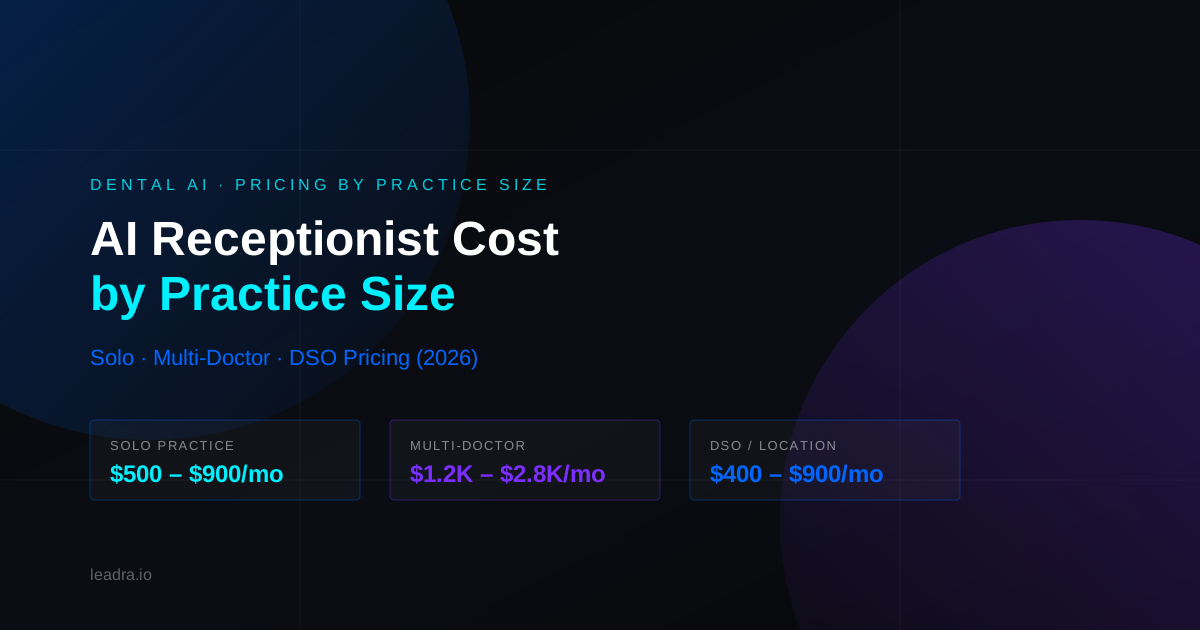
Solo Practice: $500 – $900/Month
A single-doctor practice is the simplest and cheapest tier to configure. One calendar, one location, one PMS instance.
What's typically included.
24/7 call answering, appointment booking and rescheduling, insurance and hours FAQs, new patient intake, and basic after-hours emergency triage.
What pushes it toward $900.
A second provider's calendar (hygienist or associate dentist), a two-way PMS integration instead of read-only, or multilingual support for Spanish-speaking patients.
What keeps it near $500.
Under 400 monthly calls, a single simple schedule, and a read-only integration that checks availability without writing back into the PMS.
For most solo practices, this replaces a $2,800-$3,500/month full-time front desk hire, or supplements an existing front desk so calls stop going to voicemail during lunch and after 5 PM.
Multi-Doctor Group Practice: $1,200 – $2,800/Month
A group practice with 2-6 providers under one roof needs the AI to do more than book a slot — it needs to route each call to the right provider, procedure, and operatory without human intervention.
What's typically included.
Everything in the solo tier, plus multi-provider routing logic, procedure-specific scheduling rules (some procedures need longer chair time or a specific hygienist), and a two-way PMS integration as standard, not an upsell.
What pushes it toward $2,800.
Five or more providers, a dedicated treatment coordinator workflow for case acceptance follow-ups, or call volume above 1,500 per month.
What keeps it near $1,200.
Two to three providers with overlapping schedules and a single PMS instance shared across the whole practice.
This tier is also where Dentrix and Open Dental integration depth starts to matter most, since a live two-way sync across multiple providers' calendars is where scheduling conflicts actually happen if the integration is shallow.
DSO / Multi-Location: $400 – $900 Per Location, Volume-Priced
DSOs and multi-location groups price differently than single-site practices. Instead of one flat monthly fee, most vendors quote a per-location rate that drops as the location count climbs, since the core routing engine and reporting layer are built once and replicated across sites.
3-5 locations.
Typically $700-$900 per location per month, since each site may still run its own PMS instance and needs individual integration work.
6-14 locations.
Often $500-$700 per location, once shared infrastructure and a standardized PMS rollout are in place across most sites.
15-plus locations.
Frequently negotiated down to $400-$600 per location, with centralized reporting across all sites and a dedicated account manager included at no extra charge.
DSOs should also budget for a one-time rollout cost per location during onboarding, since each site's specific scheduling rules, insurance networks, and emergency protocols need to be configured individually even when the underlying platform is shared. See the full DSO multi-location AI rollout guide for a site-by-site implementation timeline.
Side-by-Side: Pricing by Practice Size
| Practice Type | Monthly Cost | Typical Call Volume |
|---|---|---|
| Solo practice (1 provider) | $500 – $900/mo | Under 500/mo |
| Multi-doctor group (2-6 providers) | $1,200 – $2,800/mo | 500 – 1,500/mo |
| DSO, 3-5 locations | $700 – $900/location | 1,500 – 3,000/mo |
| DSO, 6-14 locations | $500 – $700/location | 3,000 – 7,000/mo |
| DSO, 15+ locations | $400 – $600/location | 7,000+/mo |
Case Study: 4-Location Charlotte Group Sizes Its AI Receptionist Correctly the Second Time
Client Story
A four-location general dentistry group in the Charlotte metro area first signed with a vendor quoting one flat rate of $1,800/month regardless of location count. Two of the group's locations ran Open Dental and two ran Eaglesoft, but the vendor's flat quote had only budgeted for a single integration build. Three months in, two locations were still on manual booking because the second PMS integration was never properly finished.
Leadra.io re-scoped the project on a true per-location basis: $800/location for the two Eaglesoft sites needing full two-way integration, and $650/location for the two Open Dental sites where the integration work was more straightforward. Total monthly cost came out to $2,900 — higher than the original flat quote, but every location actually had a working, fully-integrated AI receptionist instead of two locations running on a workaround.
Within 60 days, all four locations were booking directly through the AI with zero manual intervention, and the group's front desk staff reallocated roughly 15 hours a week previously spent on phone triage to in-office patient care coordination.
Locations fully automated
Manual booking calls/week
Front desk hours freed/wk
Monthly AI cost
The lesson generalizes beyond this one group: a flat quote that ignores per-location integration differences almost always means someone's location gets shortchanged. Ask any vendor to price per location and per PMS, not as a single bundled number.
How to Budget Correctly for Your Practice Size
Pull your actual call volume.
Most PMS and phone systems log inbound call counts. Get the real monthly number instead of guessing — it's the single biggest input into an accurate quote.
List every PMS instance across your locations.
If you're multi-location, note which system runs at each site. Mixed systems mean separate integration work, not one build reused everywhere.
Decide read-only vs. two-way integration.
Read-only (checks availability only) is cheaper but requires staff to manually confirm bookings. Two-way (books and writes back to the PMS) costs more but removes the manual step entirely.
Ask for a per-location or per-provider quote, not a flat number.
If a vendor gives you one price regardless of size or location count, ask them to break it down. A quote that doesn't scale with your actual complexity is a red flag either way.
Run a 30-day pilot before signing an annual contract.
Most legitimate vendors will let you pilot at one location or with a monthly contract first. Confirm real call handling accuracy before committing multi-location pricing.
Whatever tier you land in, compare the total AI receptionist cost against what a live answering service would run for the same call volume — for after-hours emergency coverage specifically, see how answering services and AI receptionists actually compare on emergency calls.
FAQ: AI Receptionist Cost by Practice Size
Why does AI receptionist pricing vary so much between dental practices?
Pricing scales with call volume, number of operatories, and how many locations need coverage — not a flat per-practice fee. A solo practice fielding 300 calls a month needs far less infrastructure than a 12-location DSO routing thousands of calls across different PMS instances. Vendors that quote one flat number regardless of size are usually underbuilding for large practices or overcharging small ones.
How much should a solo dental practice expect to pay for an AI receptionist?
Most solo practices land between $500 and $900 per month for a fully configured AI receptionist handling scheduling, insurance FAQs, and after-hours triage. The lower end fits practices under 400 calls a month with one operatory schedule to manage; the upper end applies once you add multilingual support or a second provider's calendar.
Do multi-location DSOs get a per-location discount on AI receptionist pricing?
Yes, typically. Most vendors price DSOs on a per-location basis that drops as location count increases, since the initial PMS integration and call-routing logic get built once and replicated. A 3-location group might pay $700-$900 per location, while a 15-plus location DSO often negotiates $400-$600 per location.
What's the single biggest factor that changes the price beyond practice size?
Practice management system integration depth. A read-only integration that just checks open slots costs far less than a two-way integration that writes appointments and syncs data live into Dentrix, Open Dental, or Eaglesoft. Practices that need the deeper integration should budget an extra $150-$400 per month on top of the base tier for their size.
Get Priced for Your Actual Practice
See What an AI Receptionist Actually Costs at Your Size
Leadra.io prices by your real call volume, provider count, and PMS setup — not a generic tier. Get a number built for your practice, not the average.