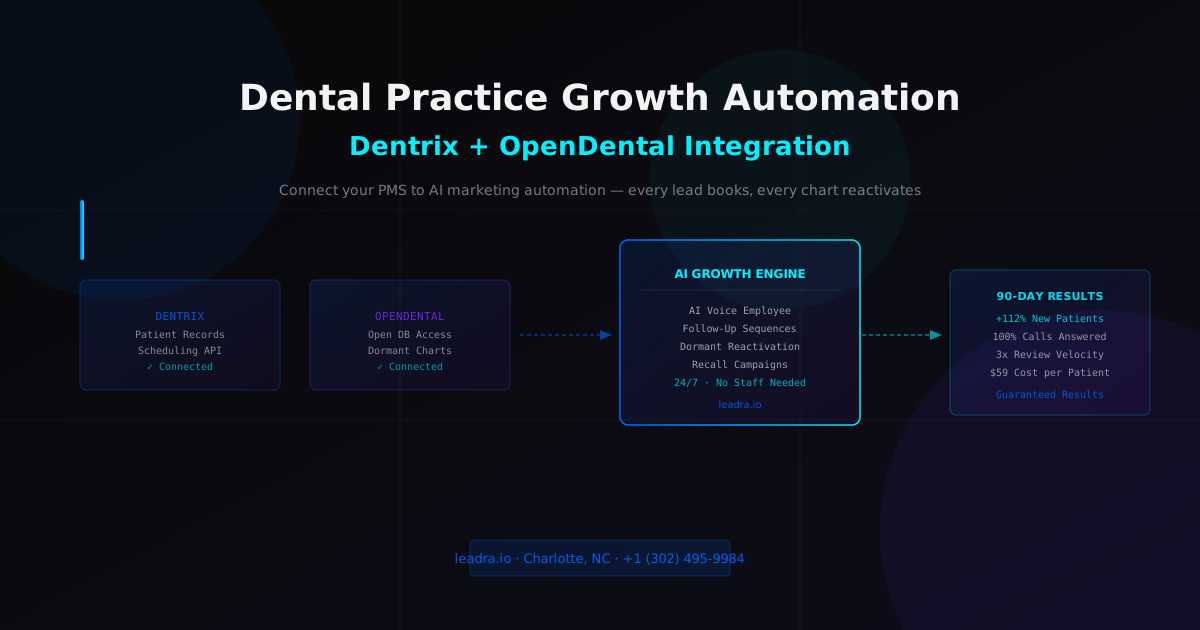
Most dental practices run two completely separate systems: a practice management software (PMS) that owns the schedule, patient records, and billing — and a marketing stack that has no idea any of that data exists. The result is a broken workflow where front desk staff manually copy-paste lead information into Dentrix or OpenDental, guess at follow-up timing, and send recall campaigns to patients who came in three weeks ago.
The practices growing fastest in 2026 closed that gap. They connected their AI marketing automation directly to their PMS — and every step of the patient journey, from first call to confirmed appointment to six-month recall, now runs without human handoffs.
This guide covers exactly how dental practice growth automation works with Dentrix, OpenDental, and Eaglesoft — what connects, what it takes to set up, and what results to expect in the first 90 days.
Why Your PMS Is the Most Underused Growth Tool in Your Practice
Dentrix and OpenDental hold everything an AI marketing system needs to drive growth: appointment history, last-visit dates, treatment plans accepted but never scheduled, insurance carrier data, and every patient contact who has walked through your door. Most practices use 15-20% of that data — for billing and scheduling. The rest sits idle.
Consider what lives in a typical OpenDental database for a 5-year-old practice:
Dormant patients
Charts with no appointment in 12+ months — average practice has 300-600 of these, each with a mean LTV of $1,800-$4,200
Unscheduled treatment
Patients who accepted a treatment plan but never booked — average value $420-$2,800 per chart, sitting in your PMS doing nothing
After-hours leads
Missed calls, web form submissions, and online appointment requests that came in while the office was closed — typically 35-40% of all inbound contacts
No-show patterns
Patients who cancel within 48 hours at higher rates than average — identifiable before they cancel, preventable with the right reminder sequence
An AI growth system connected to your PMS turns every one of those data points into automated action. Without the integration, your marketing tools are flying blind — sending generic campaigns to people who may have booked yesterday, chasing leads that already became patients, and ignoring the 400 dormant charts that are worth more than any new lead campaign.
How Dentrix Integration Works with AI Marketing Automation
Dentrix integrates with AI marketing and automation platforms through two primary methods: direct API access via the Dentrix Integration API, and through certified third-party integration hubs that act as a middleware layer between your PMS and external tools. Both methods enable read and write access — meaning the AI system can pull scheduling data to find open slots and push confirmed appointments back into Dentrix without staff involvement.
01. Inbound Call to Appointment — Zero Manual Steps
When an AI voice employee answers an inbound call, it pulls real-time availability from Dentrix to offer actual open slots — not a generic "we'll call you to schedule." The patient confirms a time, and the appointment is written directly into Dentrix. No message pad. No sticky note on the monitor. No follow-up for the front desk to handle.
For after-hours calls — which account for 35-40% of all dental inbound contacts — this means those leads are captured and scheduled at 9 PM instead of going to a competitor's voicemail. Practices using Dentrix-integrated AI voice employees typically see a 22-31% increase in new patient bookings within the first 30 days — entirely from call volume they were already receiving but not converting.
02. Unbooked Lead Follow-Up Triggered by PMS Status
When a patient contacts the practice but doesn't book, the AI system watches Dentrix. If no appointment appears within 24 hours, a 5-step follow-up sequence starts automatically — SMS, then email, then a second call attempt — until the slot is filled or the patient explicitly opts out. No manual tracking. No CRM to check. The PMS is the source of truth.
The same logic applies to web form submissions and online appointment requests. The AI reads your Dentrix schedule, identifies the best available slot for the patient's stated need, and confirms it within 60 seconds of the form submission — whether it's 2 PM or 2 AM.
03. Automated Recall Campaigns from Last-Visit Data
The AI system reads last-appointment dates from Dentrix and segments patients into recall windows: 4-6 month cleaning recall, 12-month exam recall, and dormant patients (18+ months). Each segment gets a different message at the right time — not a monthly blast to your entire patient list regardless of whether they were in last week. This eliminates the most common recall complaint: "You keep texting me and I already have an appointment."
OpenDental: The Most Integration-Ready PMS for AI Growth Automation
OpenDental's open-source architecture makes it the most flexible PMS for AI integration. Unlike proprietary systems that require specific certified partners, OpenDental allows direct database access — which means AI automation platforms can connect to patient records, procedure histories, and scheduling without a middleware layer.
For practices on OpenDental, a full AI growth integration typically connects five data streams:
| OpenDental Data | AI Action Triggered | Revenue Impact |
|---|---|---|
| Available appointment slots | AI voice employee books in real-time | +22-31% new patient conversions |
| Last visit date > 5 months | Hygiene recall SMS sequence | 60-70% recall rate vs 30% manual |
| Accepted treatment, no appointment | Treatment follow-up campaign | $420-$2,800 recovered per patient |
| Last visit date > 18 months | Dormant reactivation sequence | 12-18% reactivation rate |
| Appointment confirmed | 24hr post-visit review request | 3x review velocity |
The integration advantage is compounding. Once the AI system knows the difference between a new patient lead, a recall-due patient, a dormant reactivation target, and a post-treatment follow-up — every message is right for that specific person. Open rates for PMS-segmented campaigns run 40-55% versus 18-22% for broadcast lists. Booking rates from those campaigns are 3-4x higher. Read how AI-powered dormant patient reactivation works to understand how PMS data drives these results.
Real Numbers: Charlotte Dental Group Adds 34 New Patients Per Month Without Adding Staff
Client Story
A 3-dentist group practice in Charlotte's Dilworth neighborhood had been running OpenDental for 6 years. Their new patient count had plateaued at 28-33/month despite spending $3,800/month on Google Ads. Their front desk was handling 80-90 inbound calls per day — answering about 65% of them, with everything after 5 PM going to voicemail.
The OpenDental audit revealed: 412 dormant charts with last visits between 18-36 months, 67 patients with accepted but unscheduled treatment plans (average plan value: $1,940), and a 38% after-hours call rate with less than 20% callback success.
Leadra.io connected AI growth automation directly to their OpenDental database. AI voice employee deployed for 24/7 call handling with direct scheduling access. Dormant reactivation campaign launched to 412 charts in week 3. Unscheduled treatment follow-up sequences activated for all 67 open treatment plans.
New patients/mo
30
64
Treatment accepted
$14k/mo
$38k/mo
After-hours booked
4/mo
31/mo
Cost per patient
$127
$59
90-day results. Leadra.io monthly investment: $2,200 — replacing $3,800/month in Google Ads that was no longer scaling.
The front desk headcount did not change. The clinical team did not change. What changed was that the practice's OpenDental data started working for growth — not just billing — for the first time in six years. The 412 dormant charts alone drove 47 reactivation bookings in 90 days. That's revenue that was already in the database, doing nothing.
What It Takes to Set Up PMS-Integrated AI Automation
The biggest misconception about PMS integration is that it requires an IT project. For practices on Dentrix, OpenDental, or Eaglesoft, a full AI growth integration typically goes live in 5-7 business days. Here is what the setup process actually looks like:
Access + Data Mapping
Integration credentials are provisioned for your specific PMS. The AI system maps your appointment types, procedure codes, insurance carrier list, and provider schedule to the AI voice employee's knowledge base. Your front desk does not need to do anything — this is done by the integration team.
Sequence Configuration
Follow-up sequences are built for each patient segment: new leads, unbooked same-day contacts, recall-due patients, dormant charts, and post-treatment follow-ups. Each sequence uses PMS triggers — not timers — so messages fire based on actual chart status, not arbitrary delays.
AI Voice Employee Training + Live Test
The AI voice employee is trained on your practice specifics: FAQs your callers ask, insurance carriers you accept, emergency protocols, and which provider handles which procedure types. Test calls are run before full deployment. Your team reviews 3-5 call recordings and approves the AI before any patient hears it.
Practices that stall on setup typically have one bottleneck: access to PMS admin credentials. If you have your Dentrix or OpenDental admin login ready on day one, the integration goes live in under a week. See what AI receptionist deployment costs for dental offices to understand the full pricing picture before you commit.
Frequently Asked Questions
Can AI marketing tools integrate directly with Dentrix?
Yes. Dentrix exposes patient data and scheduling via its API and third-party integrations. AI marketing systems connect through certified integration partners to read available appointment slots, write confirmed bookings, pull patient contact data for follow-up sequences, and flag dormant charts based on last-visit date. The integration is read/write — meaning a patient can go from inbound call to confirmed appointment in Dentrix without a human touching the keyboard.
Does OpenDental support AI automation integrations?
OpenDental is one of the most integration-friendly practice management systems available. Its open-source architecture means AI automation platforms can connect directly to patient records, appointment slots, and procedure histories without relying on a proprietary API layer. This makes OpenDental ideal for practices that want to deploy a full AI growth stack — AI voice employee, follow-up automation, recall campaigns, and review requests — all triggered from real PMS data rather than a disconnected CRM.
How long does it take to set up PMS-integrated AI automation for a dental practice?
A full Dentrix or OpenDental integration typically takes 5-7 business days from start to live deployment. Day 1-2 is read access verification and data mapping. Day 3-4 is follow-up sequence configuration and AI voice employee training on your specific practice. Day 5-7 is live testing with real calls before full deployment. Practices that have integration-ready PMS credentials available from day one are live in under a week.
What is the ROI of connecting AI marketing automation to Dentrix or OpenDental?
Practices with PMS-integrated AI automation see 40-60% more new patients booked from the same lead volume versus disconnected marketing tools. The key drivers: zero manual data entry, dormant patient reactivation campaigns pulling directly from last-visit dates, and follow-up sequences that know whether a contact is a new patient or returning patient. Average cost-per-patient drops from $180-$380 (Google Ads only) to $62-$115 when AI automation is connected to PMS scheduling.
Stop Treating Your PMS and Your Marketing as Two Separate Systems
Every dental practice running Dentrix or OpenDental is sitting on a growth engine that is mostly turned off. The data is there — dormant charts, unscheduled treatment, after-hours contacts, recall windows — but without integration, none of it drives action. Your front desk chases leads manually, sends recalls to patients who were in last week, and watches after-hours calls go to voicemail.
PMS-connected AI growth automation changes the math. Every data point in your Dentrix or OpenDental database becomes an automated action: a booking, a follow-up, a reactivation, a review request. The front desk handles the complex cases. The AI handles everything else — including the 35-40% of contacts that were coming in after hours and converting at near-zero rates.
Practices that connect their AI marketing to their PMS in 2026 will have a structural advantage over every competitor still running disconnected systems by 2027. The gap compounds: higher booking rates mean more patients, more patients mean more reviews, more reviews mean higher organic ranking, higher ranking means lower cost-per-patient. It starts with the integration. Learn more about how the AI voice employee connects to your PMS from day one.
Dentrix · OpenDental · Eaglesoft · 90-Day Guarantee
See What Your PMS Data Can Drive in 90 Days
Free 30-minute audit. We pull your practice's dormant chart count, unscheduled treatment value, and after-hours call rate — and show you exactly what an integrated AI system will return. Guaranteed 90 new patients in 90 days or you don't pay.
Leadra.io
AI marketing agency — Charlotte, NC · Published May 29, 2026