A family spends three Saturdays browsing your lot. They love a $112,000 Class A. They have questions about towing capacity and slide-out clearances. They call Tuesday at 7pm. Nobody answers. They Google a competitor, get a human on the phone in 45 seconds, and put a deposit down before the week is out.
RV buyers don't shop on a dealership schedule. They research on Sunday afternoons, they call in the evenings after work, and they make decisions when the excitement is fresh — not when it's convenient for your sales team. According to the RV Industry Association, 68% of RV inquiries happen outside of traditional business hours. The dealership that answers first closes the deal 71% of the time — not the one with the best price or the widest inventory.
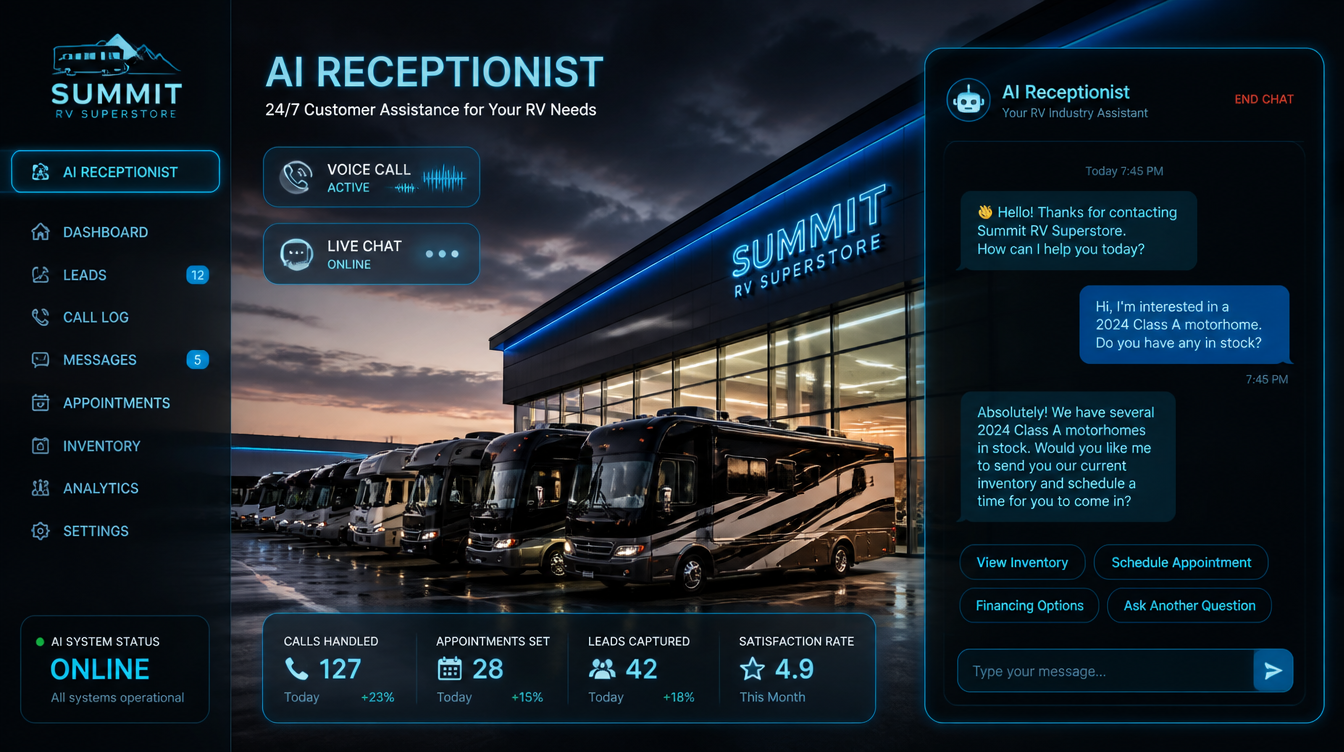
An AI receptionist for an RV dealer answers every call, text, and web inquiry the moment it comes in — any time of day, any day of the week. This guide covers exactly what it does, what it costs in 2026, and what dealerships in Charlotte and across the country are seeing after 90 days of using one.
Where RV Deals Die Before a Salesperson Ever Picks Up the Phone
The gap between a buyer's first contact and a real conversation with your team is where most RV deals are lost. It has four predictable failure points that every dealership hits regardless of inventory quality or marketing spend.
After-hours calls go to voicemail and the buyer moves on by morning.
RV purchases are emotionally driven decisions. A buyer who calls at 7pm on a Friday is at peak motivation — they've been thinking about their next camping trip all week. If that call goes to voicemail, the motivation window starts closing immediately. By Monday, they've visited two competitor websites, watched YouTube reviews, and possibly made a deposit somewhere else. The voicemail they left you is an afterthought.
Website and form leads sit for hours before anyone follows up.
The average RV dealership responds to a web inquiry in 4-8 hours. The average buyer expects contact within 15-30 minutes. A lead that waits 6 hours for follow-up is 8x less likely to convert than one reached in 5 minutes. Most dealers don't have the staffing to hit that window during peak inquiry periods — evenings, weekends, and the spring season when half your annual volume comes in.
Sales floor is overwhelmed during peak weekends and can't handle all inquiries.
When a new shipment arrives or a sale runs, inquiry volume spikes. Your team is with customers on the floor. Calls come in, texts pile up, and web leads stack in the CRM. By end of day, serious buyers who couldn't get through have found another lot. The problem isn't lack of interest — it's that your communication bandwidth has a ceiling your inquiry volume exceeds on the days that matter most.
Warm leads go cold because no one executes consistent follow-up.
A buyer who asked specific questions about a fifth wheel but didn't commit is your most valuable pipeline contact. They know exactly what they want. They just need time and the right nudge. Without a follow-up system, that lead decays over 3-7 days and disappears. Manual follow-up depends on a salesperson remembering to do it at the right time — which doesn't happen consistently when the floor is busy.
6 Things an RV Dealer AI Receptionist Handles Every Day
A real AI receptionist for an RV dealership is not a website FAQ bot. It's the full communication layer between your buyers and your team — operating around the clock across every channel your buyers use. Here's exactly what it handles:
24/7 Inbound Call and Text Answering
Every call that hits your dealership line — whether it's 10am Tuesday or 9pm Saturday — is answered within two rings. The AI greets callers by your dealership name, handles the inquiry in natural conversation, and routes or books based on intent. A buyer asking about a specific travel trailer gets current stock details, pricing, and a walkthrough appointment. A service customer gets their maintenance visit scheduled. A financing inquiry gets captured and routed to your finance desk with full context.
The system handles inbound from phone, SMS, Google Business Profile chat, and website contact forms through a unified backend. Nothing falls through. Every contact gets an immediate, useful response — not a recording, not a hold queue, not a promise of a callback that may never come.
Buyer Qualification Before a Salesperson Touches the Lead
The AI runs a structured qualification conversation the moment a buyer makes contact — asking about budget range, preferred RV type (Class A motorhome, Class B van conversion, Class C, travel trailer, fifth wheel, toy hauler), intended use (weekend camping, full-time living, cross-country travel), party size, and timeline to purchase. It takes 90-120 seconds and feels like a natural conversation, not a survey.
The result lands in your CRM as a scored, complete lead profile. When your salesperson calls back, they already know the buyer wants a 38-foot diesel pusher, has a $160,000 budget, is financing through a credit union, and wants to be on the road for a fall cross-country trip. That context turns a cold callback into a warm, efficient conversation with a buyer who already feels understood.
Walkthrough and Test Drive Appointment Booking
When a qualified buyer is ready to see a unit, the AI books the walkthrough or test drive directly into your calendar in real time. No back-and-forth over available slots. The buyer picks a time, gets a confirmation with your lot address and which units they'll be seeing, and receives a reminder 24 hours before their visit.
Dealerships using automated booking see appointment show rates of 78-88%, compared to 50-65% for verbal commitments made over the phone. The difference is the written confirmation, the reminder, and the fact that the buyer chose their own time — instead of being told when to show up. Show rate is the single biggest driver of monthly close volume for most RV lots.
Warm Lead Follow-Up Sequences
A buyer who asked about a specific Class C but didn't commit gets entered into a 5-touch follow-up sequence automatically. Touch 1 goes out 24 hours later — a direct message referencing the exact unit they asked about and inviting questions. Touch 2 at day 3 includes similar in-stock units and a note about current financing rates. Touch 3 at day 7 is a direct ask: "Are you still considering the 2026 Winnebago, or can I point you toward something better suited?"
RV dealers running this sequence recover 18-28% of leads that went quiet after initial contact — buyers who were serious but needed time or one more relevant touchpoint. Manual follow-up captures maybe 5% of those because it requires a salesperson to remember, prioritize, and execute at exactly the right moment.
Service Department Scheduling and Seasonal Reminders
Your service department is recurring revenue that doesn't require new customer acquisition. Owners of RVs you sold are prime candidates for de-winterization in spring, pre-trip inspections, slide-out maintenance, generator service, and winterization in fall. The AI sends reminders at the right calendar triggers, books appointments directly, and confirms the slot — all without a service advisor having to chase customers down.
Dealerships with automated seasonal service reminders see service department revenue increase 20-35% in year one — not from new customers, but from existing owners who simply needed to be reminded at the right time and found the booking process easy. RV service is seasonal and predictable, which makes it ideal for automation.
Trade-In Lead Capture and Valuation Routing
Trade-in inquiries are some of your highest-intent leads. A buyer asking what their current RV is worth is actively planning an upgrade purchase. The AI captures the full trade-in picture: current unit year, make, model, mileage, slide-out count, condition, and what they're looking to move into. It routes that context to your appraisal team immediately and follows up with the buyer within 2 hours with an expected response window.
Trade-in leads handled with fast, structured follow-up convert at 3.5-4x the rate of generic inventory inquiries. The buyer has already decided they're upgrading — the only question is which dealership earns the deal. Speed and structure win this category every time.
No System vs. Hiring More Staff vs. AI Receptionist: The Real Numbers
| Area | No System | Hire Staff | AI Receptionist |
|---|---|---|---|
| Monthly cost | Free | $3,500–$5,500/mo | $500–$2,500/mo |
| Hours of coverage | Business hours only | 40 hrs/week max | 24/7/365 |
| After-hours leads answered | 0% | 0% (off the clock) | 100% immediately |
| Lead response time | 4–18 hours | Minutes during shift | Under 60 seconds always |
| Buyer qualification | Manual, inconsistent | Good during shift | 100% automated |
| Walkthrough show rate | 50–65% | 55–70% | 78–88% with reminders |
| Warm lead recovery | 5% (if remembered) | 10–15% manually | 18–28% automated |
| Service dept. revenue | Reactive only | Manual outreach | +20–35% from reminders |
Case Study: Carolina RV Dealer Adds 5-8 Extra Sales Per Month Without Hiring
An RV dealership in the Charlotte, NC area was selling 18-24 units per month with a five-person sales team. Marketing was running. Inventory was strong. But the owner knew leads were coming in that weren't converting, and the close rate was stuck at 12% despite consistent traffic and ad spend.
A call log audit over 30 days showed 52% of inbound inquiries arrived outside business hours or on weekends. Of those, 58% went to voicemail. Of the voicemails, fewer than 40% received a follow-up call within 24 hours. That was the leak — not the product, not the pricing, not the ads. The dealership was generating the interest and failing to capture it.
After-hours answer rate
42%
100%
Lead response time
7.4 hrs
< 1 min
Walkthrough show rate
54%
83%
Monthly unit sales
19-23 units
24-31 units
Leadra.io deployed an AI receptionist that answered every call and text — day or night — qualified inbound buyers through a structured conversation, and booked walkthroughs directly into the sales team's calendar. Every after-hours lead that came in received an immediate response and a confirmed appointment before Monday morning.
In the first 30 days, 47 after-hours and weekend leads that would have gone to voicemail were captured, qualified, and converted into booked walkthroughs. The sales team closed 16 of those — at an average unit price of $74,000, that represented $1.18M in revenue from leads the dealership was already generating but not answering.
By month 3, the dealership was consistently closing 24-31 units per month — 5-8 more than before — without adding a single salesperson. The AI receptionist cost $1,600/month. The first additional RV sale covered 10 months of the fee.
What an AI Receptionist Costs for an RV Dealer in 2026
Pricing varies based on call volume, CRM integration complexity, and feature set. Here's how the tiers break down for RV dealerships:
Basic
$500–$800/mo
- →24/7 inbound call and SMS answering
- →Lead capture and CRM routing
- →Walkthrough and test drive appointment booking
- →Confirmation and reminder texts
- →Best for: smaller volume dealers (under 10 units/month) who need after-hours coverage without added headcount
Standard
$800–$1,600/mo
- →Everything in Basic
- →Structured buyer qualification before salesperson callback
- →5-touch warm lead follow-up sequences
- →Trade-in lead capture and appraisal routing
- →Service department scheduling and seasonal reminders
- →Best for: mid-volume dealers selling 10-25 units/month with active online inquiry volume
Full AI Receptionist
$1,600–$2,500/mo
- →Everything in Standard
- →Voice AI for inbound calls (full conversation, not IVR menus)
- →Multi-channel: phone, SMS, Google Business Profile, and website chat
- →Full CRM integration with lead scoring and pipeline stage tracking
- →Service department revenue tracking and attribution reporting
- →Best for: high-volume dealers, multi-location groups, or any dealership with an active service department
What to Look for When Evaluating an AI Receptionist for Your RV Dealership
Most AI receptionist platforms were built for dentists, law firms, and home service businesses. RV dealerships have specific requirements around high-ticket sales cycles, complex inventory, seasonal demand spikes, and buyers who often need education before they commit. Here's what separates a system that actually moves units from one that creates busywork:
Real conversation ability — not an IVR phone tree
A buyer calling about a specific Class A is not going to press 1 for sales and 2 for service. They want to talk about that RV — slide configurations, fuel type, floor plan options, towing ratings. The AI needs to hold a real contextual conversation about your actual inventory, not route people through menu options. If a vendor shows you an IVR-style demo, that's not an AI receptionist.
CRM integration that writes into your existing system
The lead data the AI captures needs to land in whatever system your team already uses — whether that's an RV-specific DMS, a generic CRM, or a custom setup. If the AI receptionist creates a parallel tracking system, your sales team will ignore it within 60 days. The data has to flow into their existing workflow without requiring them to learn a new tool.
Experience with high-ticket, long-cycle sales
Selling a $95,000 fifth wheel is a different motion than booking a haircut. The AI's conversation design needs to reflect that — building trust over the call, handling competitor comparisons, understanding that an RV buyer may take 3-8 weeks from first contact to signed paperwork. Ask any vendor specifically about their experience with RV dealers or other high-ticket retail categories before signing.
Measured results from current RV dealer clients
Ask for specific before-and-after data from active dealership clients: after-hours answer rate, lead response time improvement, walkthrough show rate, and whether monthly close volume changed. Any vendor that can't produce those numbers from real dealerships after 60 days is not measuring what matters — and won't be able to tell you whether the system is working for you either.
Frequently Asked Questions
What does an AI receptionist for an RV dealer actually do?
An AI receptionist for an RV dealer answers inbound calls and texts 24/7, qualifies buyers by budget, RV type, and intended use, books walkthrough and test drive appointments, answers inventory and financing questions, follows up on leads that went quiet, and sends service scheduling reminders — all automatically. It closes the gap between when a buyer calls and when a salesperson is available, which is where most RV deals are lost.
How much does an AI receptionist cost for an RV dealership?
AI receptionist systems for RV dealers typically cost $500 to $2,500 per month depending on inventory size, call volume, and features included. A basic system covering inbound call answering, lead capture, and appointment booking starts around $500-$800/month. A full system with voice AI, multi-channel follow-up sequences, trade-in capture, and service department automation runs $1,600-$2,500/month. Most dealerships recover the cost within 30-45 days from a single additional unit sale.
Can an AI receptionist qualify RV buyers before a salesperson calls them back?
Yes. An AI receptionist for RV dealers runs a structured qualification conversation via text or voice — asking about budget range, preferred RV type, intended use, party size, and purchase timeline. It scores the lead and delivers a complete profile to the salesperson before they call back. Your team only calls buyers who are serious, which increases close rates and cuts time wasted on unqualified inquiries.
How does an RV dealer AI receptionist handle after-hours and weekend leads?
RV buyers do most of their research on evenings and weekends — exactly when dealerships are closed or short-staffed. An AI receptionist engages those leads the moment they call or text, answers questions about specific units, captures contact information, qualifies the buyer, and books a walkthrough or test drive for the next available slot. When your team arrives Monday, there are confirmed appointments in the calendar — not a stack of cold voicemails.
Related Reading
Ready to Stop Losing RV Sales to Voicemail?
Leadra.io builds and manages AI receptionist systems for RV dealers. We handle setup, CRM integration, buyer qualification sequences, and ongoing optimization. Most dealerships close their first additional unit within 30 days of going live.