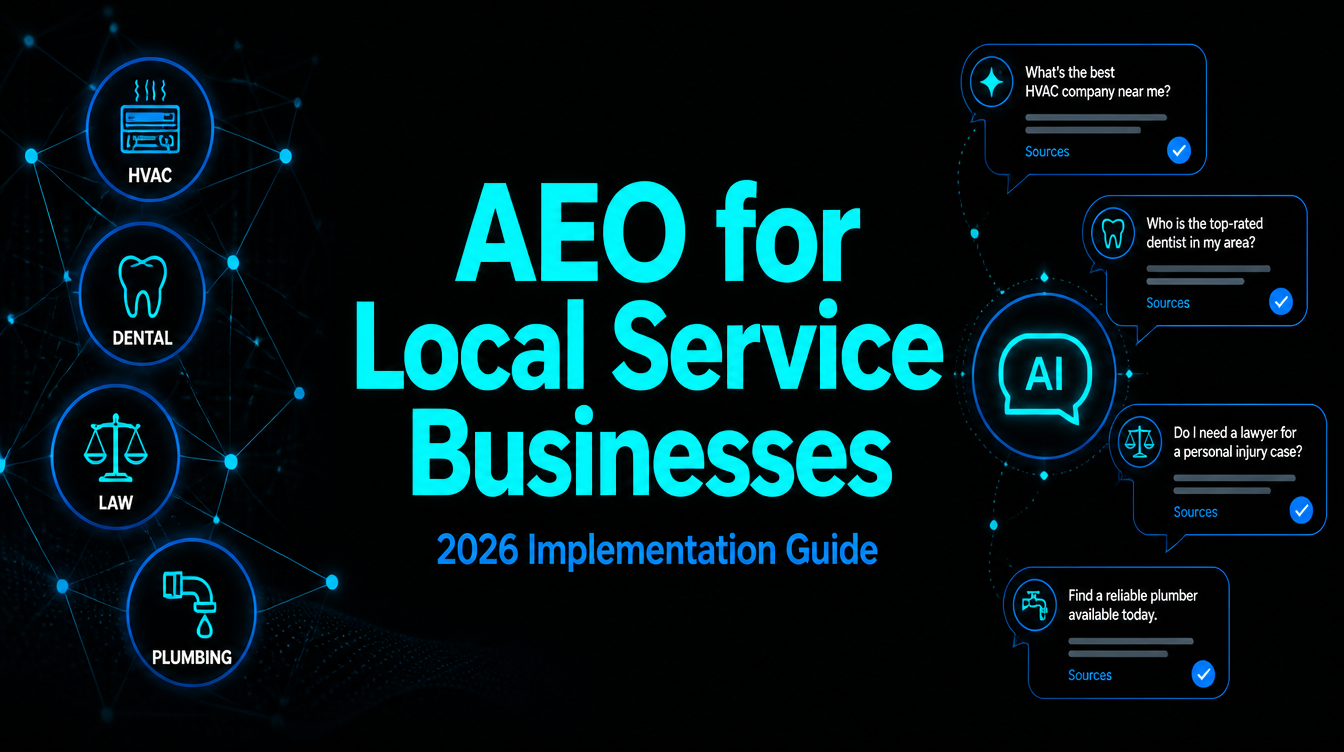
When a homeowner in Charlotte asks ChatGPT “who is the best HVAC company near me,” your company either shows up as a cited source or it doesn't. There is no middle ground. And right now, most local service businesses are invisible in that moment.
Answer Engine Optimization (AEO)is the practice of structuring your content so AI platforms — Google AI Overviews, ChatGPT, Perplexity, and Bing Copilot — pull your business as a cited source when users ask relevant questions. For national brands, AEO is a competitive advantage. For local service businesses, it's quickly becoming the difference between a phone ringing and a phone sitting silent.
Local AEO is fundamentally different from national AEO. Google AI Overviews weight geographic proximity, NAP consistency, and entity clarity when generating local answers. ChatGPT pulls from structured data and authoritative content clusters. Perplexity cites sources with fresh publication dates. Each platform has its own signals — and local service businesses that understand this are getting AI citations their competitors never will.
This guide covers the exact 6-step system we use at Leadra.io to get local service businesses cited in AI platforms. It's not theory. Every step produces a measurable output you can track.
Why Local Service Businesses Have an AEO Advantage Right Now
National AEO is crowded. Every enterprise SEO team in America is trying to get cited in AI Overviews for broad terms. Local AEO is a different game. When someone searches “emergency plumber Charlotte NC at 11pm,” the competition for that AI citation is thin. Most plumbers in Charlotte don't have FAQPage schema. Most don't have answer-first content. Most haven't published a single post about emergency plumbing in Charlotte.
That gap is the opportunity. Local queries — especially service queries with geographic modifiers — are underserved in the AI citation layer. The businesses that move first own that space for 12-18 months before competitors catch up.
According to BrightLocal's 2026 Local Consumer Review Survey, 46% of local service searches now start with an AI platform before a traditional Google search. For high-ticket services — dental implants, HVAC system replacement, estate planning — that number climbs to 61%. Your customers are asking AI before they're asking Google. If you're not in the AI answer, you're not in the consideration set at all.
The 6-Step Local AEO Implementation System
Step 1: Fix Your Robots.txt — Let AI Crawlers In
This is the most overlooked issue in local AEO. If your robots.txt blocks AI crawlers, no amount of schema or content will get you cited. Period.
Open your robots.txt file and confirm these crawlers are allowed:
User-agent: GPTBot
Allow: /

User-agent: ClaudeBot
Allow: /

User-agent: Google-Extended
Allow: /

User-agent: PerplexityBot
Allow: /

User-agent: BingBot
Allow: /
Many website builders and WordPress themes add security-focused robots.txt configurations that inadvertently block AI crawlers. Check yours before anything else.
Step 2: Add LocalBusiness JSON-LD Schema With Service Area Data
Standard LocalBusiness schema tells AI platforms who you are. Service area markup tells them where you work. Both are required for local AEO.
Your JSON-LD block should include areaServed with a list of specific cities and neighborhoods — not just your home city. For a Charlotte HVAC company, that means listing Ballantyne, Matthews, Huntersville, Concord, Mooresville, and other service areas explicitly. AI platforms use this markup to determine geographic relevance for local queries.
{
  "@context": "https://schema.org",
  "@type": "HVACBusiness",
  "name": "Your HVAC Company",
  "telephone": "+17045550100",
  "address": {
    "@type": "PostalAddress",
    "streetAddress": "123 Trade St",
    "addressLocality": "Charlotte",
    "addressRegion": "NC",
    "postalCode": "28202"
  },
  "areaServed": [
    "Charlotte, NC",
    "Ballantyne, NC",
    "Matthews, NC",
    "Huntersville, NC",
    "Concord, NC"
  ],
  "priceRange": "$$"
}
Use the most specific @type available: Dentist, HVACBusiness, Plumber, LegalService. Specific types outperform generic LocalBusiness in AI citation matching by a significant margin. See our deep-dive on JSON-LD schema for AI search citations for complete type references.
Step 3: Add FAQPage Schema With Local-Intent Questions
FAQPage schema is the single highest-ROI AEO tactic for local service businesses. It directly tells AI platforms: “here is a question, here is the answer.” AI systems are literally designed to pull this structure.
The key is writing questions the way your local customers actually ask them — with location included. Not “how much does AC replacement cost?” but “how much does AC replacement cost in Charlotte NC?” Not “what should I look for in a dentist?” but “how do I find a dentist in Charlotte that accepts Blue Cross?”
Target 4-6 questions per page. Each answer should be 60-120 words — complete enough to stand alone as an AI citation, concise enough that AI platforms don't need to truncate it.
Every service page on your site needs its own FAQPage schema block — not just your homepage. A plumber's drain cleaning page needs questions about drain cleaning in Charlotte specifically. The water heater page needs water heater questions. Each page is a separate AEO citation opportunity.
Step 4: Rewrite Service Pages With Answer-First Formatting
Traditional service pages start with brand stories, awards, and vague benefit statements. AI platforms skip all of that. They pull from the first 1-3 sentences of any section that answers a specific question.
Answer-first formatting means: every H2 section opens with a direct, one-sentence answer to the implicit question in that heading — before any context or elaboration. If your H2 is “HVAC Replacement Cost in Charlotte,” your first sentence should be “HVAC system replacement in Charlotte costs between $4,800 and $12,500 depending on system size, brand, and installation complexity.” Then you expand.
| Format | Traditional | Answer-First (AEO) |
|---|---|---|
| Section opener | “Our team has been serving Charlotte families since 2009...” | “AC tune-ups in Charlotte cost $89-$149 for a standard residential unit.” |
| H2 content | Brand story + general benefits | Direct answer + supporting data + context |
| AI citation rate | Low — AI skips preamble | High — AI pulls opening sentence directly |
| Avg. word count | 300-500 words per page | 800-1,500 words per page |
Step 5: Build a Topical Authority Cluster Around Each Service
A single well-optimized page won't win AI citations for competitive local terms. AI platforms look for topical authority — evidence that your site is a serious, comprehensive source on a topic, not a one-page shop.
For each core service, build a cluster of 4-6 related pages that link to each other. A dental practice targeting Charlotte patients should have: a main dental services page, a new patient FAQ page, a specific procedure page (implants, Invisalign), a cost guide for Charlotte, a “how to choose a dentist in Charlotte” blog post, and a patient FAQ page. These pages link to each other with descriptive anchor text.
This cluster structure sends two signals simultaneously: authority (you've covered this topic thoroughly) and relevance (all this content is about dentistry in Charlotte specifically). AI platforms weight both signals when determining which local businesses to cite.
For a broader overview of how this integrates with your overall search strategy, see our AI SEO strategy guide for 2026.
Step 6: Publish Freshly-Dated Content on a Consistent Schedule
Perplexity and Bing Copilot weight content recency heavily. A page dated 2023 loses citations to a page dated last month, even if the content is nearly identical. ChatGPT's knowledge base updates continuously pull from indexed content. Google AI Overviews factor freshness into local service queries.
For local service businesses, this means: update your core service pages with a “Last reviewed: [Month Year]” date, publish at least one new blog post per week in your topical cluster, and refresh your FAQ schema answers quarterly with current pricing, policy, or process data.
Freshness doesn't mean rewriting everything. Updating a price range, adding a new FAQ question, or adding a recent case study result is enough to trigger a re-crawl and refresh the publication date signal.
AEO by Industry: What Each Business Type Needs to Win
The 6-step system applies across all local service businesses, but the specific content and schema configuration differs by industry.
Dental Practices
Use @type: Dentistschema. Target cost questions (“how much do dental implants cost in Charlotte”) and insurance questions (“dentist in Charlotte that accepts Delta Dental”). Build separate pages for each procedure. Include AggregateRating schema with real Google review counts — AI platforms weight review density for dental citations. A Charlotte dental practice using this system went from 3 to 22 new patient inquiries per month in 11 weeks.
HVAC Contractors
Use @type: HVACBusinessschema. Target emergency queries (“HVAC company open at night Charlotte”) and seasonal queries (“AC tune-up before summer Charlotte NC”). Publish cost guides specific to Charlotte's climate. Emergency-intent queries return AI citations fastest — often within 2-4 weeks — because competition is low and intent is extremely clear.
Law Firms
Use @type: LegalServiceschema with practice area specificity. Target question-format queries (“do I need a lawyer after a car accident in Charlotte”). Publish FAQ pages for each practice area with North Carolina law specifics. AI platforms cite lawyers who provide authoritative, jurisdiction-specific answers — generic legal content gets skipped.
Plumbers
Use @type: Plumberschema. Target urgency queries (“emergency plumber Charlotte NC”, “water heater replacement cost Charlotte”). Create separate pages for each service type — drain cleaning, water heater, slab leak — with Charlotte pricing data. Emergency plumbing has some of the fastest local AEO citation timelines because user intent is extreme and the search is highly localized.
Charlotte Case Study: From Zero AI Citations to 17 Per Week
A Charlotte pediatric dental practice came to Leadra.io in March 2026 with no AI citation presence. They were ranking on Google page 2 for most target terms. Their website had no schema markup, no FAQ sections, and thin service pages averaging 280 words. AI crawlers were partially blocked in their robots.txt.
What We Changed (Over 8 Weeks)
- ✓Fixed robots.txt — allowed GPTBot, ClaudeBot, Google-Extended, PerplexityBot
- ✓Added Dentist JSON-LD schema to all pages with 9 Charlotte-area neighborhoods in areaServed
- ✓Added FAQPage schema to 7 service pages — 4-6 questions each, all location-specific
- ✓Rewrote 6 service pages with answer-first formatting (avg 1,100 words, up from 280)
- ✓Published 8 blog posts in a pediatric dental Charlotte topical cluster
- ✓Updated dateModified on all pages monthly with fresh pricing data
The fastest citations came from emergency and location-specific queries: “pediatric dentist open Saturday Charlotte NC” and “children's dentist in Ballantyne.” Broader terms like “best pediatric dentist Charlotte” took 10-11 weeks. Every week new citations appeared for queries they had never targeted explicitly — because topical authority compounds.
AEO for Charlotte NC Service Businesses
Charlotte's population growth — over 100,000 new residents since 2022 — means an enormous volume of “near me” queries from people who are new to the market and don't have established service providers. These users default to AI platforms first. They ask ChatGPT who to trust. They ask Perplexity for comparisons. They ask Google for the best option nearby.
Charlotte's neighborhood diversity creates hyper-specific query opportunities: “HVAC company in Ballantyne,” “dentist in NoDa Charlotte,” “plumber in Steele Creek.” These neighborhood-specific queries have almost no AEO competition. A service business that builds neighborhood-specific landing pages with proper schema owns these queries with very little effort.
Leadra.io is based in Charlotte. We know the local search landscape. See how we approach AI marketing for Charlotte businesses across every major service category.
Frequently Asked Questions
What is Answer Engine Optimization for local businesses?
Answer Engine Optimization (AEO) for local businesses is the practice of structuring your website content so that AI platforms — Google AI Overviews, ChatGPT, Perplexity, and Bing Copilot — cite your business when users ask local service questions. For example, when someone in Charlotte asks ChatGPT 'who is the best HVAC company near me,' AEO determines whether your business appears as a cited source. It requires LocalBusiness JSON-LD schema, FAQPage schema, answer-first content formatting, and topical authority across a cluster of related pages.
How is local AEO different from national AEO?
Local AEO targets geography-specific queries like 'best dentist in Charlotte NC' or 'emergency plumber near me,' while national AEO targets broad industry terms. Local AEO requires NAP consistency, city-specific LocalBusiness schema with areaServed markup, and content that explicitly names neighborhoods and service areas. AI platforms weight geographic proximity and entity clarity heavily for local queries, so local businesses often see AEO results faster — typically within 4-8 weeks — compared to 3-6 months for national terms.
Which local service businesses benefit most from AEO?
AEO delivers the strongest ROI for service businesses where customers ask AI systems before calling: dental practices, HVAC contractors, plumbers, law firms, and medical spas. These businesses field high-intent questions ('how much does AC replacement cost in Charlotte') that AI platforms answer directly from cited sources. Any local service business with average ticket values over $300 should prioritize AEO.
How long does it take for a local business to get AEO results?
Most local service businesses see their first AI Overview or ChatGPT citations within 6-10 weeks when they implement the full AEO system: LocalBusiness and FAQPage JSON-LD schema, answer-first content on 4-6 pages, AI crawler access in robots.txt, and consistent NAP data. Highly specific local queries — 'emergency HVAC repair Charlotte NC at night' — can appear in AI citations within 2-4 weeks because competition is low. Businesses that already rank on Google page one often see AEO citations 30-50% faster.
Get Your Local AEO Audit Free
We'll review your site's current AI citation presence, identify your biggest local AEO gaps, and show you exactly which queries you should be winning. No sales pitch — just data.