Best AI CRM for Kitchen and Bath Remodelers: Estimate Follow-Up Tools Compared (2026)
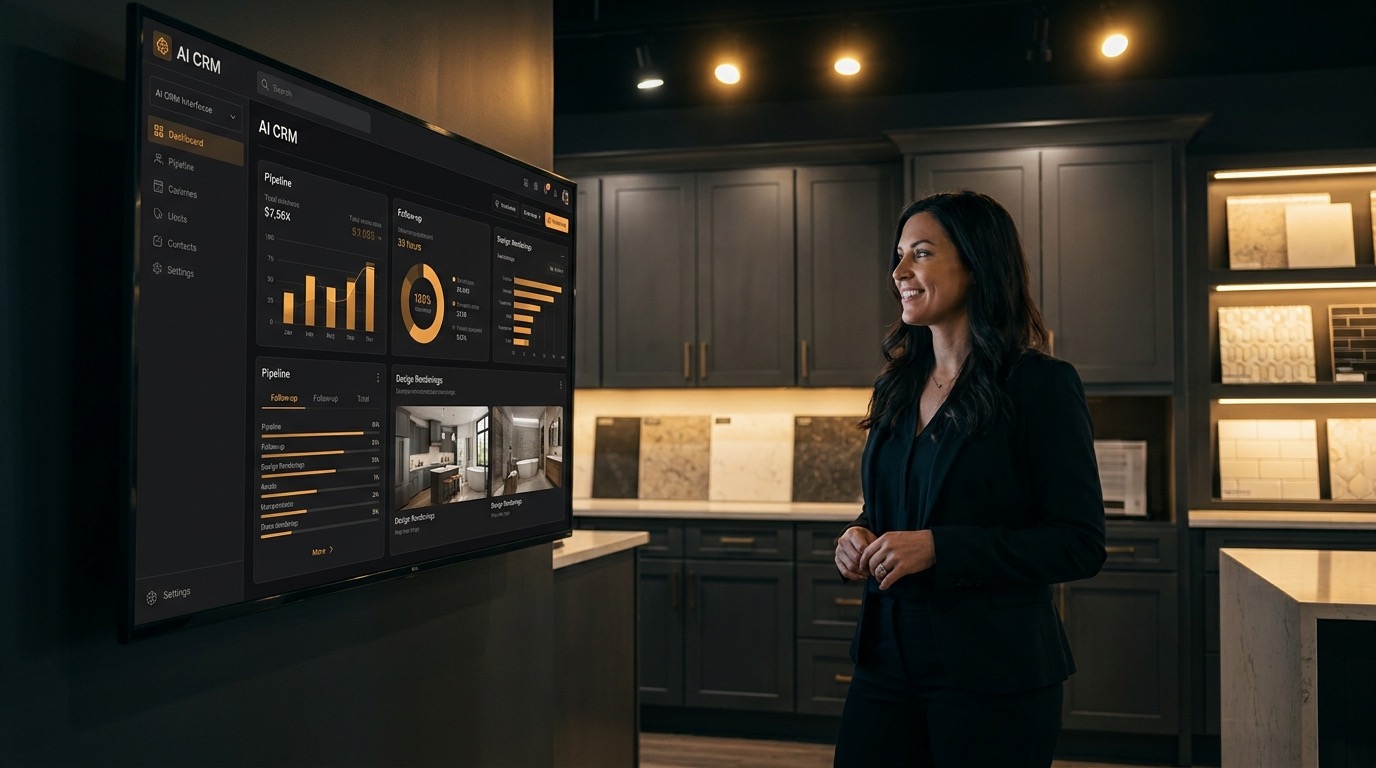
Most kitchen and bath remodelers already have a CRM. It sits mostly unused after the first month, because logging every call and typing out a follow-up email takes time nobody on a small design team actually has during a busy spring selling season. The deals fall through a gap the software was supposed to close.
A spreadsheet or a $30-a-month CRM board can hold a list of names. It cannot notice that a homeowner's quote has gone eleven days without a reply, cannot draft a follow-up that references the exact cabinet door style and countertop material they picked out, and cannot pick up the phone when a new inquiry comes in during a selections appointment. That gap between “the software tracks it” and “someone actually follows up” is where most stalled kitchen and bath quotes die.
This guide breaks down what the best AI CRM for kitchen and bath remodelersactually does differently from a generic sales CRM, how it stacks up against tools like Pipedrive and HubSpot, what it costs, and how to evaluate a system before you switch off whatever you're using today.
Why a Generic CRM Isn't Enough for a Kitchen and Bath Business
Tools like Pipedrive, HubSpot, and Close were built for sales teams with dedicated reps whose entire job is working a pipeline. A kitchen and bath remodeler's pipeline gets worked by a designer who is also running a selections appointment, an owner who is also on a jobsite, or an office manager juggling four other roles. The CRM ends up being a place where leads get entered - if there's time - and then sit.
Three specific gaps show up over and over in remodeling businesses running a generic CRM:
Gap 1: Nothing captures the lead automatically. A generic CRM is a database, not a receptionist. If a homeowner calls during a showroom walkthrough and no one picks up, that inquiry never makes it into the pipeline at all - the CRM has nothing to show for a deal that never got entered.
Gap 2: Follow-up still depends on a human remembering to do it.Task reminders help, but a reminder that says “follow up with Johnson kitchen quote” still requires someone to stop what they're doing, recall the details of the project, and write a message from scratch. On a busy week, that reminder gets snoozed, then forgotten.
Gap 3: Reporting doesn't match how remodeling actually sells.Generic deal stages like “Contacted” and “Proposal Sent” don't capture what matters in a kitchen and bath sale - whether a homeowner has completed their selections, whether a design quote is inside or past the typical 2-5 week comparison window, or whether an allowance overage is holding up a signature.
The best AI CRM for kitchen and bath remodelers closes all three gaps by pairing the pipeline with an AI system that captures, qualifies, and follows up automatically - instead of asking an already-stretched team to do it manually on top of everything else.
Spreadsheet vs. Generic CRM vs. AI CRM: A Direct Comparison
Here is how the three most common setups compare for a kitchen and bath remodeling business specifically:
| Capability | Spreadsheet | Generic CRM | AI CRM |
|---|---|---|---|
| Captures missed calls automatically | No | No | Yes, 24/7 |
| Qualifies project type and budget | Manual | Manual | Automatic |
| Sends follow-up without a human trigger | No | Reminder only | Yes, automated |
| References specific selections in follow-up | No | No | Yes |
| Design-quote close rate (typical) | 14-20% | 18-25% | 33-45% |
| Setup time | None | 1-3 weeks | 7-10 days |
| Monthly cost (typical single-location) | $0 | $50-$400 | $700-$1,400 |
The monthly cost line looks like the AI CRM loses on price. It doesn't once you factor in what each option actually returns. A generic CRM at $200/month that recovers zero additional design quotes costs you every stalled deal it fails to catch. An AI CRM at $1,000/month that recovers even two extra kitchen quotes a quarter, on a $38,000 average project value, pays for well over a year of the service from that recovered revenue alone.
What a Purpose-Built AI CRM Actually Does: 5 Components
Not every tool marketed as “AI CRM” does all of this. Here is the full system that separates a purpose-built platform from a generic pipeline with an AI label bolted on:
Component 1: Automatic Lead Capture and Logging
Every call, text, and web form submission gets answered and logged into the pipeline the moment it arrives - no manual data entry, no missed calls during a showroom walkthrough or after hours. The AI voice agent greets the homeowner, confirms project type, and creates the lead record automatically.
Component 2: Budget and Project-Type Qualification
The AI asks the qualifying questions your team would ask - rough budget range, cabinet style preference, timeline to start - and tags the lead accordingly, so designers spend their time on selections appointments that are actually likely to close.
Component 3: Selections-Specific Follow-Up Sequences
Once a design quote goes out, the AI runs a multi-touch sequence across the real 2-5 week comparison window - a text at 3 days, an email referencing the exact cabinet line and countertop material at one week, a call at two weeks, a final check-in before the quote expires. No generic templates.
Component 4: Design Software Integration
A true AI CRM writes directly into 2020 Design, ProKitchen, Chief Architect, or a comparable platform, so designers keep working where they already do and nothing requires a second manual entry step.
Component 5: Reporting Built for the Selections Cycle
Instead of generic deal stages, reporting tracks design-quote close rate, average days to decision, and where in the comparison window quotes are stalling - the numbers that actually explain why revenue is up or down month to month.
Case Study: Switching from Pipedrive Recovers $19,000/Month
A two-location kitchen and bath remodeler in the Charlotte area had run Pipedrive for three years. Leads got entered when someone had time, follow-up tasks piled up unfinished, and the sales manager estimated roughly a third of design quotes never received a second touch after the initial send.
Leadra.io replaced the manual pipeline with a purpose-built AI CRM in 9 days: lead capture and qualification scripting, design-quote follow-up sequences mapped to their existing 2020 Design workflow, and a reporting dashboard built around design-quote close rate instead of generic deal stages.
Results after 90 days:
- →Design-quote close rate: 23% to 39%
- →Quotes receiving zero follow-up: 34% to under 2%
- →Average lead response time: 6 hours to 3 minutes
- →Monthly revenue: $198,000 to $217,000
- →Monthly system cost: $1,250 (replacing $158/month Pipedrive plan)
- →Net monthly gain: roughly $17,900 after the cost difference
The sales manager's summary: “Pipedrive told us a deal was stalled. It never did anything about it. Now the follow-up just happens, with the right cabinet and countertop details in every message, and we can finally see exactly where quotes are dying instead of guessing.”
4 Things to Check Before You Switch AI CRM Tools
1. Does it capture leads, or just track them?
Some tools sold as “AI CRM” are really just a pipeline with an AI-generated summary feature bolted on. Confirm the system actually answers calls and web forms and logs them automatically - that's the difference between capture and tracking.
2. Does follow-up reference actual project details?
A follow-up sequence that sends the same generic template to every lead performs close to what manual follow-up already gets you. Ask for a sample message and confirm it pulls in the homeowner's specific cabinet, countertop, and tile selections.
3. Does it integrate with your design software?
If the AI CRM can't write into 2020 Design, ProKitchen, or Chief Architect, your designers end up maintaining two systems - which usually means the second one gets ignored within a month.
4. Can you see design-quote close rate, not just deal count?
Deal count tells you activity happened. Design-quote close rate tells you whether the system is actually working. If a vendor can't show you that number directly, ask why.
AI CRM Pricing for Kitchen and Bath Remodelers: 3-Tier Breakdown (2026)
| Tier | Monthly Cost | What's Included |
|---|---|---|
| Core | $700-$1,200/mo | 24/7 lead capture, project qualification, automated design-quote follow-up (4 touchpoints). Best for solo remodelers and single-location showrooms. |
| Growth | $1,200-$2,600/mo | Everything in Core + design software integration, automated review generation, close-rate reporting dashboard. Best for 2-4 designer teams. |
| Enterprise | $2,600-$4,000/mo | Everything in Growth + multi-location support, local SEO content, custom qualification logic by project type, dedicated account manager. |
Add $80-$200/month for call minutes and SMS credits depending on lead volume. Most single-location remodelers land in the $900-$2,400 all-in range - typically less than what one recovered mid-size kitchen quote returns.
An AI CRM works best as one piece of a full lead generation system. For the complete picture of how capture, qualification, and follow-up fit together across every inbound channel, read our guide on the AI lead generation system for local service businesses.
If you're still deciding between platforms outside the remodeling space, our comparison of Pipedrive vs. Close vs. Zoho CRM for small businesses breaks down how generic CRMs stack up on their own terms.
For a full cost breakdown across every tier of AI adoption for this trade, see our companion guide on AI cost for kitchen and bath remodeler businesses, and for the selections-and-allowance follow-up angle specifically, read the kitchen and bath remodeler marketing automation guide.
Frequently Asked Questions
What is the best AI CRM for kitchen and bath remodelers?
The best AI CRM for kitchen and bath remodelers is one built around the estimate-and-selections cycle specific to the trade - not a general sales pipeline tool. Look for automatic capture of every call and web inquiry, budget and project-type qualification, a follow-up sequence that references the homeowner's actual selections, and reporting built around design-quote close rates rather than generic deal stages.
How is an AI CRM different from a generic CRM like HubSpot or Pipedrive for a remodeling business?
A generic CRM gives you a pipeline board and manual reminder tasks, but someone still has to notice the reminder and write the follow-up. An AI CRM automates that step entirely - it answers the inbound call, logs the project details, and sends the follow-up sequence itself, referencing the specific cabinet line and countertop material discussed in the selections appointment.
How much does an AI CRM for kitchen and bath remodelers cost?
An AI CRM for kitchen and bath remodelers runs $700-$1,400 per month for a core package with lead capture and automated estimate follow-up, and $1,400-$4,000 per month for a full system with design-software integration, local SEO content, and automated review generation. Generic CRMs cost less per seat but require you to build and staff the follow-up process yourself.
Can I keep my existing design software and add an AI CRM on top?
Yes. A well-built AI CRM integrates with the design software your team already uses - 2020 Design, ProKitchen, Chief Architect, or a comparable platform - instead of replacing it. Leads and follow-up activity sync into your existing pipeline automatically, so designers keep working in the tools they know.
Stop Losing Design Quotes to a CRM That Doesn't Follow Up
Leadra.io deploys AI CRM systems for kitchen and bath remodelers in 7-10 days, including design software integration and 30 days of live monitoring. Most businesses recover the first month's cost within their first two weeks of automated follow-up.