Most music school owners are teaching 20-30 lessons a week themselves, managing a roster of instructors, and running the business with one person handling all scheduling, billing, and parent communication. When a parent texts at 7 PM asking about piano lessons for their 9-year-old, the odds that message gets a response before the family moves on are low. They sign up with the school down the street by Saturday.
This guide answers a specific question: which AI system will actually move the numbers that matter for a music school — trial lesson bookings, trial-to-enrollment conversion, recital participation, student retention, and lapsed student reactivation — and what does it cost versus what it returns?
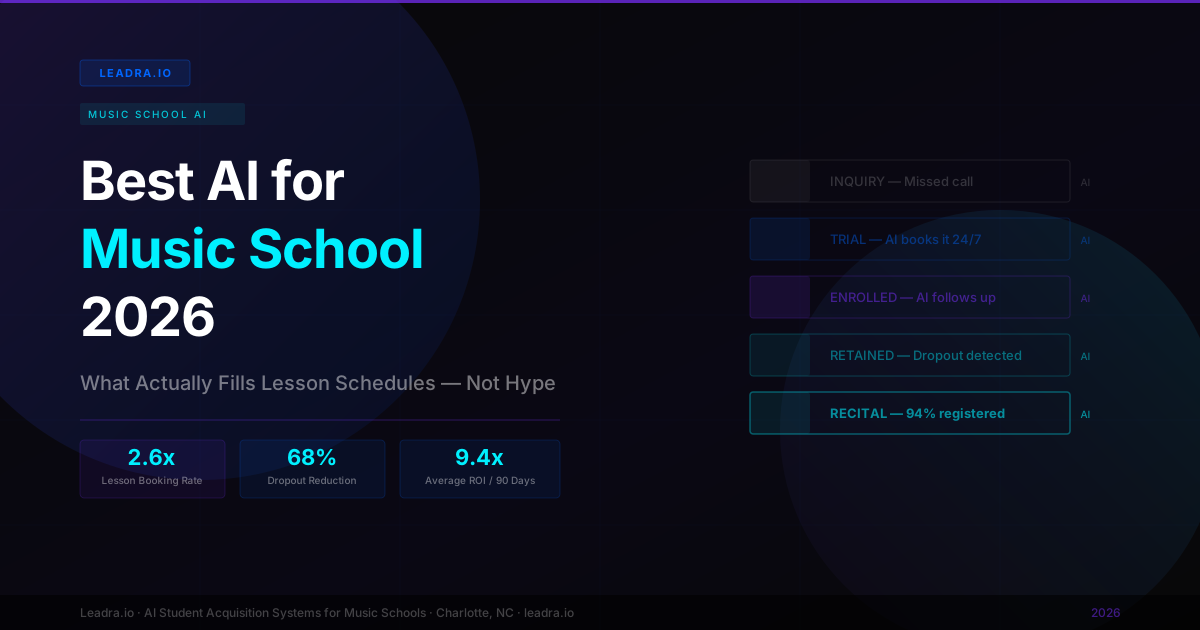
This covers the five AI capabilities that drive real revenue for music schools in 2026, how they compare to what schools handle manually today, what Jackrabbit and iClassPro integration looks like in practice, and what a Charlotte-area music school produced over 90 days running the full system.
Short answer: the best AI for a music school is not a chatbot on your website, not a CRM with drip emails, and not your scheduling software's built-in reminder. It's a connected system — inquiry capture, trial booking, conversion follow-up, recital automation, dropout detection, and reactivation — operating on live student data from your actual studio management software.
Why Most Music Schools Are Losing 30-45% of Potential Revenue to Process Gaps
The music school business model has specific revenue leak points that generic business software doesn't address. The four biggest ones appear consistently across schools regardless of size, instrument mix, or market.
Inquiry-to-trial conversion is broken by timing
Parents research music lessons in the evening when their kids are home and can weigh in. Most inquiries — texts, website form fills, voicemails — arrive between 5 PM and 9 PM. A school that responds the next morning converts 13-19% of those inquiries to booked trial lessons. An AI system that responds in seconds, answers questions about curriculum, age programs, and instructor availability by instrument, and books the trial directly converts 62-76%. For a school getting 25 monthly inquiries, that timing gap costs 11-14 trial bookings per month before anything else goes wrong.
Trial-to-enrollment dropout is a follow-up problem
The average school converts 22-30% of trial students to enrolled monthly students. The rest enjoy the first lesson and then get busy. Each unconverted trial represents $1,440-$2,880 in lost 12-month tuition value — from a lead the school already paid to acquire through ads, referrals, or intro pricing. The gap between 26% and 55% conversion is not a marketing budget issue. It's a structured 7-day follow-up sequence that most music schools run inconsistently or not at all.
Recital revenue and retention are left on the floor every cycle
Recitals are the most predictable high-value event in a music school — participation fees run $30-$80 per student, and students who perform consistently retain at 3.5x the rate of those who skip. Yet most schools register only 55-65% of eligible students per cycle. The rest don't respond to the one email blast. A structured 4-touch AI reminder sequence personalized by instrument and readiness pushes registration to 88-96% — recovering $1,500-$3,000 in missed participation revenue per recital cycle.
Student dropout is caught too late to save the relationship
The average music school loses 5-8% of active students every month. Most schools don't notice until the student has already missed 4+ consecutive lessons — by which point the family has mentally cancelled and the next billing cycle feels confrontational. Early detection at 2 missed lessons, with an automated personal outreach from the instructor, cuts that dropout rate to 1.5-2.5%. That's the difference between a school that grows and one that burns through its waitlist just to stay flat.
These four leaks compound in the same direction: your marketing and referrals bring in inquiries, your process fails to convert them to trials, your follow-up fails to convert trials to students, and your retention system fails to keep the students you worked hard to enroll. AI closes all four gaps simultaneously — without hiring more administrative staff or taking instructors away from teaching.
The 5 AI Capabilities That Move the Numbers for Music Schools
Each capability maps directly to one of the four revenue leaks above and produces a measurable outcome. Here's what the best AI for a music school does in practice:
24/7 AI trial lesson booking (voice + SMS)
Most music school inquiries come from parents researching during evenings and weekends — when your instructors are teaching and your front desk is either packed or closed. An inquiry that hits voicemail converts to a booked trial lesson at 13-19%. An AI voice and SMS booking agent that answers in seconds, explains your intro offer, checks instructor availability by instrument, and books the trial lesson directly into your scheduling system converts at 62-76%. For a school receiving 25 monthly inquiries, that's the difference between 3-4 booked trials and 15-19 booked trials — before you improve anything else. The AI handles instrument-specific routing (piano vs. guitar vs. violin), age-appropriate teacher matching, and same-session booking confirmation via text.
Trial-to-enrollment conversion automation
The first lesson is where music school revenue is made or lost. A parent books a trial, the child plays through a simple piece, the instructor wraps up warmly, and then... nobody follows up for four days. The family gets busy. The moment passes. The average music school converts 22-30% of trial students to enrolled monthly students using manual follow-up — whoever the instructor remembered to text, or whoever the front desk got to before the next lesson wave. AI runs a structured 7-day conversion sequence: a same-day post-trial message celebrating the child by name and referencing the specific song they learned, a day-3 follow-up with enrollment packages and a limited intro-month rate, and a day-7 call trigger for families who haven't responded. This pushes trial-to-enrollment conversion to 49-62% — doubling the manual rate and recovering $1,400-$3,200 per month in revenue you were leaving on the floor.
Recital and showcase event automation
Recitals are the highest-value recurring event in a music school — emotionally for students and families, and economically for the school. Participation fees run $30-$80 per student, and the students who perform in recitals retain at 3.5x the rate of those who skip. Yet most schools register only 55-65% of eligible students per recital cycle because the blast email gets buried. AI runs a 4-touch recital sequence: a personalized invite noting the student's current repertoire and readiness level, a 10-day countdown with a one-tap registration link, a 5-day nudge for families who haven't registered, and a same-week confirmation with what to expect on performance day. Registration rates climb from 58-63% to 88-96% of eligible students. For a school with 120 active students and a $50 average recital fee, that's the difference between 72 students participating ($3,600) and 112 participating ($5,600).
Early dropout detection and retention outreach
The average music school loses 5-8% of its student base every month. The pattern is almost always the same: a student goes from two lessons a week to one, then misses a week, then stops scheduling. By the time the school notices, the family has mentally moved on and a cancellation request feels imminent. AI detects the dropout signal at 2 missed lessons — not a month later. It triggers an automated retention sequence: a personal check-in text from the instructor referencing the student by name and their current piece, a motivational message tied to their next recital or milestone goal, and a scheduled call from the studio director if the family doesn't respond within 48 hours. Schools using early dropout detection reduce monthly churn from 6-7% to 1.5-2.5% — protecting $800-$2,400 in monthly recurring tuition per retained student.
Lapsed student reactivation
Former students who studied for 6-18 months and then stopped are the highest-conversion audience a music school has. They invested in an instrument. They remember enjoying it. Their child still has the guitar in the corner. Most schools send one generic 'come back!' email per year and see 4-7% return. AI runs a personalized reactivation sequence that references the last piece the student was working on, how long it's been since their last lesson, and a specific milestone they could hit in the next 2-3 months if they returned — paired with a time-limited re-enrollment offer. This converts 28-37% of students who have been inactive for 60-150 days. For a school with 50 lapsed students in that window, reactivating 14-18 of them at $120/month tuition adds $1,680-$2,160 in monthly recurring revenue from students you already built a relationship with.
Software Integration
All five capabilities connect to your studio management platform via API — Jackrabbit Music, iClassPro, Pike13, MusicTeacherHelper, or a custom Google Calendar setup. The AI reads live enrollment records, lesson attendance, and instructor schedules. It writes trial bookings, event registrations, and student notes directly to your system. Your front desk manages one platform. Parents interact with one calendar. No double-entry, no manual syncing. Integration takes 48-72 hours.
Manual Operations vs. AI: The Side-by-Side Reality for Music Schools
The gaps between what schools handle manually and what AI produces are not marginal improvements — they're the difference between a studio that grows year over year and one that replaces dropout with new enrollments just to stay flat:
| Metric | Manual / No System | AI System |
|---|---|---|
| After-hours lesson inquiry | Goes to voicemail, 13-19% convert | AI books the trial instantly, 62-76% convert |
| Trial-to-enrollment conversion | 22-30% (manual follow-up) | 49-62% with 7-day AI sequence |
| Recital registration rate | 55-63% of eligible students | 88-96% with 4-touch AI reminder sequence |
| Monthly student dropout rate | 6-7% (noticed 3-5 weeks late) | 1.5-2.5% (flagged at 2 missed lessons) |
| Lapsed student reactivation | 4-7% (generic blast) | 28-37% (personalized AI outreach) |
| Instructor scheduling conflicts | Handled manually, same-day panic | AI reroutes and notifies families in minutes |
| Staff time on inquiry + follow-up | 2-4 hours/day | Under 20 minutes (oversight only) |
| Monthly system cost | $0 (but 25-40% revenue unrealized) | $350-$2,800 |
The instructor scheduling conflict row deserves attention. Music schools run on tight instructor availability matrices — an instructor calling in sick at 3 PM can cascade into 6-8 families receiving no notification until they show up at the studio. AI detects the conflict immediately, notifies affected families by text with reschedule options, and books the makeup lesson without any manual intervention. The families who get a proactive 2-hour notice retain at significantly higher rates than families who show up to an empty room.
The staff time number is where most owners feel the immediate relief. A studio with 80-150 active students typically has one person spending 2-4 hours per day on inquiry responses, recital registration follow-ups, no-show outreach, and reschedule texts. AI handles all of it. The front desk shifts from administrative firefighting to relationship management and in-studio experience.
Case Study: Charlotte Music Studio Goes from $9,600 to $21,400/Month in 90 Days
Client Story — Charlotte, NC
A private music school in Charlotte's SouthPark area came to Leadra.io in early 2026. The owner offered piano, guitar, violin, and voice lessons with 6 instructors, 112 active enrolled students at an average of $115/month, and a waitlist of 18 families that had been sitting in Jackrabbit for 90 days with no systematic follow-up. He had two recitals per year and consistently struggled to get more than 60% of eligible students registered. His trial conversion rate was 24%, his inquiry response time averaged 11 hours, and he had 44 students in Jackrabbit marked as inactive in the last 90 days.
Leadra.io integrated with Jackrabbit Music and deployed all five AI capabilities in sequence. The trial booking agent went live first — answering parent texts and calls after hours, routing by instrument and age group, and booking trials directly into Jackrabbit. The 7-day trial-to-enrollment conversion sequence launched the following week for every trial student. Recital automation activated ahead of the school's scheduled May recital cycle. Early dropout detection began monitoring lesson attendance in real time. The lapsed student reactivation campaign ran in month 2 against the 44 inactive students.
Results across 90 days:
Monthly tuition revenue
$9,600
$21,400
Trial conversion rate
24%
57%
Monthly dropout rate
6.4%
2.0%
Lapsed reactivations
—
19 in 60 days
System cost: $1,200/month for Jackrabbit integration with AI voice + SMS trial booking, 7-day enrollment conversion sequences, recital automation (May cycle: 93% of eligible students registered vs. 61% prior cycle), early dropout detection, and lapsed student reactivation. $21,400 revenue vs. $9,600 prior = $11,800 monthly lift. ROI: 9.8x. Primary drivers: trial conversion lift (24% to 57%), dropout reduction (protecting $2,600/month in tuition), and 19 lapsed reactivations adding $2,185 in new monthly recurring revenue.
The owner noted that recital automation was the unexpected win. He'd been sending one group email blast three weeks before every recital and accepting whoever registered. The AI ran personalized sequences: a student who had been working on a Chopin piece got a different message than a beginner still on scales — with a message framing recital participation as a natural next step in their specific progression. Registration went from 61% of eligible students to 93% in that single cycle.
The dropout reduction compounds over time. Protecting 4.4% of monthly enrollment from attrition seems incremental. Over 12 months, it's the difference between a school that ends the year at 185 students and one that ends at 112 despite the same inquiry and enrollment volume.
How to Evaluate AI Systems for Your Music School: 4 Things That Matter
Not every system marketed as “AI for music schools” delivers on any of the above. Here's how to filter quickly:
Native integration with your studio management software
The system has to write trial bookings, event registrations, and student notes directly to your Jackrabbit, iClassPro, or Pike13 database — not a separate app, not a manual sync. If the AI can't read your live lesson schedule and write confirmed trial bookings directly to your instructor's calendar in real time, it can't do dropout detection, personalized recital outreach, or enrollment-based conversion follow-up. Ask: 'Does your system write confirmed trial bookings directly to my Jackrabbit instructor calendar in real time?' If the answer involves any manual step, move on.
Personalization that uses actual student data
Generic follow-up — 'Thanks for trying a lesson! We hope you'll enroll!' — converts at the same rate as no follow-up. The conversion sequences that push trial-to-enrollment rates above 50% reference the specific song the student worked on, the instructor they connected with, the next piece in their curriculum, and their child's name in every message. The dropout outreach references the student's current repertoire and their next recital milestone. This requires the AI to pull data from your actual student records — not just a name from a contact form.
Dropout detection based on lesson attendance, not billing cycles
Most studio software sends a payment failure alert when tuition is declined. That's billing failure detection, not dropout prevention. Real dropout prevention monitors lesson attendance in real time, flags the student at 2 consecutive missed lessons, and triggers instructor outreach before the family decides to quit. Ask: 'What is the trigger threshold for dropout outreach, and what data does the sequence personalize on?' If the answer is billing-based or time-based rather than attendance-based, it's not early enough to save the relationship.
After-hours voice capability, not just SMS
Music school inquiries come via text and phone call. SMS automation handles one channel. The school that captures phone inquiries after hours — with an AI voice agent that speaks naturally, answers questions about instrument availability, age programs, instructor styles, and lesson schedules, and books the trial before the parent hangs up — wins the enrollment before competitors even see the inquiry. If a system only does SMS automation, you're solving 60% of the after-hours problem.
What AI for Music Schools Costs in 2026
Pricing varies by active student count, software platform, and whether AI voice calling is included. Here's what each tier covers:
Tier 1 — Small studio (under 60 active students)
$350–$700/monthSMS trial follow-up sequences, trial-to-enrollment conversion automation, recital reminders (SMS), basic dropout detection (text-based). No AI voice agent at this tier. Best for solo instructor studios or small teams where the owner handles most incoming calls directly.
Tier 2 — Mid-size school (60-160 active students)
$800–$1,600/monthFull 5-capability system: AI SMS and voice trial booking agent, 7-day enrollment conversion sequences, 4-touch recital automation, real-time attendance-based dropout detection, lapsed student reactivation campaigns (quarterly). Jackrabbit, iClassPro, or Pike13 integration included. This is the most common tier for independent music schools.
Tier 3 — Large or multi-location school
$1,700–$3,200/monthAll Tier 2 features plus multi-location enrollment sync, instrument-specific inquiry routing, inbound call overflow during peak scheduling windows, custom curriculum-based follow-up sequences (piano vs. guitar vs. voice tracked separately), and revenue analytics by instrument and instructor.
The ROI math follows the same structure regardless of tier. Take your current monthly inquiry volume and multiply by the difference between 16% and 69% trial booking conversion — that's your additional trial potential. Multiply those additional trials by your current trial-to-enrollment rate and the improvement from 26% to 53%, at your average monthly tuition. Add the dropout you'd protect at 4% monthly churn reduction. The system cost is typically recovered within 30-45 days from enrollment conversion alone.
Related guides: AI for tutoring businesses, best AI for gym owners, and AI personal trainer client retention for context on how the same system adapts across education and fitness businesses.
Frequently Asked Questions
What is the best AI for a music school in 2026?
The best AI for a music school in 2026 is a connected system that does five things: books trial lessons 24/7 by voice and SMS, runs a structured trial-to-enrollment conversion sequence after the first lesson, automates recital and showcase event reminders and registration, detects early dropout signals and triggers retention outreach, and reactivates lapsed students with personalized sequences. It must integrate directly with your studio management software — Jackrabbit Music, iClassPro, Pike13, or MusicTeacherHelper — writing lesson bookings and schedule changes to your live system in real time. Generic chatbots and generic email marketing tools don't qualify.
How much does AI cost for a music school?
AI systems for music schools typically cost $350 to $2,800 per month depending on active student count, whether AI voice calling is included, and which software platform you use. A school with 80-160 active students doing $10,000-$18,000 in monthly tuition typically sees 7-11x ROI within 90 days — primarily from trial-to-enrollment conversion lift, no-show reduction on trial lessons, and lapsed student reactivation. The system cost is usually recovered within the first 30-45 days from enrollment conversion alone.
Can AI reduce student dropout at a music school?
Yes. The average music school loses 5-8% of its active students per month — most quietly, without any warning. AI dropout prevention detects the signal early: a student who misses 2 consecutive scheduled lessons triggers an automated outreach sequence with a personal check-in from the instructor, a motivational message tied to their current repertoire milestone, and a scheduled call if they don't respond within 48 hours. Schools using this system reduce monthly dropout rates from 6-7% to 1.5-2.5% — protecting $700-$2,200 in recurring monthly tuition per retained student.
Does AI for music schools work with Jackrabbit or iClassPro?
Yes. The AI systems that produce the best results for music schools integrate directly with Jackrabbit Music and iClassPro via API — reading live student enrollment records, lesson attendance data, and instructor schedules to power personalized outreach. The same integrations are available for Pike13, MusicTeacherHelper, and custom Google-Calendar-based studio setups. Setup takes 48-72 hours. Once live, the AI uses your actual student database so your front desk manages one system and every communication reflects real lesson and schedule data.
The Best AI for Your Music School Is the One That Fills Lesson Slots and Keeps Students
The pitch for AI in music education is getting louder. “Automate your studio” can mean a contact form responder, a scheduling email, or a full connected system that tracks every student from their first parent inquiry to their fifth year of recital performances. Only one of those moves enrollment numbers.
The five capabilities in this guide — 24/7 trial booking, enrollment conversion sequences, recital automation, dropout detection, and lapsed student reactivation — address the specific economics of a recurring-tuition studio built on student progression and relationship. They account for the timing of parent inquiries, the psychology of performance milestone motivation, and the silent attrition that compounds every month a school lets it go undetected.
Leadra.io builds and manages AI systems for music schools, arts studios, and local service businesses. We integrate with your existing studio software, go live in under a week, and back every engagement with a results guarantee — measurable improvement in enrollment conversion, dropout rate, and monthly recurring tuition, or you don't pay.
Free Studio Revenue Audit
See How Much Enrollment Your Music School Can Add With AI
30-minute audit. We calculate your inquiry-to-trial conversion gap, enrollment conversion opportunity, dropout cost, and lapsed student reactivation potential — with an ROI projection specific to your student count and monthly tuition — before you commit to anything.
Leadra.io
AI marketing agency — Charlotte, NC · Published June 20, 2026