A property manager for a 200-unit apartment complex submits a landscaping inquiry through your website on a Tuesday morning. Your office calls back Wednesday afternoon and leaves a voicemail. The AI at the competing landscaping company sent a qualification text within 90 seconds, scheduled a site visit for Thursday, and delivered a formal proposal with a portfolio pricing tier by Friday. The property manager signs with the competitor. You never knew you had a $6,500/month contract in your inbox.
This is the most expensive mistake in commercial landscaping sales. A residential homeowner is worth $150-$250 per month. A property manager overseeing a mid-size apartment complex or office park is worth $3,000-$12,000 per month — sometimes more if they control multiple sites. But most landscaping companies route both types of leads through the same intake process: a callback queue, a generic quote email, and a 14-day residential follow-up sequence that treats an HOA board contact the same as a homeowner asking about lawn edging.
Commercial leads require a completely different sales process. The buying timeline is longer. The decision often involves multiple stakeholders or board approval. The proposal needs to address liability, contract terms, and seasonal service schedules in writing. The follow-up cadence needs to align with board meeting cycles, not homeowner decision windows. Running commercial leads through residential workflows wastes the opportunity — and property managers who receive a residential-style follow-up assume you don't work at commercial scale.
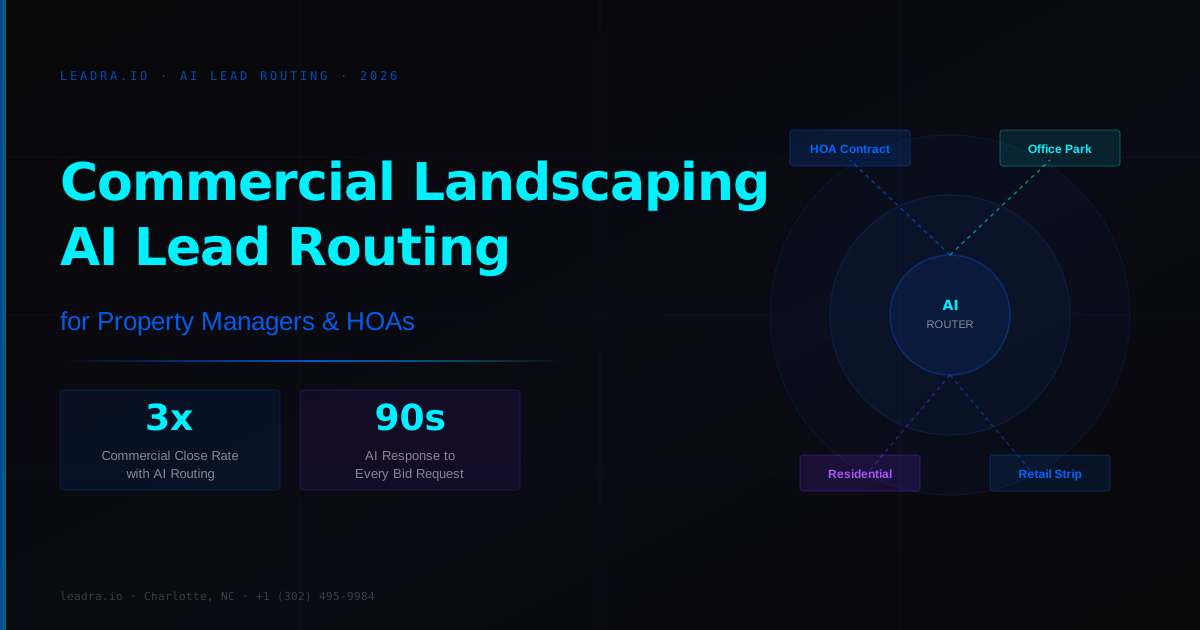
AI lead routing solves this by automatically identifying commercial intent at first contact, qualifying the lead before a human gets involved, and routing it to a dedicated commercial sales workflow designed for property managers and HOA boards. This guide covers exactly how that system works and what landscaping companies in Charlotte and across the country are gaining from deploying it.
Why Commercial Landscaping Leads Fail in Residential Sales Processes
The core problem isn't lead quality — it's workflow mismatch. Landscaping companies that generate commercial inquiries through their website, Google Business Profile, or referral network often lose those leads not because they priced wrong or had the wrong services, but because they handled the first 48 hours incorrectly.
Commercial property managers evaluate speed differently than homeowners
A homeowner requesting a lawn care quote expects a reply within a few hours. A property manager sending an RFP expects an acknowledgment within the hour and a site visit proposal within 24-48 hours. Property managers handle dozens of vendor relationships simultaneously. A slow response to their landscaping inquiry signals that your company won't be responsive on service calls, complaints, or seasonal change orders either. Studies in commercial real estate vendor management show that 74% of commercial property managers select vendors based in part on initial response professionalism — not just price.
HOA contracts require board-ready proposals, not homeowner quotes
When a landscaping company sends a one-page residential quote to an HOA board contact, the board member can't present it at their next meeting. HOA boards need formal proposals with scope of work, service frequency schedule, unit pricing breakdown, insurance certificates, and references from comparable-size communities. A residential quote format forces the board contact to go back to you for more information — introducing delay and friction that a competitor with a commercial proposal template eliminates. Landscaping companies that win HOA contracts consistently report that their proposal format was the differentiating factor, not price.
Multi-property portfolio opportunities go unrecognized
A property management company managing 12 commercial properties across Charlotte often sends one inquiry for one property. A company with no commercial qualification process never asks about the rest of the portfolio. AI lead routing identifies portfolio leads through qualification questions and triggers a portfolio pricing conversation early — presenting volume tiers across multiple locations before the prospect signs with individual vendors for each property. Missing this question at intake leaves 10 additional contracts on the table from a single inbound lead.
The fix isn't hiring a dedicated commercial sales rep — it's deploying an AI system that does the identification, qualification, and initial routing before a human ever touches the lead. By the time your commercial estimator sees the inquiry, they know the property type, approximate acreage, budget range, decision structure, and optimal follow-up timeline. The conversation starts four steps ahead.
How AI Detects Commercial vs. Residential Intent Across Every Channel
Commercial intent shows up differently depending on the channel. AI lead routing monitors all of them simultaneously and applies the correct qualifier for each:
| Inbound Signal | Without AI Routing | With AI Routing |
|---|---|---|
| Inbound phone call with commercial keyword | Standard callback queue — next available | AI qualifies acreage, property count, decision role in real time |
| Website form submission | Generic quote email within 2-4 hours | Dedicated commercial intake SMS within 90 seconds |
| Google Business Profile message | Manual reply during business hours | AI qualifies property type and routes to commercial estimator |
| HOA or property manager email inquiry | Added to general follow-up queue | Site visit proposal sent within 48 hours, 30-day nurture sequence starts |
Key Insight
Commercial intent detection doesn't require the prospect to check a box that says “I am a commercial client.” The AI identifies it from context: a business email domain, a search term containing “commercial maintenance contract,” a caller who says “we manage several properties,” or a form submission that lists a property name rather than a personal name. These signals are consistent enough that AI systems correctly identify commercial leads with 92-95% accuracy at first contact — before any human qualification takes place.
The 5-Step Commercial Landscaping AI Lead Routing Workflow
Here's the exact workflow Leadra.io deploys for landscaping companies targeting property managers, HOAs, and commercial real estate clients:
Commercial intent detection at first contact
The AI monitors every inbound channel — website forms, phone calls, Google Business Profile messages, and SMS — for commercial intent signals. These include property type selectors ('HOA', 'commercial', 'multi-family'), Google search terms that generated the visit, business email domains, and verbal cues during phone conversations ('our portfolio', 'property management company', 'multiple locations', 'bid submission'). When any signal fires, the lead is immediately tagged as commercial and the AI initiates a qualification sequence rather than a standard residential quote flow. This separation happens before a human sees the lead — which means your commercial estimator's inbox contains only qualified commercial opportunities, not a mixed queue of homeowner requests and million-dollar HOA contracts requiring the same response.
Automated qualification — acreage, budget, and decision authority
Once tagged commercial, the AI sends a qualification SMS or initiates a brief voice call to collect four data points: the property type and approximate acreage or square footage, the number of properties in the portfolio if they manage multiple sites, the decision-making structure (do they need board approval, one decision-maker, or a bid submission process), and a rough budget range or their current provider's pricing. This qualification data routes to one of three tracks: hot commercial (decision-maker with budget, needs site visit this week), warm commercial (board approval required, longer timeline), or commercial research phase (gathering bids for future contract cycle). Each track gets a different follow-up cadence and different communication content — a board-approval track gets a formal proposal template and 45-day nurture; a hot commercial track gets a same-day site visit offer.
Site visit scheduling and proposal automation
For hot and warm commercial leads, the AI proposes a site visit within 48 hours of qualification. The site visit invitation references the specific property type and location, offers three time slots from your estimator's calendar, and includes a brief description of what the walkthrough covers — turf assessment, irrigation check, current condition notes, and seasonal plan. For HOA leads specifically, the AI also asks whether to include a presentation slide deck for the board meeting along with the written proposal. This attention to HOA process signals that your company understands commercial procurement — which is often the deciding factor when a property manager is choosing between landscaping companies with similar pricing. The site visit confirmation also triggers your field team's calendar block and a pre-visit property address brief pulled from public records.
Commercial-specific follow-up cadence — 30 days, not 14
Commercial landscaping decisions take longer than residential. An HOA board meets monthly. A property management company runs contract renewal cycles tied to lease renewals or fiscal quarters. The AI adjusts follow-up timing automatically based on the qualification data. A hot commercial prospect with a single decision-maker gets a 14-day follow-up window with a site visit in the first 48 hours. A board-approval track gets a 45-day sequence: proposal delivery, check-in at day 14 ahead of the next board meeting, a summary of your Google reviews and client references at day 25, and a final follow-up at day 38. For property management companies with multiple sites, the AI sends a portfolio pricing summary at day 7 showing volume discount tiers — which no residential follow-up sequence ever contains. Every touchpoint reinforces that you operate at commercial scale.
Contract won — automated onboarding and upsell routing
When a commercial contract is signed, the AI triggers a structured onboarding sequence: a welcome packet with your crew schedule, emergency contact, and service guarantee, a 30-day check-in call request to confirm satisfaction before the renewal window, and a property enhancement proposal at day 60 (mulch refresh, seasonal color rotation, or irrigation upgrade based on what you noted during the site visit). For property managers with multiple sites, the AI proactively offers to service additional locations in their portfolio — referencing the specific sites they mentioned during qualification. This portfolio expansion sequence adds an average of 1.4 additional properties per commercial account over the first year. Combined with the reduced churn rate from proactive onboarding, commercial accounts acquired through AI-routed leads have 30% higher lifetime value than those closed through manual intake.
Manual Commercial Lead Handling vs. AI Routing: The Performance Gap
The difference between manual commercial lead handling and AI-routed commercial intake isn't subtle. Every step that matters to property managers — speed, qualification depth, proposal format, follow-up alignment — improves materially:
| Factor | Manual Process | AI Lead Routing |
|---|---|---|
| Lead identification speed | Only if staff asks right question | Automatic at first contact, every channel |
| Qualification depth | Inconsistent — depends on who answers | Standardized 4-point commercial qualifier every time |
| Response time to HOA inquiry | 2-8 hours during business hours | 90 seconds, 24/7 |
| Site visit proposal timing | 1-3 days if flagged correctly | 48-hour proposal, auto-scheduled |
| Follow-up cadence | Same 14-day residential sequence | 30-45 day commercial sequence by track |
| Board presentation support | Rarely offered or forgotten | Automatically offered for HOA leads |
| Portfolio expansion offers | Only if estimator remembers | Automated at 60-day mark for multi-property clients |
| Commercial close rate | 12-18% | 38-52% |
The 38-52% commercial close rate versus 12-18% manual is the headline number. But the portfolio expansion metric compounds the economics further. A landscaping company that closes one property management client controlling eight sites at an average of $2,800/month per site adds $22,400 in monthly recurring revenue from a single commercial lead — revenue that vanishes entirely if the lead gets routed into a residential workflow and the property manager signs with a competitor.
Case Study: Charlotte Landscaping Company Adds $180K ARR from Commercial Lead Routing
Client Story — Charlotte, NC
A 7-crew landscaping company based in south Charlotte — primarily residential lawn care and seasonal installs — started generating commercial inquiries in early 2026 after a Google Ads campaign targeting “commercial lawn maintenance Charlotte.” The problem: their intake system was built for residential. Every inbound lead — homeowner or HOA board member — went into the same callback queue and received the same 14-day SMS follow-up sequence. In Q1 2026, they generated 22 commercial inquiries. They closed 3. The other 19 signed with competitors or went silent.
Leadra.io deployed the AI commercial lead routing system in 96 hours. The system connected to their website form, inbound phone line, Google Business Profile, and email inbox. Commercial intent detection was calibrated to their market — Charlotte-area property management companies, HOA community associations, and commercial real estate managers. The qualification sequence ran via SMS and collected property type, acreage estimate, decision authority, and budget range before routing to the commercial estimator.
In their first full month with AI routing, 18 commercial inquiries came in. The AI correctly identified 17 as commercial at first contact, qualified 14 as warrantable opportunities, and scheduled 11 site visits. The owner closed 8 of those 11 — a 72% close rate on site-visited leads. Three of the eight clients were property management companies with multiple sites. Within 60 days of the initial contracts, the AI's portfolio expansion sequence converted two of those three managers to additional properties, adding 5 more locations.
Commercial close rate
14% (3/22)
44% (8/18)
Site visit rate
~30%
61% (11/18)
Portfolio expansion
0 additional sites
+5 sites in 60 days
Added ARR (month 3)
$0
$183,600
System cost: $1,800/month · 13 commercial contracts · avg $1,175/month per site · 15 total sites (original 13 + 2 portfolio expansions) = $17,625 MRR. Annualized: $211,500. Net of system cost: $183,900 added ARR. ROI month 3: 8.5x.
The owner noted that the most significant change wasn't the close rate — it was the quality of conversations. “Every commercial lead my estimator talks to now has already been qualified. He knows their budget, their timeline, their property count. He's not starting at zero.” Estimator time per commercial lead dropped from 45 minutes of back-and-forth to 20 minutes of focused site visit and proposal work.
The portfolio expansion component produced $42,000 of the total added ARR — entirely from existing commercial relationships, with no additional lead generation spend. That revenue would not exist without the 60-day check-in sequence asking each property manager about additional sites.
How to Deploy Commercial Lead Routing for Your Landscaping Company
Deploying AI commercial lead routing takes 3-5 business days and doesn't require changes to how your residential workflow operates. The systems run in parallel.
Audit inbound channels and identify commercial signal sources
The first step is mapping where commercial inquiries currently enter your business — and where they get lost. Leadra.io reviews the last 90 days of inbound leads, identifying any that appear to be commercial based on language, email domain, or property type mentioned. In most cases, landscaping companies with a web presence discover 8-15 commercial inquiries in the prior quarter that were either mishandled or abandoned. These aren't hypothetical leads — they're real contracts that routed to the wrong workflow and went to competitors. That audit becomes the ROI baseline for the routing deployment.
Configure commercial detection logic for your specific market
Not every market's commercial signals look the same. In Charlotte, property management companies often include their company name in the contact form (Crescent Communities, Quintessential PM, Lincoln Property Company). In suburban markets, HOA leads often come from community association email addresses (.org domains or named-association emails). Leadra.io calibrates the detection logic to your geography and target client profile — including the Google search terms you're bidding on so that paid traffic from commercial searches routes correctly from the first click. This calibration period takes 24-48 hours and includes a test run against your last 30 days of inbound to verify accuracy before going live.
Build the commercial sales sequence and proposal templates
Before the system goes live, you need two things: a qualification flow (the questions the AI asks to determine property type, acreage, decision authority, and budget) and a commercial proposal template your estimator uses after the site visit. Leadra.io provides the qualification flow structure; your estimator reviews and edits the questions. For the proposal template, we recommend a 3-page format: cover page with the property address and scope summary, service schedule with monthly pricing by category (turf maintenance, bed maintenance, seasonal color, snow removal if applicable), and a references page with three comparable commercial clients and their contact information. This template is what allows your estimator to deliver a board-ready proposal within 48 hours of the site visit — not two weeks later.
For a broader look at AI in landscaping sales, see AI quote follow-up automation for landscaping companies and seasonal reminder automation for landscaping client rebooking.
The Economics: Why One Commercial Contract Justifies the Entire System
Commercial landscaping contracts carry 5-20x the lifetime value of residential accounts. A residential lawn care client at $180/month has a 3-year lifetime value of $6,480. An HOA community at $4,500/month for common area maintenance has a 5-year lifetime value of $270,000. Office parks and retail centers often have even longer contract cycles — it's not uncommon for commercial landscaping relationships to run 7-10 years once established.
Commercial ROI Calculation
These numbers use a conservative $2,200/month average commercial contract — well below what HOA communities and large office parks pay. Landscaping companies serving Charlotte's Ballantyne, South Park, and University City commercial corridors regularly work with contracts in the $5,000-$15,000/month range. At those contract values, closing a single additional commercial account from better lead routing covers the system cost 3-8x over in the first month.
The compounding effect compounds further when you consider retention: commercial accounts closed through a professional, structured sales process churn at 30% lower rates than those closed through informal referrals or manual intake. The property manager who received a 90-second response, a detailed site visit proposal, and a board-ready contract document remembers that experience when their renewal comes up — and when a competitor calls.
Frequently Asked Questions
What is AI lead routing for commercial landscaping companies?
AI lead routing for commercial landscaping companies is an automated system that identifies whether an inbound inquiry is from a property manager, HOA board member, commercial real estate owner, or residential homeowner — within seconds of first contact. The system asks qualification questions via SMS or voice, collects property type, acreage, decision authority, and budget range, then routes the lead to the appropriate workflow. Commercial leads go to a dedicated commercial sales sequence with longer follow-up windows, site visit scheduling, and formal proposal delivery. Residential leads go to a standard quote-and-follow-up workflow.
How does AI identify commercial landscaping leads vs residential?
AI identifies commercial landscaping leads through a combination of intake data signals: the lead source (Google search terms like 'commercial lawn maintenance contract'), form field answers (property type, square footage), phone conversation signals (caller mentions 'property management', 'HOA', 'multiple locations', or 'RFP'), and business email domain. Once a commercial signal is detected, the AI triggers a qualification sequence to collect property count, decision-making authority, contract budget, and existing provider information. This data routes the lead to the correct follow-up track — hot commercial, board-approval cycle, or research phase — before any human sees it.
Why do landscaping companies need a different sales process for HOA and property manager leads?
HOA and property manager leads require a different sales process because the buying cycle, decision authority, and contract structure differ completely from residential. A homeowner can approve a $200/month contract in one conversation. An HOA contract requires a board presentation, competitive bid process, and 4-8 weeks of follow-up. Property management companies need site visits at multiple properties before issuing an RFP. Running these leads through a 14-day residential follow-up sequence with homeowner-style messaging signals that you don't understand commercial procurement — which is often why landscaping companies lose these contracts despite competitive pricing.
What types of commercial landscaping clients benefit most from AI lead routing?
The commercial landscaping clients that produce the highest ROI from AI lead routing are HOA communities (recurring contracts worth $4,000-$20,000/month), office parks and business campuses (multi-year maintenance contracts), retail strip centers (high-visibility properties requiring reliable year-round service), multi-family apartment complexes (100+ unit properties with full-service landscape budgets), and hospital or healthcare campus grounds. These clients share a key characteristic: contract values are 10-50x the average residential account, making the longer sales cycle worth a dedicated commercial process.
Commercial Leads Are Already Coming In — Most Are Going to the Wrong Workflow
If your landscaping company has a website, a Google Business Profile, or any paid search presence, commercial property managers and HOA contacts are already finding you. The question isn't whether to pursue commercial — it's whether those leads are being handled in a way that actually wins the contracts.
A residential follow-up sequence running a 14-day SMS cadence with homeowner-style messaging won't close a property manager evaluating vendors for 12 sites. It signals inexperience, misaligns with the buying timeline, and loses the contract to a competitor who responded in 90 seconds and delivered a board-ready proposal within 48 hours of the first contact.
AI lead routing fixes this permanently. It identifies commercial intent at first contact, qualifies the opportunity before a human is involved, and routes to a dedicated commercial workflow designed for property managers, HOA boards, and commercial real estate clients. Leadra.io deploys this system for landscaping companies across the U.S. Contact us to review your current commercial lead volume and close rate — or call directly.
Commercial Lead Audit — Free
See How Many HOA and Property Manager Leads Your Process Is Losing
30-minute audit. We review your last 90 days of inbound leads, identify misrouted commercial opportunities, and project the revenue impact of AI lead routing for your specific market and inquiry volume.
Leadra.io
AI marketing agency — Charlotte, NC · Published July 1, 2026