A roofing company in Concord, NC sends 22 estimates in a week after a hail event. The estimator did the inspections, measured every square foot, built accurate scopes, and sent professional PDFs. Seven homeowners sign within 48 hours. The other 15 go quiet. The office follows up once. They hear back on 3 of them. The remaining 12 estimates are never recovered.
At $10,000 per job, that's $120,000 in lost revenue from leads the company already earned — through inspections they already ran, with homeowners who were already interested enough to get an estimate. The problem is not the estimate. The problem is what happens after the estimate lands in the homeowner's inbox and nobody follows up on a structured schedule.
Estimate follow-up automation for roofing companies fixes this. It triggers a 5-stage outreach sequence the moment an estimate is sent — SMS, AI voice calls, objection handling, and booking links — all without a single manual action from your office. This guide covers how the sequence works, why estimates go cold, what the automation does at each stage, and the results Charlotte-area roofing contractors are seeing in 2026.
Why Roofing Estimates Go Cold After You Send Them
The industry average close rate on sent roofing estimates is 20-35%. That means for every 10 estimates a roofing company writes, 6-8 of them generate zero revenue. According to data from roofing contractors across the Carolinas, the top three reasons estimates die after delivery are:
The homeowner is still collecting estimates and waiting to compare.
Most homeowners get 2-4 estimates before deciding on a roofing contractor. If your estimate arrives first, the homeowner sets it aside until the others come in. By the time they've seen all four, the contractor who followed up most recently wins — not necessarily the contractor with the best price. Structured follow-up puts you back at the top of their mind at the exact moment they're ready to sign.
The estimate landed at a bad time and the homeowner forgot.
Homeowners receive your estimate, intend to review it, and then life gets in the way — work, kids, travel. The estimate sits in an inbox for three days and mentally 'ages out' without ever being rejected. A single follow-up SMS sent 24 hours after delivery recovers 15-20% of these leads. They reply, you schedule, the job moves forward. Without the follow-up, those leads simply never respond.
The homeowner has a soft objection nobody surfaced.
Price anxiety, contractor trust concerns, timeline questions — these are the objections that stop homeowners from signing estimates. They don't voice the objection because nobody asked. They just go quiet. An AI follow-up call on day 3 can surface these objections with a simple question: 'Was there anything in the estimate you had questions about?' When the objection comes out, it can be addressed. When it stays hidden, the job dies silently.
The Estimate Close Gap
Industry avg. close rate on sent estimates
20-35%
Without structured follow-up
Close rate improvement with AI follow-up
+40%
On the same estimate pipeline
Avg. days before an estimate goes cold
3-5
Without any follow-up contact
The 5-Stage Estimate Follow-Up Sequence for Roofing Companies
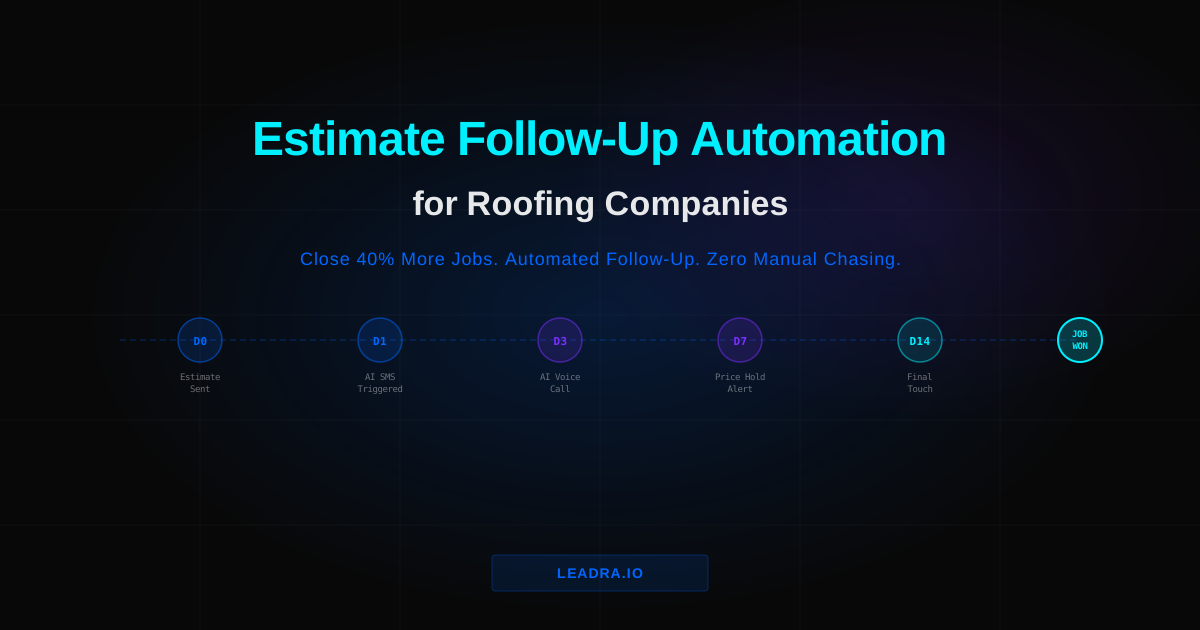
Estimate follow-up automation for roofing companies runs a defined sequence from the moment an estimate is delivered. Here's how each stage works and why the timing matters:
Same Day: Delivery Confirmation SMS
Within 2 hours of the estimate being sent, the homeowner receives an SMS: 'Hi [name], your roofing estimate from [company] is in your inbox — let us know if you have any questions or want to walk through it together. Here's a direct link to schedule a quick call if easier: [booking link].' This message serves two functions: it confirms delivery so the homeowner opens the estimate, and it offers a zero-friction booking path for homeowners who are ready to move immediately. Contractors who add this step alone see 10-15% of estimates signed within the first 24 hours.
Day 1-2: Response Check SMS If No Booking
If no appointment is booked and no reply received within 24-48 hours, the system sends a second message: 'Just checking — did you get a chance to look at your estimate? Happy to answer any questions or walk through the scope. Reply here or call us at [number].' This is not a sales message. It's a service check. The framing matters: homeowners who ignored the first message often respond to this one because it feels like customer service, not a sales pitch. Response rates on this touchpoint run 20-30% on cold estimates.
Day 3: AI Outbound Voice Call — Objection Surface
If no response after two SMS messages, the AI places an outbound call on day 3. The script opens with the estimate context — job address, inspection date, scope summary — and asks one open question: 'Was there anything in the estimate you had questions about, or is there anything we can clarify about the scope or timeline?' This question surfaces the real objection. If the homeowner says they're getting other estimates, the AI acknowledges it and offers to answer comparison questions. If price is the concern, the AI explains financing options or adjustment flexibility. If it's a voicemail, the AI leaves a warm, specific message referencing the estimate.
Day 7: Price-Hold Alert SMS
The day-7 message creates honest urgency: 'Quick heads-up — material prices in our area are shifting this month and we want to hold your current estimate pricing for you. If you'd like to lock it in before it adjusts, just reply or tap here to schedule: [booking link].' This message works because it's factually grounded — material costs in roofing genuinely fluctuate — and it gives the homeowner a real reason to act without manufactured scarcity. Booking rates from this touchpoint run 8-12% of remaining cold estimates.
Day 14: Final Follow-Up — Handoff to Human Queue
The final automated touchpoint goes out on day 14: 'Last message from us on your roofing estimate — we want to make sure you're taken care of before the busy season fills our schedule. If you'd like to move forward or have any remaining questions, just reply or call [number]. We're here.' After this message, the lead moves into a manual sales queue for a human conversation. The estimate isn't marked dead — it's moved to a 30-day re-engagement campaign that re-touches the lead when seasonal timing is relevant (fall check-ins before winter, spring outreach before storm season).
The full sequence runs 14 days, uses 5 touchpoints, requires zero manual action from your office, and routes unresponsive leads into a human handoff queue rather than marking them dead. See how post-approval follow-up automation works for insurance roofing claims.
Manual Follow-Up vs. AI Automation on Roofing Estimates
Most roofing companies handle estimate follow-up the same way: the estimator calls the homeowner once, around day 3, leaves a message if no answer, and moves on. Here's what that approach costs compared to a structured AI sequence:
| Metric | Manual Follow-Up | AI Follow-Up Sequence |
|---|---|---|
| Time to first follow-up after estimate sent | 24-72 hours (if remembered) | Under 2 hours (automatic trigger) |
| Number of follow-up touchpoints | 1-2 calls (staff bandwidth limit) | 5 across 14 days (SMS + voice) |
| Objection surfacing | Only if homeowner volunteers it | Day-3 call explicitly asks for objections |
| Consistency across all estimates | Inconsistent — depends on estimator | 100% consistent on every estimate sent |
| Close rate on sent estimates | 20-35% | 45-55% (same pipeline) |
| Staff time per estimate follow-up | 20-40 min/estimate over 2-3 weeks | Under 3 min (review + manual handoff only) |
| Re-engagement of 30-90 day cold leads | Rarely — leads are marked dead | Automatic seasonal re-engagement campaign |
| Estimate pipeline visibility | Manual tracking, often incomplete | Full CRM logging of every touchpoint and outcome |
The close rate gap compounds over a storm season. A roofing company that sends 80 estimates per month and closes 30% manually signs 24 jobs. The same company with AI follow-up automation closing 50% signs 40 jobs — a difference of 16 additional jobs per month from the same lead volume. At $10,000 average job value, that's $160,000 in additional monthly revenue. See the full AI lead generation and follow-up system for service businesses.
Case Study: Mecklenburg County Roofer Doubles Estimate Close Rate in 60 Days
Client Story
A 4-crew residential roofing company in Mecklenburg County was writing 55-70 estimates per month during storm season. Their estimating team was tight — accurate scopes, competitive pricing, professional presentation. Their close rate was 28%. Follow-up was the estimator calling homeowners once, usually on day 2 or 3 after sending the estimate. If no answer, they left a message and moved on. No second call. No SMS. No structured sequence.
Leadra.io deployed a 5-stage estimate follow-up automation sequence integrated with their existing JobNimbus CRM. The trigger: the moment an estimate status changed to 'Sent' in JobNimbus, the sequence fired automatically. Same-day SMS went out within 90 minutes. Day-3 AI call placed if no response. Day-7 price-hold alert. Day-14 final touchpoint with handoff to a manual queue. All 55-70 estimates per month received the full sequence without any additional staff workload.
In the first 60 days: close rate increased from 28% to 54% on the same estimate volume. The day-3 AI call surfaced 14 objections that previously went unaddressed — 9 of them converted after the AI handled the objection and offered a follow-up call from the estimator. The day-7 price-hold SMS drove 8 additional bookings from leads that had been cold for 5-6 days. The 30-day re-engagement campaign recovered 3 additional jobs from estimates sent the prior month.
Estimates sent/month
Close rate
Jobs closed/month
Objections surfaced
The revenue impact: at an average job value of $11,200, the difference between 17 closures (manual baseline) and 35 closures (AI follow-up) is $201,600 in additional monthly revenue during storm season — without a single additional estimate being written or a dollar of new lead generation spend.
The owner's observation: "We were spending money on ads to generate more leads when the real leak was in our follow-up. Half the jobs we should have been closing were already in our estimate pipeline — we just never followed up properly."
What Estimate Follow-Up Automation Costs for Roofing Companies in 2026
Pricing depends on your current technology stack and whether you're adding follow-up to existing AI infrastructure or building from scratch:
- —5-stage estimate follow-up sequence (same-day through day 14)
- —SMS + AI outbound voice call automation
- —Calendar booking link integration
- —CRM status logging for every touchpoint (JobNimbus, AccuLynx, Jobber, or custom)
- —30-day cold lead re-engagement campaign
- —Up to 150 active estimate sequences per month
Best for: Roofing companies with an existing CRM who want to add structured follow-up without replacing their current stack
- —AI voice agent (24/7 inbound call handling + outbound follow-up calls)
- —5-stage estimate follow-up sequence with objection handling scripts
- —Objection handling for top 7 homeowner objections (price, timeline, trust, deductible, other estimates, financing, scope)
- —Calendar booking integration (Google Calendar, Calendly, or ServiceTitan)
- —Monthly close rate attribution report by sequence stage
- —CRM sync with full touchpoint logging and lead status updates
Best for: 3-6 crew operations who want end-to-end automation from first call through signed estimate — no standalone tools, one system
- —Everything in Full AI System
- —AI lead qualification scoring on inbound inquiries before the estimate is even written
- —Post-approval insurance claim follow-up sequence (separate trigger from estimate follow-up)
- —Review generation sequence triggered 7 days after job completion
- —Local SEO content engine (2 blog posts/month targeting roofing search terms)
- —Monthly analytics: close rate by lead source, sequence stage, job type, and crew
Best for: Multi-crew operations where every stage of the pipeline — lead, estimate, approval, close, review — needs to run on automation
At $8,000-$15,000 average residential replacement value, closing one additional job per week from a stalled estimate pipeline covers the cost of the full system for the year. The follow-up layer alone — at $350-$700/month — typically pays for itself from a single recovered job that would have gone cold. See the full AI implementation cost breakdown for home service businesses.
How to Set Up Estimate Follow-Up Automation in 5-8 Business Days
Setup is faster than most contractors expect because the trigger is simple — an estimate status change in your existing CRM. Here's the full process:
1. Identify your estimate trigger in your CRM.
The sequence fires from a single event: the moment an estimate moves to 'Sent' or 'Delivered' status in your CRM. In JobNimbus, AccuLynx, and Jobber, this is an existing status field. If you're using spreadsheets or a custom system, we create a lightweight intake trigger via a simple form submission. Identifying the trigger is a 30-minute conversation — you likely already have it, you just haven't connected it to anything.
2. Load your estimate details into the message templates.
Each touchpoint in the sequence is personalized using data from the estimate: homeowner name, property address, estimate amount, job type (repair vs. full replacement), and scope summary. The more data you pull from the estimate, the more specific the follow-up feels. Personalized messages outperform generic ones by 3-4x on response rate. Template setup takes 1-2 hours — you review and approve every message before the system goes live.
3. Build your objection handling scripts.
The day-3 AI call surfaces objections. You need a trained response for each one. The seven most common homeowner objections on roofing estimates are: (1) I'm getting other estimates, (2) the price is higher than I expected, (3) I need to talk to my spouse, (4) I'm not sure about the timeline, (5) I'm worried about my insurance deductible, (6) I need to check my financing options, and (7) I don't know your company well enough yet. Review the default scripts for each and adjust to match your pricing, timeline, and sales approach.
4. Connect your booking calendar.
Every SMS and AI call includes a direct booking link that puts an appointment on your estimator's calendar — no back-and-forth. Calendar integration requires API access to Google Calendar, Calendly, or your ServiceTitan scheduling module. This step eliminates the friction between 'I'm ready to move forward' and an actual scheduled appointment. Integration setup takes 1-2 business days once credentials are provided.
5. Run 5 test estimates through the full sequence before going live.
Before the system touches real homeowners, run 5 simulated estimates through every stage: confirm the SMS sends within 2 hours, verify the day-3 call script fires correctly, check the booking link routes to the right calendar, confirm CRM records are updated at each touchpoint, and verify the day-14 handoff alert reaches the right person on your team. Fix any routing issues in testing — not after a homeowner has experienced a broken flow.
For roofing contractors in the Charlotte metro — covering Mecklenburg, Cabarrus, Union, Gaston, and Iredell counties — having estimate follow-up automation live before storm season is a competitive advantage that compounds all season long. Every estimate you write after your competitors, every homeowner who's already collecting quotes, every lead who went quiet after your inspection — the follow-up system works all of them in parallel while your crew is on the roof. Pair estimate follow-up with a 24/7 AI voice agent for complete storm cycle coverage.
Frequently Asked Questions
What is estimate follow-up automation for roofing companies?
Estimate follow-up automation for roofing companies is a system that triggers a multi-touch outreach sequence the moment an estimate is sent — without any manual action from your office. It sends a same-day SMS, places an AI outbound call on day 3 if no response, fires a price-hold alert on day 7, and delivers a final touchpoint on day 14 before routing the lead to a human queue. Each touchpoint is personalized to the homeowner's name, address, estimate amount, and job type.
Why do roofing estimates go unanswered after they're sent?
Roofing estimates go cold for three main reasons: the homeowner is still collecting estimates and waiting to compare; the estimate landed at a bad time and the homeowner forgot; or the homeowner has a soft objection — price, timeline, or contractor trust — that nobody surfaced because there was no structured follow-up. AI follow-up automation addresses all three with timed outreach and a day-3 objection-surfacing call.
How much does estimate follow-up automation cost for roofing companies?
Estimate follow-up automation costs $350-$700/month as a standalone follow-up layer, or $800-$1,400/month as part of a full AI voice plus follow-up system. At an average job value of $8,000-$15,000, closing one additional stalled estimate per week covers the full system cost for the year. Most roofing contractors see a positive return within the first 30 days of deployment.
How long does it take to set up roofing estimate follow-up automation?
Setup takes 5-8 business days from kickoff to live sequences. The core steps are: identify the estimate send trigger in your CRM, load estimate data into message templates, build objection handling scripts for the top 7 homeowner objections, connect your booking calendar, and run 5 test estimates through the full sequence. Contractors with an existing JobNimbus, AccuLynx, or Jobber CRM can be live in under a week.
The estimates are already written. The inspections are already done. The homeowners are already interested — or they wouldn't have taken the meeting. What happens in the 14 days after you send the estimate determines whether those jobs go on your books or a competitor's. Estimate follow-up automation for roofing companies closes that gap by putting a structured, personalized, objection-handling sequence on every estimate — without adding a single hour to your office's workload.
At Leadra.io, we build estimate follow-up systems for roofing contractors in Charlotte and across the Carolinas. Setup takes 5-8 business days. The sequence runs on your existing phone number and CRM. We can have your estimate pipeline recovering stalled jobs before the next storm event passes.
Built for Roofing Contractors
Stop Losing Estimates You Already Earned
Every estimate your team sends deserves a structured follow-up sequence. AI automation handles every touchpoint — same-day SMS, day-3 AI call, price-hold alert, final outreach — while your crew stays on the roof. We set it up in under two weeks. You close more jobs from the same pipeline.