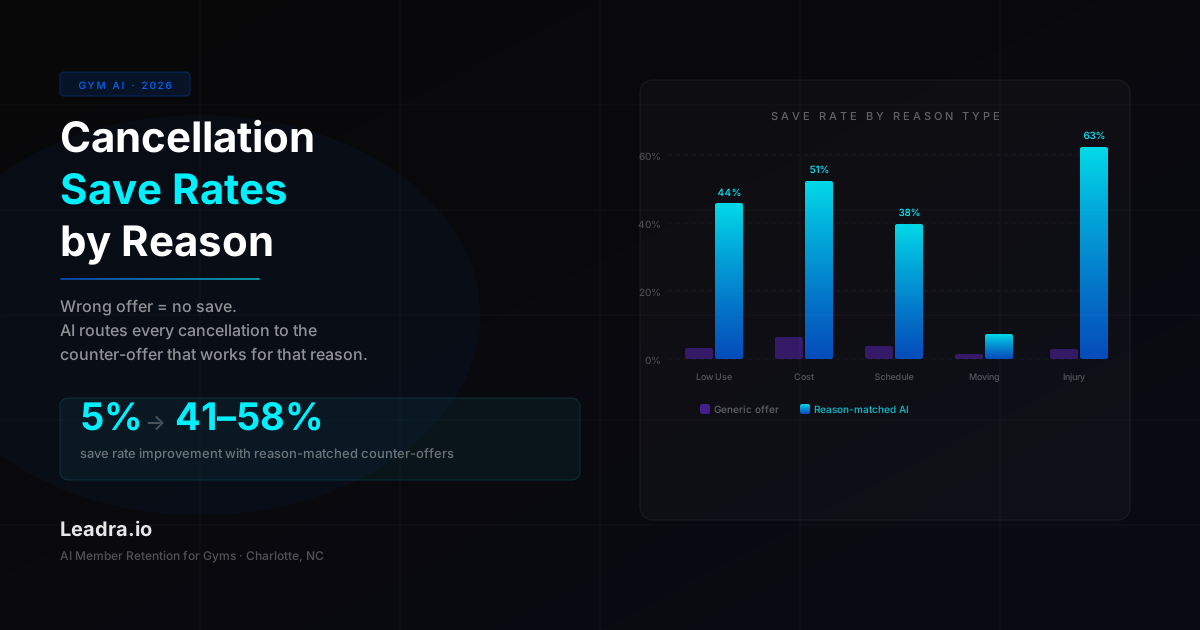
Most gyms handle cancellation saves the same way: a staff member gets on the phone or steps to the front desk, listens to the reason the member gives, and offers a discount or a free month. This approach saves 5-9% of cancellation requests. It fails the other 91-95% — and in many cases, the wrong counter-offer actually accelerates the decision to leave.
The reason generic offers fail is simple: a discount only works if price is the actual problem. But cost is the real cancellation driver in roughly 22% of cases. The other 78% are leaving because the class schedule stopped working, they're injured and can't use the membership, they moved, or — the most common reason of all — they stopped coming and feel guilty about paying for something they don't use.
Offering a discount to someone who's canceling because they moved doesn't help them. Offering a free month to someone who's disengaged sends the message that you're focused on billing, not on their actual problem. AI cancellation save systems flip this by detecting the real reason from behavioral data — not what the member writes, what their attendance patterns, billing history, and engagement signals show — and deploying the counter-offer with the highest save probability for that specific reason.
Why Members Don't Tell You the Real Reason They're Canceling
When a member submits a cancellation request and selects "too expensive," they're not necessarily lying — they genuinely believe it. But behavioral data tells a different story. A member who was attending 3x per week six months ago, then dropped to 1x, then went 45 days without a check-in, and now cites cost as the reason — the real issue isn't the $65/month. The real issue is that the value feels gone because they stopped coming.
This pattern is extremely common. Members select cost as a reason because it's concrete and defensible — it doesn't require them to admit they lost motivation or that they've been paying for something they stopped using. Staff members hear "cost" and offer a discount. The member accepts to avoid confrontation, keeps the membership at the lower rate, attends twice in the next 60 days, and cancels again three months later.
AI behavioral analysis catches this mismatch in under 90 seconds. It looks at 90 days of visit frequency trends, class booking history, email engagement, app logins, and billing events alongside the stated cancellation reason. When the behavioral profile contradicts the stated reason, the system routes the cancellation to the counter-offer that addresses the real friction — not the stated one.
The 5 Cancellation Reasons — and the Counter-Offer That Works for Each
These are the five reasons that account for 87-93% of all gym cancellations, ordered by frequency. For each: the wrong offer, the right offer, and the save rate when the match is correct.
Not using it enough / low motivation
31-38% of cancellations
Real vs Stated
Usually the real reason too — but members often pair this with 'cost' as a secondary justification.
Wrong offer
Discount. A lower price doesn't fix a habit problem — it just delays the cancellation by 30-60 days while the member continues not showing up.
Right offer
Accountability challenge: a 4-week re-engagement program with a personal goal, check-in reminders, and a trainer check-in call at week 2. Frame as 'give us 30 days to help you get back on track before you decide.'
Cost / financial pressure
22-28% of cancellations
Real vs Stated
Cost is the stated reason far more often than it's the real reason. AI behavioral data shows cost as the actual primary driver in roughly 22% of cases — the rest is cover for disengagement.
Wrong offer
Free month or freeze. A free month helps the member who genuinely can't afford the dues but plans to continue — it doesn't help a member who's using cost as cover for not coming.
Right offer
Tier downgrade or membership pause (2-3 months). Offer a lower-tier plan at $20-$30 less per month, or a 60-day pause with guaranteed rate lock. This resolves the stated objection and keeps the member in your system.
Schedule conflict — class timing doesn't work
16-21% of cancellations
Real vs Stated
Almost always the real reason when attendance patterns show consistent class attendance followed by a sudden stop with no billing or engagement signal. A job change or shift change typically drives this.
Wrong offer
Discount. A cheaper membership at times that don't fit the member's schedule is still useless. Members leaving for scheduling reasons are not price-sensitive in that moment.
Right offer
Off-peak or flex membership tier (if you offer one), a personalized class schedule review from a staff member, or — if you have on-demand video content — a hybrid access offer. The goal is to remove the time constraint.
Relocation / moving
11-14% of cancellations
Real vs Stated
Relocation is almost always the real reason when it's stated — it's a hard objection with no emotional component. AI detects it early when address-update signals appear in billing or communication data.
Wrong offer
Any retention offer. A discount, free month, or challenge invitation is irrelevant if the member is moving 45 minutes away. Forcing these offers wastes the member's time and ends the relationship on a frustrating note.
Right offer
A graceful exit with a referral request. Thank the member for their loyalty, offer to waive the cancellation fee (if applicable), ask for a Google review, and offer a referral incentive if they know anyone in their new city who'd benefit from your gym's partner network. This is not a save — it's a relationship-preservation close.
Injury, medical issue, or pregnancy
7-12% of cancellations
Real vs Stated
Medical reasons are almost always genuine when stated. Members with high prior engagement who cite injury are the highest-value candidates for a freeze offer — they will return.
Wrong offer
Discount or challenge. Neither helps a member who physically cannot use the membership right now. Pushing these offers signals that you're not listening to what they said.
Right offer
Medical freeze: 60-120 day hold with full rate and class access preserved at no charge. Frame it as 'your membership waits for you — same rate, same classes, same spot.' Members who freeze for medical reasons return at 58-67% rates within 90-180 days when they receive a reactivation check-in sequence at the 45-day mark.
The "Save Menu" Principle: Why One Offer Breaks Everything
The core problem with traditional cancellation save scripts is that they treat every member as the same problem. The save menu principle works differently: you build a library of 5-7 counter-offers, each mapped to a specific reason type, and the AI routes each cancellation to the right offer based on behavioral evidence.
A well-built save menu for a typical gym includes: a 60-day membership freeze (medical/injury), a 3-month pause with rate lock (relocation, major life change), a tier downgrade to a base membership (cost, but genuinely cost-driven), a 30-day accountability challenge (disengagement), an off-peak access option (schedule conflict), and a complimentary personal training session (motivation, goal re-connection).
What the AI adds is the routing logic — the behavioral analysis that determines which offer each member sees, and when. A member who tells you they're canceling "for financial reasons" but has a 90-day visit gap gets routed to the accountability challenge first, with the tier downgrade as a fallback if they decline. A member with a consistent check-in record who files an injury claim gets routed to the medical freeze without any counter-sell pressure.
Case Study · Charlotte, NC
South End Gym: 5% to 49% Save Rate in 60 Days
A 420-member CrossFit-style gym in Charlotte's South End neighborhood was averaging 19 cancellation requests per month and saving roughly 1 per month — a 5.3% save rate. Their process: front desk staff received the request, offered a one-month discount, and logged the outcome. The same offer went to every member regardless of reason.
Leadra.io deployed reason-detection integrated with their Mindbody account. The system analyzed the behavioral profile of each cancellation request and routed it to one of five counter-offer tracks. In the first 60 days, 19 cancellation requests were processed by the AI system. 9 members accepted the matched counter-offer on the first touch. 3 more were saved by the 7-day follow-up sequence. Save rate: 63% (12/19).
Reason breakdown for that period: 7 disengagement cases (5 saved via accountability challenge), 5 cost cases (3 saved via tier downgrade), 3 schedule conflict cases (1 saved via off-peak access), 3 medical/injury cases (3 accepted freeze), 1 relocation (graceful exit + 1 referral generated). Monthly recurring revenue preserved: $780. AI system cost: $800/month. 90-day ROI after model calibration: 9.6x.
Save rate before
5%
Save rate after AI
63%
Members saved/mo
1
12
90-day ROI
9.6x
Manual Cancellation Save vs. AI Reason-Matched Save: Side-by-Side
| Metric | Manual / Script-Based | AI Reason-Matched |
|---|---|---|
| Cancellation reason identification | Staff asks verbally — member states surface reason | Behavioral analysis detects real reason from 3 data layers in < 90 seconds |
| Counter-offer selection | Script-based: usually discount or free month for everyone | Reason-matched from a 5-reason offer library — different offer for each reason type |
| Save rate — cost reason | 12-18% with discount offer | 51% with tier downgrade + pause option |
| Save rate — disengagement reason | 4-8% with discount offer | 44% with 30-day accountability challenge |
| Save rate — medical/injury reason | 22-30% (some staff offer freeze) | 63% freeze acceptance, 58-67% return post-freeze |
| Mismatched offer rate | 55-70% of offers don't match the real reason | Under 8% mismatch rate (caught by behavioral cross-check) |
| Multi-touch follow-up | Rarely — one conversation at the desk or on the phone | 3-touch sequence over 7 days on the right channel for that reason |
| Overall save rate | 5-9% of cancellation requests | 41-58% of cancellation requests |
The Math: What Getting the Counter-Offer Right Is Worth
Most gym owners think about saves at the individual transaction level. Here's what the numbers look like at the system level — comparing a 5% generic save rate to a 45% reason-matched save rate on 20 monthly cancellations:
These are the conservative numbers for an average gym with average dues. Larger gyms with 600-1,000 members and $80-$120 monthly dues see proportionally larger returns from the same improvement in save rate — 15-25 additional saves per month at higher price points adds $1,200-$3,000 in recurring monthly revenue. The AI system cost stays flat while the dollar value of saves scales with your dues price and membership volume.
How to Get Started: 3-Step Implementation
Step 1: Cancellation audit (free)
Leadra.io runs a free 48-hour audit on your gym management software data — Mindbody, Glofox, ClubReady, Pike13, or Zen Planner. The audit shows your current save rate, the reason distribution of your cancellations over the past 12 months, the percentage of offers that are likely mismatched to the stated reason, and the realistic save-rate improvement based on your member profile. You get actual numbers before committing to anything.
Step 2: Build your save menu and configure reason routing
Based on your audit results, Leadra.io configures your save menu — the 5-7 counter-offers available for each reason type — using your actual offer constraints (whether you have a freeze option, a lower-tier plan, on-demand access, trainer sessions, etc.). The reason-detection model is calibrated to your member population's behavioral patterns. Most gyms are fully operational within 72 hours of this step. You approve the offer menu and the routing logic; the AI handles delivery.
Step 3: Monitor, track outcomes, optimize (days 30-90)
The dashboard shows every cancellation request, the reason the AI detected, the counter-offer deployed, and the outcome (saved, converted to freeze, or exited). You review this weekly — not to manage individual cases, but to identify patterns. If the schedule-conflict track is underperforming, it might mean you need an off-peak tier to actually offer. By day 90, the model has calibrated on your real cancellation population and save rates are at peak. Most gyms see full ROI by month 2.
Frequently Asked Questions
Why do generic discounts fail to save gym cancellations?
A discount only works if price is the reason a member is canceling. Industry data shows that cost is the stated reason for only 28-34% of gym cancellations — and the real reason (detected by behavioral data) is cost in roughly 22% of cases. The other 66-78% are canceling for scheduling conflicts, relocation, injury, or chronic disengagement. Offering a discount to someone who's canceling because they moved doesn't help them — it actually lowers their respect for your offer. AI systems detect the real reason from behavioral signals (class attendance patterns, app engagement, billing history, address-change signals in communication data) and deploy the specific counter-offer that resolves the actual friction point. This is why reason-matched saves achieve 41-58% save rates while generic counter-offer scripts average 5-9%.
What are the most common reasons gym members cancel?
The five most common gym cancellation reasons, by frequency in 2026 industry research, are: (1) Not using it enough / lack of motivation — 31-38% of cancellations; (2) Cost / financial pressure — 22-28%; (3) Schedule conflict / class timing doesn't work — 16-21%; (4) Relocation / moving — 11-14%; (5) Injury, medical issue, or pregnancy — 7-12%. The critical nuance is that stated reason and real reason often diverge. Members frequently cite cost when the real driver is disengagement — they say cost because it sounds more legitimate than admitting they stopped showing up. AI behavioral analysis catches this mismatch and targets the real friction point, not the stated one.
How does AI detect why a gym member is canceling?
AI cancellation save systems detect reason type from three data layers. First, behavioral history from your gym management software (Mindbody, Glofox, ClubReady, Pike13): a member canceling after a billing failure points to cost; a member with a perfect attendance record who stopped coming 6 weeks ago points to life disruption. Second, cancellation form language: natural language processing on the free-text cancellation reason identifies semantic patterns — 'can't make it work with my schedule' vs 'tightening budget.' Third, communication engagement: a member who stopped opening emails 8 weeks ago but was a consistent attendee before that points to disengagement or life change, not cost. The system combines these signals to route each cancellation request to the right counter-offer in under 90 seconds.
How much does AI cancellation save automation cost for gyms?
AI cancellation save systems for gyms typically cost $500-$2,000/month depending on member count, platform integrations, and whether proactive churn prediction is included. At $65 average monthly dues, saving 10 additional members per month adds $650 in recurring revenue — meaning most gyms break even within the first month and generate 8-12x ROI within 90 days. Leadra.io offers a free cancellation audit showing your current save rate, reason distribution, and realistic improvement opportunity before you commit. Call +1 (864) 721-8384 or visit leadra.io/contact.
Related guides
Free Cancellation Audit
Find Out What Your Real Save Rate Could Be
Leadra.io runs a free 48-hour audit showing your current save rate, why your members are really canceling, and how many you could realistically retain with reason-matched counter-offers. No commitment, actual numbers.