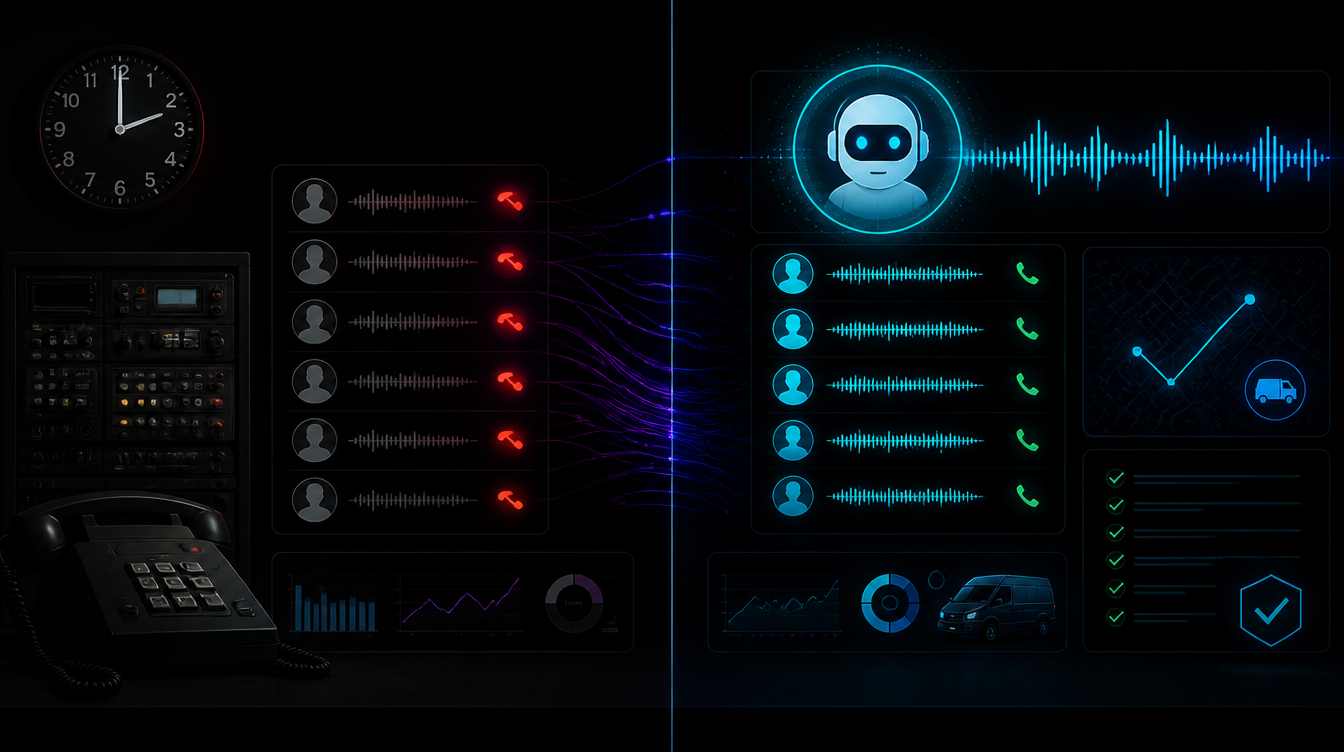
It's 2:07 AM on a July night. A homeowner's AC dies. They pick up their phone and call your HVAC company. What happens next depends entirely on what's answering.
If you have a traditional answering service, an operator takes a message. The homeowner hangs up with no confirmation, no appointment, and no reason to wait for your callback. By the time your on-call tech sees the message and dials back — 20 to 90 minutes later — the homeowner has already called your competitor and gotten a confirmed arrival window.
That job was worth $400 to $800. It walked out the door because your answering service took a message instead of taking the job.
This guide compares HVAC AI answering services against traditional answering services across every variable that matters: speed, booking capability, emergency triage, cost, and real-world revenue impact. By the end, you'll know exactly which option fits your operation — and what the wrong choice is costing you every month.
What a Traditional HVAC Answering Service Actually Does
Traditional answering services employ live operators who handle your overflow and after-hours calls. They're trained to be professional, collect basic information, and relay messages to your team. That sounds useful. The problem is what they cannot do.
A traditional operator cannot book an appointment. They don't have access to your calendar. They can't dispatch your on-call tech. They can't give the caller a confirmed arrival window. What they can do is take a message and send it to you — and then your caller waits.
In the HVAC industry, waiting kills conversions. A 2023 study by ServiceTitan found that HVAC companies that respond to emergency inquiries within 5 minutes close at a 78% rate. Companies that respond after 30 minutes close at 17%. Most traditional answering services don't even deliver the message to your on-call tech within 5 minutes — let alone get your tech on the phone with the customer.
The traditional answering service loop:
- 1. Caller dials. Operator answers (20-90 seconds).
- 2. Operator collects name, number, brief issue description.
- 3. Caller is told someone will call back. Call ends. No booking, no window.
- 4. Message is texted or emailed to your on-call contact (5-30 min later).
- 5. Your on-call tech sees the message, calls the customer back (another 10-40 min).
- 6. If the customer answers, you manually book the job over the phone.
- 7. Total time from call to confirmed job: 30-90 minutes. Caller drop-off rate: 35-55%.
Traditional answering services are not bad businesses. They do what they say they do — answer your phone and take a message. The problem is that taking a message is not the same as capturing revenue. For HVAC emergency calls at 2 AM, that distinction is everything.
What an HVAC AI Answering Service Does Differently
An AI answering service for HVAC is built to do what a live operator cannot: complete the transaction. It answers, qualifies, triages, dispatches, and confirms — before the caller hangs up.
The AI voice agent picks up in 1-2 rings, introduces itself as your company's virtual assistant, and begins a natural conversation. It asks about the issue, the address, the urgency. If the caller says "my AC is completely out and I have a newborn at home," the system recognizes that as a priority emergency and routes differently than a routine maintenance request. The caller gets a different response: your on-call tech will contact them within 15-30 minutes, and an automated SMS fires to your dispatcher immediately.
For non-emergency calls — tune-ups, second opinions, replacement quotes — the AI books directly into your calendar, sends a confirmation SMS to the customer, and pushes the job details to your CRM. The customer hangs up with a confirmed appointment. Your team wakes up to a full schedule rather than a list of callbacks to make.
Answer in 1-2 rings, 24/7.
No hold music. No 'please leave a message after the tone.' The AI voice agent handles every call immediately, whether it's 3 PM on a Tuesday or 2 AM on a holiday weekend. Peak-season call floods that would overwhelm a traditional answering service are handled simultaneously without degradation.
Real-time emergency triage.
The AI detects urgency signals in the caller's language — 'no heat,' 'furnace won't turn on,' 'AC is completely dead,' 'it's 95 degrees in the house.' Emergency calls trigger an escalation path: on-call tech gets an immediate SMS alert with the caller's name, address, and issue summary. Non-emergency calls route to standard booking.
Booking before the call ends.
For standard service requests, the AI books the appointment directly into your field service software — Jobber, ServiceTitan, Housecall Pro, or Google Calendar. The caller gets a confirmed date and time before they hang up. No callback required. No manual entry by your team.
Dispatch confirmation to your tech.
For emergency escalations, the AI sends a structured dispatch notification to your on-call tech via SMS: caller name, address, phone number, issue type, and urgency level. Your tech has everything they need to call the customer back in under 5 minutes — with context, not a blank voicemail.
Automated follow-up for leads that don't book.
Callers who hang up before booking (line dropped, called back another company, undecided) enter an automated follow-up sequence: SMS and email touchpoints over 5-10 days. These are jobs that a traditional answering service message would have lost permanently.
Side-by-Side: HVAC AI Answering Service vs Traditional Answering Service
Eight variables. This is how the two options stack up when an emergency HVAC call comes in after hours.
| Feature | Traditional Answering Service | AI Answering Service |
|---|---|---|
| Speed of response | Operator answers in 20-90 seconds. Message relayed 5-30 min later. | AI answers in 1-2 rings. Caller is triaged and dispatched in under 3 min. |
| What the caller gets | Confirmation that someone will call them back. No booking, no window. | Confirmed appointment window or on-call tech ETA before they hang up. |
| Emergency triage | Operator marks the call urgent. You see it when you check your phone. | Detects emergency language, routes differently, and texts your tech immediately. |
| Job booking | None. Someone on your team has to call back and book manually. | Books into your calendar directly (Jobber, ServiceTitan, Google Calendar). |
| Caller drop-off risk | High. Callers who get a message-only service often call a competitor next. | Low. Caller gets a confirmed response, reducing the urge to shop around. |
| Data captured | Name, number, brief description. Manually entered into your CRM. | Name, number, address, service type, urgency level, pushed to CRM automatically. |
| After-hours cost per call | $1.25-$2.50 per minute of operator time plus monthly base fee. | Fixed monthly rate regardless of call volume. No per-minute charges. |
| Scalability during peak season | Operator lines can get overloaded. Callers wait or get dropped. | Handles unlimited simultaneous calls with no degradation. |
Cost Comparison: What You're Actually Paying For
Traditional answering services look cheaper on paper. That changes when you calculate the cost of every job they fail to book.
Traditional Answering Service
- Monthly base fee$150–$400
- Per-minute overage (after-hours)$1.25–$2.50/min
- Dispatch upgrade (some providers)+$150–$300/mo
- Typical total/month$300–$700
Jobs booked: 0. All bookings happen manually after callbacks.
AI Answering Service
- Core AI voice agent + triage$500–$1,000/mo
- Calendar booking integrationIncluded
- SMS dispatch + follow-up sequences+$100–$300/mo
- Typical total/month$700–$1,500
Jobs booked: every after-hours call that qualifies gets a confirmed appointment before hanging up.
The gap in monthly cost is $400 to $800. The average HVAC emergency service call generates $400 to $800 in revenue. One extra job captured per month from after-hours calls puts you at break-even. Most HVAC companies running AI answering services recover 6-15 additional jobs per month that were previously lost to unanswered calls or competitors who picked up faster.
The traditional service isn't cheaper. It's just cheaper at taking messages.
Charlotte HVAC Company: Before and After
A six-tech residential HVAC company in Charlotte, NC was using a traditional answering service at $380/month. They tracked after-hours calls for 90 days before switching to an AI answering service and compared the same 90-day window after.
The company was not missing calls — they were answering them. They were missing the booking. A traditional answering service handed that gap to every competitor who answered faster and booked on the spot.
4 Questions to Ask Before Choosing an HVAC Answering Service
Not every AI answering service is worth the upgrade, and not every traditional service is the same. Ask these four questions before you sign anything.
Can it book directly into your field service software?
If an AI answering service can't integrate with Jobber, ServiceTitan, Housecall Pro, or your scheduling calendar, it's not a booking system — it's a fancy message-taker. Require a live demo of the calendar sync before committing. This is the single most important feature.
What is the emergency escalation path?
Ask exactly what happens when a caller reports a no-heat, no-AC, or gas-related emergency. A real system has a defined escalation: classify the emergency, alert the on-call tech via SMS within 60 seconds, provide the caller with a tech ETA or callback commitment. Vague answers here mean the system was not built for HVAC.
How does it handle calls it can't complete?
Every system hits the edge of its training. For callers with unusual issues, multi-language needs, or situations outside the script, there must be a defined fallback: escalate to your dispatcher, collect info for morning callback, or transfer to a human operator backup. Systems that hallucinate or go silent on edge cases will cost you customers.
What does the reporting show you?
You should know exactly how many after-hours calls came in, how many were booked by the AI, how many were escalated as emergencies, and how many are in follow-up sequences. If an answering service can't report on booking rate, it can't help you improve it. Demand a dashboard with call-to-booking conversion metrics.
Which Option Is Right for Your HVAC Company?
The honest answer: it depends on call volume and how much after-hours revenue you're currently leaving on the table.
If you receive fewer than 10 after-hours calls per month and your on-call tech reliably returns calls within 15 minutes, a traditional answering service at $200-$400/month may be adequate. You're not missing many calls, and your manual callback system is fast enough to retain most callers.
If you receive 20 or more after-hours calls per month — or if you operate during peak HVAC season where a single July weekend can produce 30-50 emergency calls — a traditional answering service is actively costing you revenue. The math is simple: at an average of $550 per emergency job and a 40% caller drop-off rate from message-based services, 25 after-hours calls per month with a 40% drop-off equals 10 lost jobs equals $5,500 in lost monthly revenue. An AI answering service at $1,100/month that recovers 70% of those calls returns $3,850/month net — after paying for itself.
Most HVAC companies in growth mode should not be running a traditional answering service by 2026. The cost difference is smaller than the revenue difference, and every month of delay is a month of jobs going to competitors who picked up and booked while you were still waiting for a message relay.
Frequently Asked Questions
What is the difference between an AI answering service and a traditional answering service for HVAC?
A traditional answering service uses live operators who collect a caller's name, number, and brief message, then relay that message to your on-call staff via text or email. The caller is never booked — they're in a queue waiting for a callback that may come 30-90 minutes later. An AI answering service for HVAC conducts a full conversation, collects service type and address, triages urgency, dispatches the on-call tech via automated alert, and sends the caller a confirmed appointment window — all in under 3 minutes, with zero human involvement. The difference is a message vs a booked job.
How much does an AI answering service for HVAC cost compared to a traditional service?
Traditional answering services for HVAC companies typically cost $150-$400/month for basic message relay, or $400-$900/month for dispatch-capable services with on-call escalation. An AI answering service with full HVAC triage, booking, and dispatch automation costs $700-$1,800/month depending on call volume and integrations. The AI option costs more upfront, but it generates direct revenue (booked jobs) rather than just taking messages. Most HVAC companies recover the AI cost in 2-4 recovered emergency jobs per month.
Can an AI answering service handle true HVAC emergencies like a furnace failure or no AC in summer?
Yes. A well-configured AI answering service for HVAC detects emergency language in real time — 'no heat,' 'furnace won't start,' 'AC is completely out,' 'pipes might freeze' — and triggers a different response path than a routine tune-up call. The emergency path collects the address, confirms the issue type, tells the caller your on-call tech will contact them within 15-30 minutes, and immediately fires an SMS alert to your dispatcher or on-call tech. Non-emergency calls are routed to standard next-day booking. The system keeps your on-call line reserved for true emergencies.
What happens if an AI answering service can't handle an HVAC caller's question?
Every AI answering service should have a defined escalation path for calls that fall outside its script. For HVAC, this typically means: if the caller describes a situation that sounds dangerous (gas smell, carbon monoxide concern, visible electrical damage), the AI immediately transfers to your emergency line or dispatcher's cell and simultaneously fires an urgent alert. For questions the AI can't confidently answer — custom pricing, commercial job estimates, warranty disputes — it collects the caller's info and flags it for a morning callback rather than guessing. A properly built system knows what it doesn't know.
Stop Losing 2 AM Emergency Jobs to Your Competition
Leadra.io builds and deploys AI answering systems for HVAC companies — configured for emergency triage, calendar booking, and dispatch automation. Most setups go live in 10-14 days. Call us or book a free audit of your current after-hours call handling.