Insurance Broker AI Marketing Strategy: The 6-Step Playbook for Independent Brokers in 2026
Independent insurance brokers have every advantage over large carriers and captive agents — product flexibility, local relationships, and the ability to customize. What most lack is a marketing system that runs those advantages at scale. AI gives you that system.
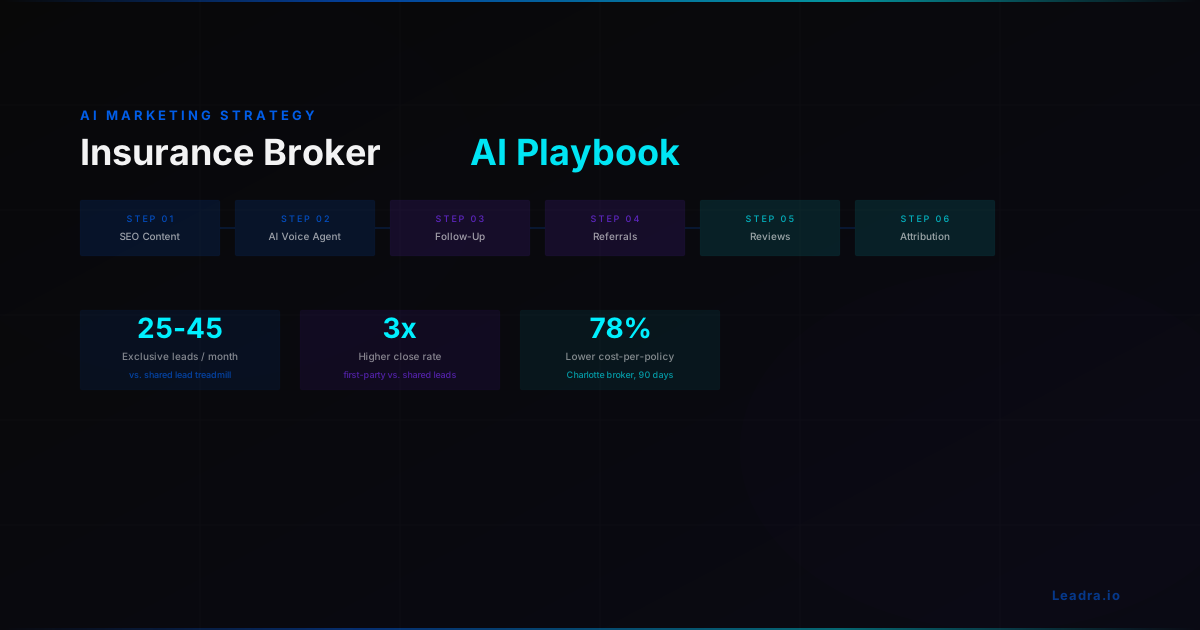
A Charlotte independent broker — P&C and commercial lines, four licensed agents — was running a decent agency. Steady renewal base. A few referrals every month. Google Ads budget eating $2,400/month for inconsistent results. Their core problem: no system. Every lead came in through a different channel, got handled differently depending on who picked up, and either converted or didn't based on timing and luck.
They deployed a structured AI marketing strategy over 14 days. The system replaced guesswork with a repeatable six-step process. In 90 days: 38 new policies written from AI-generated and AI-nurtured leads, Google Ads spend cut to $600/month, cost per new policy dropped from $340 to $74. The agency grew by 11% in quarterly written premium without adding headcount.
This guide covers the exact six-step AI marketing strategy that produced those results — and how independent insurance brokers in any market can replicate it.
Why Most Insurance Brokers' AI Marketing Fails Before It Starts
The most common mistake independent insurance brokers make with AI marketing is buying point solutions without a strategy connecting them. An AI chatbot on the website. A drip email tool that sends generic newsletters. A Google Ads campaign with no follow-up system behind it. Each tool does something — but none of them compound into a pipeline.
A real insurance broker AI marketing strategy has three properties:
The six-step strategy below builds all three properties. It's designed specifically for independent brokers with 1-12 agents who want to compete on their own terms against large carriers and aggregator-dependent agencies. See the full AI lead generation system for insurance agencies.
The 6-Step AI Marketing Strategy for Independent Insurance Brokers
Independent insurance brokers have a structural SEO advantage that large carriers can't replicate: local market knowledge. A carrier publishes generic content about auto insurance. You publish content about auto insurance rates in south Charlotte after the I-77 expansion raised accident rates, or why Mecklenburg County homeowners need flood riders that most standard policies exclude. That specificity wins local search. An AI content engine publishes 6-8 of these hyperlocal articles per month — targeting coverage-specific queries, local rate factors, carrier comparisons, and claim scenario guides. Within 90-120 days, the agency ranks for dozens of long-tail searches that bring in first-party prospects who already trust you before they call.
Research from InsideSales.com shows that 35-50% of all insurance quote requests are submitted outside of business hours — evenings, weekends, holidays. An independent broker without 24/7 coverage is losing roughly half their inbound leads to voicemail. An AI voice agent answers every call on the first ring, conducts a structured intake conversation (coverage type, current carrier, approximate premium, timeline, decision-maker status), qualifies the prospect, and either books them directly into an agent's calendar or routes them into a product-specific nurture sequence. The intake takes 4-6 minutes. Qualified prospects land in your calendar with a full brief. The agent arrives knowing the prospect's situation before saying hello.
Industry data consistently shows that 80% of insurance sales require 5-12 touchpoints before a prospect commits. The average independent broker makes 1-2 attempts before moving on. The gap between those numbers is where most revenue is lost. A properly structured follow-up sequence for insurance works in two layers: urgency-based (prospects who have a near-term need like a new home purchase or renewal date) and education-based (prospects who are mid-term and just starting to shop). Urgency-based sequences run for 14-21 days with daily touches in the first week. Education-based sequences run for 60-90 days with weekly and bi-weekly touches, delivering relevant content — local rate factors, coverage gap examples, carrier comparison data — until the renewal window opens.
Referrals are the highest-closing, lowest-cost leads in the insurance industry. They close at 3-5x the rate of cold leads, arrive pre-trusting the broker, and rarely shop on price alone. The problem is most brokers generate referrals inconsistently — asking when they remember, which is not often enough and rarely at the right moment. AI referral automation changes that by triggering referral requests at the three highest-probability moments: 7 days after a policy binds (peak satisfaction), 30 days after a positive claim resolution, and during the annual renewal review. The request is personal, specific, and gives the client an easy way to introduce people — a pre-written text they can forward, a referral link, or a simple call to action. Brokers with automated referral systems generate 30-50% of new leads from their existing book at effectively zero acquisition cost.
Local search click-through rate on Google is heavily influenced by review count and star rating. A broker profile with 4.9 stars and 95 reviews gets 3-5x more clicks than a profile with 4.1 stars and 22 reviews — even when the lower-rated broker ranks higher in the local pack. AI review generation sends an SMS review request to every client 48-72 hours after a positive service interaction: new policy binding, successful rate reduction, claim that resolved smoothly, or renewal with savings found. The timing matters — the window of peak client satisfaction is narrow and most brokers miss it. Agencies that automate this process typically accumulate 50-100 five-star reviews in the first 90 days, permanently improving their local search performance and the trust signals every future prospect sees.
The sixth step is what separates a strategy from a set of tools running in parallel. Monthly attribution tracking answers three questions: Which source generated each new policy written last month? What was the cost per acquired policy by source? What is the 90-day conversion rate on leads from each channel? With this data, you can cut spending on channels that produce expensive policies and increase investment in channels producing the best-quality leads. Most brokers discover within 60 days that their AI-driven organic and referral channels are producing policies at 5-15x the efficiency of their paid channels. That data drives budget reallocation that compounds ROI month over month.
AI Marketing Strategy vs Traditional Broker Marketing in 2026
Here's how a structured AI marketing strategy stacks up against the approach most independent brokers are running today:
| Metric | Traditional Approach | AI Marketing Strategy |
|---|---|---|
| Lead response time | Next business day or missed | Under 60 seconds, 24/7 |
| After-hours lead capture | Voicemail — 60-70% lost | 100% captured and qualified |
| Follow-up consistency | 1-2 manual attempts | 90-day automated sequences |
| Referral process | Ad hoc when agents remember | Automated at peak satisfaction moments |
| Google reviews | Organic — slow and inconsistent | Automated post-binding — 50-100 in 90 days |
| Cost per new policy | $180 – $400 (paid + shared leads) | $45 – $110 (AI system fully loaded) |
| Close rate on leads | 10 – 18% (shared/cold) | 24 – 40% (exclusive, qualified, fast) |
| Scalability | More volume = more staff | Same team handles 3-5x the volume |
Case Study: Charlotte Broker Cuts Cost-Per-Policy by 78% in 90 Days
A four-agent independent P&C broker in south Charlotte — personal lines (auto, home, umbrella) plus a growing commercial book — came to Leadra.io in Q1 2026. They had a $2,400/month Google Ads budget, a generic website, and no follow-up system beyond what individual agents remembered to do. Lead quality was inconsistent. Close rate on paid leads was 14%. The team was busy but the production numbers didn't reflect the activity level.
Before AI — Baseline Month
- —$2,400/month in Google Ads spend
- —42 inbound leads/month — mixed quality, no consistent intake process
- —24 new policies written (closed 14% of leads after multiple manual touches)
- —Average cost per new policy: $340 (ad spend + estimated agent time)
- —6 five-star Google reviews, 3.8 average rating
- —0 systematic referral requests — 3-4 referrals per month happened organically
- —After-hours calls going to voicemail — no tracking on how many were lost
We deployed all six components over 14 business days. The AI voice agent went live on their main line first — that's the fastest ROI component because it starts capturing leads immediately. The follow-up sequences were built for three tracks: new home purchase (urgent, 14-day), general auto shopper (60-day), and commercial prospects (90-day). The referral automation launched to their 290-policy existing book on day 8. Review generation went live the same day.
The content engine started publishing two articles per week targeting Charlotte-area insurance queries — local flood zone coverage guides, Charlotte auto insurance rate factors by zip code, contractor liability coverage for Mecklenburg County businesses. Content takes 60-90 days to rank, so this component builds into the later months.
By the end of month one, the AI voice agent had handled 29 after-hours calls that previously went to voicemail. Of those, 18 booked appointments and 11 became new policies. The first referral from the automated system came in on day 12. The Google profile jumped to 4.8 stars with 31 new reviews in 30 days. Month three results told the full story.
New policies/month
Cost per new policy
Google reviews
Google star rating
The Google Ads budget was reduced to $600/month in month two — the organic and AI-captured leads were producing at better quality and lower cost. Monthly AI system cost: $2,200. Total acquisition spend month three (AI + reduced Ads): $2,800. 38 new policies at an average of $1,680 in first-year premium: $63,840 in new monthly premium volume. Cost per new policy: $74. The ROI conversation stopped being about whether AI marketing works and started being about how fast to expand.
The principal's observation: "Before this, our marketing was random. Some months were great, some were terrible, and we couldn't tell you why. Now we know exactly where every policy came from and what it cost. The consistency changed everything about how we run the agency."
How to Implement This Strategy in 14 Business Days
The right deployment sequence matters. Here's how to go from nothing to a fully operational AI marketing system in two weeks without disrupting your existing operation:
Days 1-3 — Audit and intake configuration.
Map your current lead sources, close rates by source, and product line mix. Document the intake questions that determine quote readiness for each of your primary products. For personal lines: current carrier, vehicles, drivers, homeowner status, violation history. For commercial: business type, revenue, employee count, current coverage, renewal date. This audit determines your follow-up sequence structure and the AI intake script. It also sets the baseline against which you'll measure ROI.
Days 4-7 — Deploy AI voice agent and connect to calendar.
Configure the AI voice agent for your phone system. Route your main line and website form submissions through the AI intake. Connect to your AMS (Applied Epic, AMS360, EZLynx, or HubSpot) and agents' calendars. Set routing rules: which agent handles which product line, daily appointment caps, overflow handling for high-volume periods. Test with internal calls before going live. The goal is zero friction — a prospect calling your agency gets a professional intake experience and ends up in the right agent's calendar.
Days 8-10 — Build and activate follow-up sequences.
Build three sequences minimum: a 14-day urgency sequence for immediate-need prospects (new home purchase, policy cancellation notice, new business opening), a 60-day standard sequence for general shoppers, and a 90-day commercial sequence for business prospects. Each sequence should include a mix of AI voice callbacks, SMS touches with relevant content, and email with local rate data or coverage guides. Connect sequences to your AMS so leads automatically enter the right track based on their intake information.
Days 11-12 — Launch referral automation and review generation.
Configure referral requests to trigger 7 days after policy binding and 30 days after claim resolution. Launch review generation to trigger 48 hours after every new policy binding. For the first batch, send a retroactive review request to every client who received positive service in the past 90 days — this seeds the Google profile while the ongoing automation builds it. Both components require minimal ongoing management once configured.
Days 13-14 — Start the content engine and set up attribution tracking.
Brief the AI content engine with your top 20 target keywords — coverage types, local search queries, carrier comparison terms, claim scenario guides. Publish the first two articles on days 13-14 and set a publishing cadence of 6-8 articles per month. Simultaneously, configure your attribution tracking: tag every lead source, set up conversion tracking in your AMS, and schedule your first monthly review for day 30. The content takes 60-90 days to produce ranking results, but starting immediately is critical — every week of delay is a week of SEO compounding you don't get back.
The system is designed to integrate with your existing operation, not replace it. Your agents still handle every consultation and close. The AI handles capture, qualification, follow-up, review requests, and referral asks — the high-volume, repeatable work that agents don't have time to do consistently. See the detailed 14-day AI implementation timeline.
Most independent brokers who deploy all six components see measurable results within the first 30 days from the voice agent and follow-up components. The SEO, referral, and review components compound into a self-sustaining growth engine by month three.
Frequently Asked Questions
What is an AI marketing strategy for independent insurance brokers?
An AI marketing strategy for independent insurance brokers is a six-component system covering local SEO content, 24/7 AI voice and SMS lead capture, automated follow-up sequences, referral automation, Google review generation, and monthly attribution tracking. Each component handles a specific stage of the buyer journey. Independent brokers who run all six components generate 25-45 exclusive leads per month and typically achieve 10x-18x ROI within 90 days, without adding headcount.
How does AI marketing help independent insurance brokers compete against large carriers?
Independent brokers compete against large carriers using AI through hyper-local personalization and speed. Large carriers have brand recognition but slow, scripted processes — a carrier call center typically responds to web leads in 2-24 hours during business hours only. An independent broker with an AI system responds in under 60 seconds around the clock, with a personalized intake conversation calibrated to their local market. This combination of speed, local knowledge, and follow-up consistency produces close rates of 25-40% on first-party leads versus 8-15% for carrier call centers on the same prospect pool.
How long does it take for an AI marketing strategy to produce results for an insurance broker?
Results come in two waves. The AI voice agent and follow-up sequences produce results in week one — most brokers report 8-15 additional qualified appointments in the first 30 days from this component alone. The SEO content engine, referral automation, and Google review generation take 60-90 days to reach full output. By day 90, most brokers are generating 25-45 exclusive leads per month from the combined system, with cost per new policy typically running 60-80% lower than their previous paid lead channels.
What AI tools should an independent insurance broker use for marketing in 2026?
Independent insurance brokers need four categories of AI tools: an AI content engine for hyperlocal SEO blog content; an AI voice and SMS agent for 24/7 lead capture and qualification; a CRM-connected follow-up automation platform for 60-90 day product-line-specific nurture sequences; and a review and referral automation system. The right combination depends on agency size, product mix, and primary goals. Most independent brokers with 2-10 agents get the best ROI from a fully integrated system — where all four categories work off the same CRM data — versus deploying point solutions from different vendors.
The independent broker advantage in 2026 is real — product flexibility, local relationships, and the ability to put client needs ahead of any one carrier's quota. But that advantage only converts to revenue if the marketing system behind it matches the quality of the service you deliver. AI closes the gap between what you offer and how consistently you can put it in front of the right prospects at the right moment.
At Leadra.io, we build AI marketing strategies for independent insurance brokers across Charlotte and the Carolinas. Setup takes 14 business days. The system works on your existing phone number, website, and agency management platform. Most brokers see their first AI-captured lead in the first week. See how AI automation also handles policy renewal and cross-sell.
Built for Independent Insurance Brokers
Get a Marketing System That Compounds
We'll build your AI marketing strategy in 14 business days. Every lead captured in under 60 seconds. Every prospect followed up for 90 days. Your existing book generating referrals and reviews automatically. First-party leads that close at 3x the rate of anything you're buying from an aggregator.