Marcus ran a two-man landscaping operation out of Charlotte for four years. He and one part-time crew member handled residential lawn care, installs, and seasonal cleanups across Ballantyne and Waxhaw. Revenue sat at $38,000-$45,000 per month — decent for two people, but flat. Every time he tried to grow, the same wall stopped him: he spent 3-4 hours a day on the phone returning calls, following up on quotes, scheduling jobs, and dispatching his crew. There was no time left to actually sell.
That ceiling — where the owner becomes the bottleneck — is the most common growth problem in landscaping. The business has enough lead flow. The work quality is good. The pricing is competitive. But the owner is buried in operational tasks that don't require a human. Every call he takes at 7pm returning a quote inquiry is time he didn't spend on crew oversight, commercial account development, or his own life.
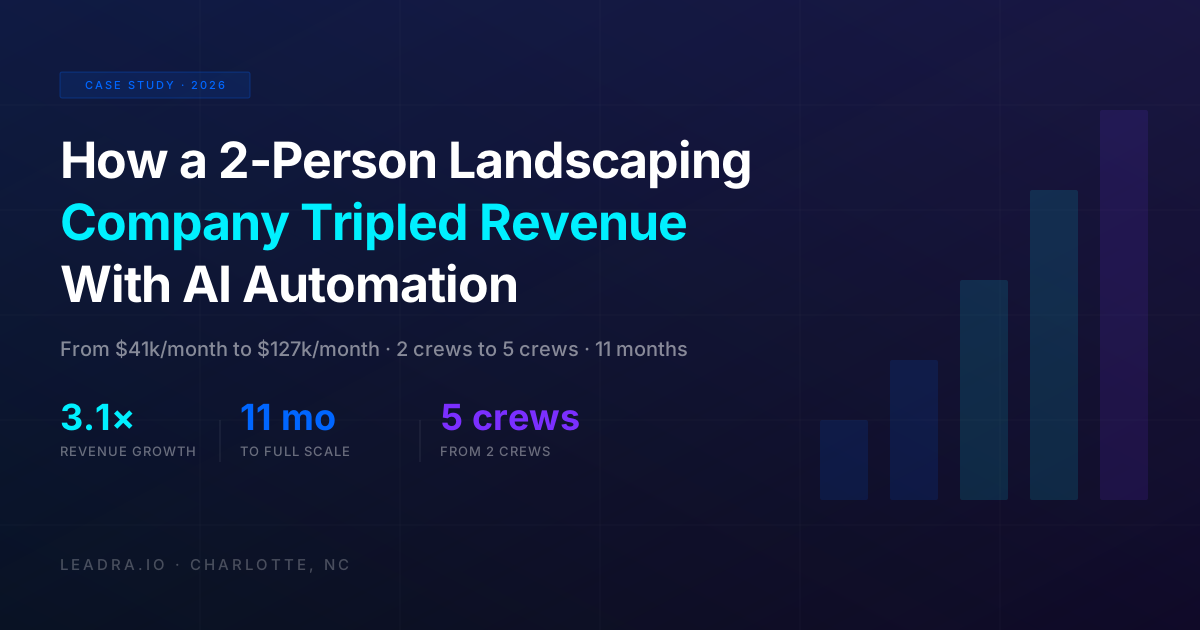
Leadra.io deployed a three-phase AI automation system for Marcus starting in August 2025. Eleven months later, he runs five crews, generates $127,000 per month in recurring revenue, and spends his mornings on the things that actually require his judgment. The AI handles everything else. This is what that build looked like — phase by phase, with real numbers.
11-Month Results at a Glance
Monthly revenue
$41k
$127k
Crew size
2 crews
5 crews
Quote close rate
26%
51%
New contracts/month
8-10
28-35
Google reviews
11 reviews
134 reviews
Owner admin hours/day
3-4 hrs
Under 45 min
Total AI system cost across all phases: $2,100/month at full scale. Month-11 ROI: 60x cost. Net revenue added vs. pre-automation baseline: $86,000/month.
The Real Problem: The Owner Was the Bottleneck
Before automation, Marcus's typical day looked like this: He'd be in the field by 7am, stop to answer five quote inquiry texts and two calls by 9am, break from mowing to call back a prospect who had left a voicemail the night before (often reaching voicemail himself), manually schedule three new jobs in Jobber while eating lunch in his truck, dispatch his crew to an address change via text, send out two quote emails himself in the evening, and follow up on exactly none of the 14 other open quotes from the past two weeks.
The math on that follow-up failure was brutal. Landscaping customers typically request quotes from 3-5 companies simultaneously and commit within 10-14 days. According to research from the National Association of Landscape Professionals, landscaping companies that follow up five or more times on a quote close contracts at 2.5x the rate of companies that follow up once. Marcus was following up on roughly 20% of his open quotes — the ones he happened to remember during his rare desk time.
The lost revenue wasn't from bad leads or bad pricing. It was from the gap between the number of people who wanted to hire him and the number of people he had time to properly pursue. That gap — the operational ceiling — is exactly what AI automation is built to eliminate.
Manual Operations vs. AI Automation for Landscaping Companies
The performance difference between running a landscaping company manually and running one with AI automation isn't a marginal improvement. It removes entire categories of work from the owner's day while running each process more consistently than any human could manage alone:
| Area | Manual Process | With AI Automation |
|---|---|---|
| Response to new inquiry | Hours (when owner is free) | 90 seconds, 24/7 |
| After-hours lead capture | Voicemail or missed call | 100% captured, instant reply |
| Quote follow-up touches | 1-2 on average | 5 touches over 14 days |
| Quote close rate | 22-28% | 45-55% |
| Daily scheduling/dispatch | 60-90 min of owner time | Automated, zero owner time |
| Commercial account pursuit | Occasional cold calls | Systematic outreach + follow-up |
| Service upgrade attach rate | Only when remembered | Automated seasonal sequences |
| Google reviews/month | 2-4 (when asked in person) | 15-25 (100% of completed visits) |
Every row in that table represents hours per week that the owner of a small landscaping company is currently spending on tasks that don't require his expertise. Automating those tasks doesn't just save time — it runs each one more consistently, at higher volume, and without the variance that comes from trying to do everything between jobs.
The 3-Phase AI Automation Build: What We Deployed and When
Leadra.io phases the implementation to match the landscaping company's capacity to absorb new contracts. There's no value in generating 30 new client inquiries per month if you don't have the crews to serve them. Each phase unlocks the next growth ceiling — first by converting more leads, then by managing more volume, then by maximizing the value of each existing client relationship.
Lead intake and quote follow-up automation
Revenue
$41k → $67k/month
2 crews
What We Built
- AI intake agent deployed to website, Google Business Profile, and inbound phone number
- 5-touch, 14-day quote follow-up sequence configured for residential lawn care and one-time installs
- Jobber integration activated — AI pulls property address and service details to personalize every message
- Post-visit Google review request added after each completed job
Result
Quote close rate jumped from 26% to 49% in month 2. New contracts grew from 8/month to 19/month with the same lead volume. Google reviews went from 11 to 38 in 90 days.
Scheduling automation and crew route optimization
Revenue
$67k → $98k/month
2 crews → 4 crews
What We Built
- AI scheduling layer connected to Jobber — new jobs assigned to crew routes automatically by geographic cluster
- SMS dispatch system deployed: crews receive daily route briefings, property access codes, and gate notes without owner involvement
- Same-day rescheduling handled by AI — clients receive proactive notification and new time window automatically
- Commercial property manager outreach campaign launched targeting HOA contacts and property management companies in the Charlotte market
Result
Owner freed 3+ hours per day from manual scheduling and dispatch. Added third crew in month 5 and fourth in month 7 without adding office staff. Commercial accounts grew from zero to $18,500/month by end of phase.
Client retention, upsell automation, and referral engine
Revenue
$98k → $127k/month
4 crews → 5 crews
What We Built
- Seasonal service upsell sequences deployed: spring mulch refresh, summer irrigation check, fall aeration/overseeding, winter prep
- Lapsed client reactivation campaign targeting 47 homeowners who had requested quotes in prior 12 months but never converted
- Referral reward program automated — AI sends referral link via SMS after first 3 completed visits, follow-up if not clicked
- Year-over-year renewal reminders deployed for all clients approaching 12-month anniversary with price increase notice and easy renewal link
Result
Service upgrades attached to 31% of active residential accounts adding $4,800/month. Reactivation campaign recovered 14 dormant leads (30% conversion). Referral system generated 11 new residential clients in months 9-11 with zero ad spend.
The Scheduling Automation That Made Adding Two Crews Painless
The biggest operational bottleneck Marcus hit when revenue started climbing wasn't leads — it was scheduling. Adding a third and fourth crew without an office manager meant he was spending 90 minutes each morning manually assigning jobs, texting property addresses, reminding crews about gate codes, and adjusting routes when a client rescheduled.
The AI scheduling layer Leadra.io configured in phase two solved this in three specific ways. First, when a new job was booked in Jobber, the AI automatically assigned it to the crew route with the most geographic proximity to other properties already on that day's schedule — cutting drive time between jobs by an average of 22 minutes per day per crew. Second, each crew received an automated morning briefing via SMS at 6:45am with their full route for the day: property addresses, special access notes, service scope, and any client communication flags from the previous week. Third, when a client rescheduled or cancelled same-day, the AI proactively messaged the crew and automatically offered the freed slot to the next client on the waitlist — filling 70% of cancellations with same-day replacements rather than leaving gaps in the schedule.
Marcus went from spending 90 minutes on morning dispatch to reviewing the AI's activity log in under 10 minutes. That time savings — multiplied across five days a week — amounted to the equivalent of a full working day every week redirected from administration to business development. The commercial account push that added $18,500 in monthly revenue by month seven happened entirely because he finally had the time to pursue it.
Key Insight
Landscaping company owners consistently underestimate how much revenue their scheduling overhead is costing them — not in direct cost, but in opportunity cost. Every hour spent on manual dispatch is an hour not spent closing commercial accounts, building referral relationships, or managing crew quality. For Marcus, the scheduling automation didn't just save time — it funded an entire new revenue category that now represents 24% of total monthly revenue.
How AI Helped Land the First Commercial Accounts
Commercial landscaping contracts — HOAs, property management companies, office parks, retail centers — are the most valuable accounts in the landscaping industry. A single HOA contract can be worth $3,000-$8,000 per month with year-round schedule and far lower churn than residential clients. Marcus had always known they were there. He'd never had time to pursue them.
Leadra.io built a targeted commercial outreach campaign as part of phase two that identified 140 property management companies and HOA management groups within Marcus's service radius using public business directory data and LinkedIn. The AI ran a 4-touch email and LinkedIn sequence over 21 days, referencing specific properties in the prospect's portfolio, the square footage involved, and the services most relevant to commercial maintenance. When a property manager responded, the AI qualified the account — property count, current contract status, decision timeline — and scheduled a site walk automatically.
In four months, 14 commercial conversations were opened. Six became active contracts ranging from $1,200 to $4,400 per month. The commercial book now generates $18,500 monthly — accounts that would have stayed invisible if Marcus had continued relying on word-of-mouth and yard sign referrals alone.
For more on how AI lead generation works for local service businesses at this scale, see how to build an AI lead generation system for local service businesses.
The Full ROI Picture at Month 11
By the end of the 11-month automation build, Marcus's AI system was running across six distinct functions: inbound lead response, quote follow-up, scheduling and dispatch, commercial outreach, service upsell sequences, and Google review generation. The total monthly cost for the system at full scale was $2,100 — a number that gets contextualized quickly against the revenue it generates.
Month-11 ROI Breakdown
The "commercial account revenue" line in that table is the one that surprised Marcus most. Before automation, he had never landed a commercial account because he never had bandwidth to pursue one. That $18,500/month — representing 24% of his current revenue — didn't exist before the scheduling automation freed up his calendar. It's the most compelling argument for starting with operational automation before lead generation: when you remove the admin ceiling, growth opportunities emerge that were invisible before.
For a related case study on the specific quote follow-up component and how it drives close rate improvements for landscaping companies, see AI quote follow-up automation that closes 3x more landscaping jobs and how landscaping companies automate seasonal reminders to rebook existing clients.
How to Start: 3 Steps for a Small Landscaping Company
The three-phase approach above is the proven path. But if you're a 1-3 crew landscaping company just starting with AI automation, the entry point is always the same: fix the revenue leak first, then fix the operational bottleneck.
Audit your current close rate and response time
Pull your last 60 days of quote activity from your field service software. Count how many quotes you sent, how many converted, and how many follow-up touches each received on average. Most landscaping companies discover they're closing 22-28% of quotes with an average of 1.5 follow-up touches. That gap — between 1.5 touches and the 5 touches that industry data shows is optimal — is the single biggest revenue lever you have available today. A 30-minute audit of your own data will show exactly how much you're leaving on the table before you spend a dollar on any new system.
Start with lead intake and quote follow-up (week 1)
Leadra.io connects to your Jobber, LMN, or Service Autopilot account and deploys the AI intake agent and quote follow-up sequence in 72-96 hours. You provide access to your website contact form, the phone number you want monitored, and your pricing structure for the AI to reference in follow-up messages. The 5-touch, 14-day sequence is configured in your voice with your seasonal offers and scheduling language. Most landscaping companies see measurable close rate improvement within the first two weeks of the sequence going live. The foundation should be stable and producing results before you add scheduling automation.
Add scheduling automation when you're adding crews (month 2-3)
Once close rate improves and new contract volume climbs, the scheduling bottleneck typically appears within 60-90 days. That's the signal to deploy the scheduling and dispatch layer. Leadra.io configures geographic route clustering, automated crew morning briefings, same-day rescheduling handling, and waitlist filling at this stage. If you're pursuing commercial accounts, the outreach campaign is added here as well — targeting property managers and HOA contacts in your service area with an AI-driven 4-touch sequence that your office would never have time to run manually. From there, the upsell and retention layers are added as your active client base grows into them.
Frequently Asked Questions
How can a small landscaping company use AI to grow without hiring more office staff?
A small landscaping company can use AI to replace the admin bottleneck that normally caps growth. AI handles inbound lead response 24/7, sends quote follow-up sequences automatically, schedules jobs and assigns crew routes without manual dispatch, and sends service reminders and review requests after each visit. This means one or two owners can manage 5-6 crews without a full-time office manager — the AI acts as the back-office system that growing landscaping companies normally need to hire for.
What AI tools do landscaping companies use to automate scheduling and dispatch?
Landscaping companies typically use AI-powered workflow automation layered on top of their existing field service software like Jobber, LMN, or Service Autopilot. The AI connects to the scheduling calendar, reads crew availability and property locations, and assigns new jobs to routes automatically based on geographic clustering. For dispatch, AI voice agents and SMS bots handle same-day schedule changes, crew check-in notifications, and property access instructions without owner involvement. Setup typically takes 3-5 days.
How long does it take for a landscaping company to see ROI from AI automation?
Most landscaping companies see measurable ROI from AI automation within the first 30-45 days — typically from the quote follow-up component alone. A landscaping company sending 50 quotes per month at a 25% close rate that improves to 45% with AI follow-up gains 10 additional contracts per month. At $195/month average contract value, that's $1,950 in added monthly recurring revenue within the first billing cycle. Full system payback across scheduling, intake, and review generation typically occurs within 60-90 days.
Can AI automation help a landscaping company add commercial accounts?
Yes. AI lead routing systems can specifically target commercial property managers and HOA contacts through LinkedIn outreach, local business directory campaigns, and Google Business Profile optimization. Once a commercial prospect reaches out, the AI handles initial qualification — property size, service frequency, contract term — and schedules a site walk for the owner. Commercial landscaping contracts worth $1,500-$6,000/month require consistent follow-up over weeks. AI-driven follow-up sequences recover 30-40% of commercial prospects who go quiet after the initial conversation.
The Ceiling Was Never the Business — It Was the Systems
Marcus didn't triple his revenue because he suddenly got better at landscaping. He did it because he stopped being the bottleneck in his own business. Every follow-up call he used to make manually, every schedule he used to build by hand, every quote that fell through because he ran out of time to chase it — the AI replaced all of it, and did it more consistently than he ever could between jobs.
The pattern repeats across every landscaping company Leadra.io works with. The owner is skilled. The work is good. The leads are there. The thing that's missing is the back-office infrastructure to convert and manage the volume the business is already capable of generating. AI automation is that infrastructure — deployed in days, not months, and paid for within the first few contracts it closes.
If your landscaping company is stuck at a revenue ceiling that doesn't reflect your actual lead flow or crew capacity, the bottleneck is almost certainly operational. Call us and we'll tell you exactly where it is.
Free Operations Audit
Find Out Where Your Landscaping Revenue Ceiling Is
30-minute call. We'll map your current quote volume, close rate, and admin bottlenecks — then show you exactly which AI components remove the ceiling first and what the ROI looks like at your specific monthly volume.
Leadra.io
AI marketing agency — Charlotte, NC · Published July 1, 2026