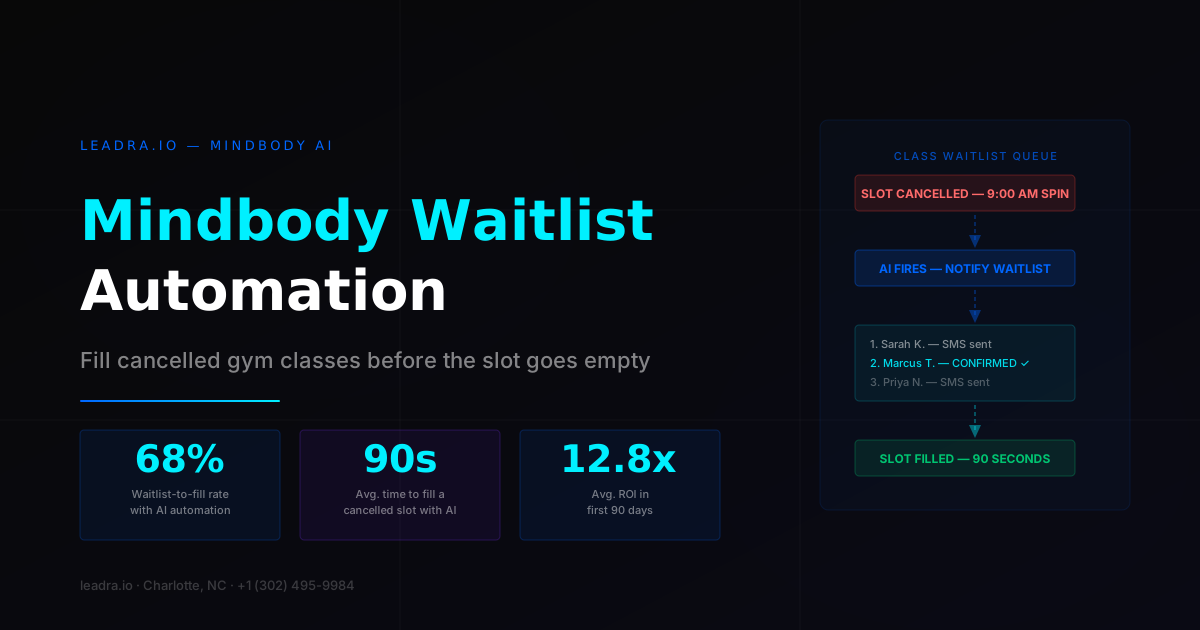
A 9:00 AM spin class has 24 spots. It sold out in two hours when it opened for booking. At 8:40 AM, three members cancel. Mindbody sends waitlist emails at 9:05 AM — five minutes after class started. Three spots sat empty. That's $75-$105 in lost revenue before your instructor even unlocked the studio door.
This happens at almost every boutique fitness studio and gym running Mindbody. The native waitlist works — in theory. In practice, email-based waitlist notifications arrive too slowly and convert too poorly to fill most last-minute cancellations. According to Mindbody's own industry data, average class cancellation rates run 15-22% within 24 hours of class time. For a studio running 10 full classes per day, that's 15-22 cancelled spots every single day.
AI-powered Mindbody waitlist automation fixes the timing and channel problem. The system connects to your Mindbody account via API, detects cancellations in real time, and fires SMS notifications to waitlisted members within 60-90 seconds of the cancellation — not 20-60 minutes later. Waitlist-to-fill conversion goes from 18-25% with native Mindbody to 52-68% with AI automation. That difference, multiplied across hundreds of classes per month, is where gyms and studios are finding $15,000-$35,000 per year in recovered revenue they were leaving on the floor.
This guide covers exactly why Mindbody's built-in waitlist underperforms, the 5-component AI system that solves it, and the results a Charlotte fitness studio saw in the first 90 days of running it.
Why the Native Mindbody Waitlist Leaves Money on the Table
Mindbody's waitlist feature is useful. Members can join a waitlist, and when a spot opens, they get notified. The problem is in the execution — specifically, three structural gaps that consistently kill waitlist conversion rates for busy gyms.
Email is the wrong channel for time-sensitive decisions
Mindbody waitlist notifications go out primarily via email. Transactional email open rates average 15-22%, and most emails are opened hours after they arrive — not within minutes. A 9:00 AM class cancellation at 8:35 AM requires a decision within 25 minutes. A member who opens the email at 11:00 AM is looking at a class that started two hours ago. SMS open rates run above 90% within 3 minutes of delivery, making it the only viable channel for same-day class fill notifications. AI-powered automation routes waitlist alerts via SMS first, with email as a fallback — not the primary channel.
Slow notification speed kills intent
Mindbody's notification timing depends on processing cycles and platform queue depth. During peak cancellation windows — 45-90 minutes before a morning class — email notifications often arrive 20-60 minutes after the cancellation event. By then, a member who wanted to attend has likely made another plan or is no longer near the studio. Research on booking conversion shows that response rate to class availability notifications drops by 65% when the notification arrives more than 15 minutes after the spot opens. AI systems that fire within 90 seconds catch members while they're still in decision mode.
No fallback when the waitlist is empty or unresponsive
When a class has no waitlist — or all waitlisted members miss the notification window — the spot simply goes unfilled in Mindbody. There's no mechanism to reach the broader member base, re-engage members who previously attended the class, or recover the revenue. AI automation adds a second-chance fill path: if the waitlist cascade fails to fill the spot, the system sends a targeted outreach to members who have attended the same class in the past 45 days but aren't currently booked. This lapsed-booker segment converts at 22-31% for same-day class opens.
The revenue math is straightforward. A boutique studio averaging 2 unfilled cancelled spots per day at $30 drop-in value loses $21,900 per year in recoverable class revenue. At a 62% fill rate improvement with AI automation, that's $13,578 recovered annually — from an automation that runs completely in the background without touching a single staff member's workflow.
The 5-Component AI Waitlist System for Mindbody Gyms
Here's the full system Leadra.io deploys for Mindbody gym and studio clients. Each component handles a specific failure point in the native Mindbody waitlist flow. The result is a fully automated fill loop that runs 24/7 without staff intervention.
Real-time cancellation detection via Mindbody API
The AI connects to your Mindbody account via webhook. The moment a member cancels a spot in a full class — whether through the Mindbody app, the member portal, or an SMS response to a reminder — the cancellation event fires to the AI system in real time. The system confirms the class is full (no open spots left) and checks whether a waitlist exists for that class. If both conditions are true, the waitlist fill sequence starts within 15-30 seconds of the cancellation. Native Mindbody waitlist notifications typically fire 20-60 minutes later, by which point many waitlisted members have already made other plans.
Priority-ordered multi-channel notification cascade
The AI notifies waitlisted members in waitlist order via SMS first, then push notification, then email — all within 60-90 seconds of the cancellation. SMS gets a 91-95% open rate within 3 minutes, compared to 15-22% for email. The message is short: class name, time, instructor, and a one-tap confirmation link. Each member gets a 12-15 minute response window before the cascade moves to the next person. The cascade logic respects the order of the waitlist but adjusts dynamically — if member 1 has previously shown a pattern of ignoring waitlist notifications (tracked across past classes), the window shrinks to 8 minutes before the cascade continues. This prevents one unresponsive member from blocking the slot from getting filled.
One-tap spot confirmation and instant Mindbody booking
When a waitlisted member confirms via SMS reply or link tap, the AI creates the booking directly in Mindbody via API — no staff interaction required. The member receives an immediate confirmation with class details, location, and a calendar add link. The system also updates the waitlist to remove the confirmed member and notifies the next people in line that the class is now full. Members who miss their window receive a courtesy notification so they know they didn't get the spot. The full confirmation loop — from cancellation to confirmed new booking — runs in under 90 seconds on average.
Empty-waitlist fallback: reactivate lapsed bookers
When a spot opens in a class that has no waitlist — or where all waitlisted members decline — the AI activates a secondary fill path. It pulls members who have previously attended the same class but haven't booked in 14-45 days (lapsed bookers for that specific class), and sends them a personalized win-back text: 'A spot just opened in [Class] with [Instructor] at [Time] — book it now?' This segment converts at 22-31% for same-day classes. The message targets members with a known affinity for the specific class rather than sending a generic open-spot blast to your full member list, which produces low conversion and high opt-out rates.
Fill rate reporting and waitlist size optimization
Every cancellation event, waitlist notification, conversion, and unfilled slot is logged automatically. After 30 days, the system produces a class-level fill rate report: which classes have the highest cancellation volume, which waitlists are too short to cover typical cancellation patterns, and which time slots consistently go partially empty due to late-cancellations without a waitlist buffer. This data tells you exactly where to run promotions to build waitlist depth and which classes are candidates for adding a second session. Gyms that use this data to optimize their schedules see a further 8-12 percentage point improvement in average class fill rate over 60-90 days.
Why SMS Cascade Outperforms First-Come-First-Served
Mindbody's native waitlist uses a first-come-first-served model: all waitlisted members get notified at the same time, and the spot goes to whoever books first. This feels fair, but it creates a race that pushes members to opt into multiple waitlists and book the first one that opens — then cancel the others. AI cascade logic gives each member a guaranteed window (12-15 minutes) before the spot moves to the next person. Members get a real opportunity to respond, not a speed test. The result is higher conversion per notification and fewer cascade-through-the-list scenarios where nobody books because everyone assumes someone above them got it.
Native Mindbody Waitlist vs. AI Automation: Side-by-Side
Here's how the two approaches compare across every dimension that drives waitlist fill rates:
| Factor | Native Mindbody | AI Automation |
|---|---|---|
| Notification speed after cancellation | 20-60 minutes (Mindbody email batch) | 60-90 seconds (real-time SMS + push) |
| Notification channel | Email only | SMS first, then push, then email (cascaded) |
| Waitlist-to-fill conversion rate | 18-25% | 52-68% |
| Response window per member | First come, first served (no enforced window) | 12-15 min cascade per member (dynamic) |
| Fallback when waitlist is empty | Slot goes unfilled | Lapsed booker re-engagement (22-31% conversion) |
| Booking creation | Staff manually process or member self-books | Instant Mindbody booking via API on confirmation |
| Staff time per filled slot | 5-15 min (monitor + process manually) | 0 min (fully automated) |
| Fill rate data and reporting | Not tracked systematically | Class-level dashboard, updated daily |
The comparison doesn't mean Mindbody's native waitlist is broken — it means it was designed for a different problem. The native waitlist handles booking management well. It was not designed to maximize same-day fill rates through multi-channel, time-sensitive notification cascades. AI automation adds that layer on top of Mindbody without replacing any of the core scheduling functionality you depend on.
Case Study: Charlotte Studio Goes From 24% to 71% Waitlist Fill Rate in 63 Days
Client Story — Charlotte, NC
A Charlotte barre and cycle studio in the NoDa neighborhood runs 14 classes per day across two spaces, all managed in Mindbody. When they came to Leadra.io in early 2026, their peak classes (6:00 AM, 7:00 AM, and 5:30 PM) were running at 85-95% booked capacity but ending up at 70-76% actual attendance due to late cancellations. Their average cancellation volume was 31 spots per day across all classes, and their self-reported waitlist fill rate was “maybe 1 in 4” — roughly 24%. They estimated they were losing 23 filled spots per day that should have been filled from the waitlist but weren't.
Leadra.io connected to their Mindbody account via API, configured the 5-component waitlist system with a 13-minute cascade window per member, and added a lapsed-booker fallback targeting members who had attended the same class within the past 30 days. SMS was set as the primary notification channel, with push notification as secondary and email as the 5-minute fallback. The studio was live in 58 hours. Staff training took 20 minutes — their only new task was reviewing the daily fill report each morning.
Daily cancelled spots
31 avg
31 avg
Waitlist fill rate
24%
71%
Spots filled per day
7-8
22
Weekly recovered revenue
~$1,750
~$5,390
System cost: $750/month. Drop-in / class pack value: $25/spot. 22 filled spots/day at $25 = $550/day recovered. Weekly: $3,850 net vs. $1,750 prior. Month-1 ROI: 12.8x. Lapsed-booker fallback filled 18% of all recovered spots in month 1.
The most significant finding from the Charlotte deployment was the 6:00 AM class pattern. This class had the highest cancellation rate (28% of booked spots cancelled within 3 hours of class time) and the longest waitlist. With the native Mindbody system, most of those waitlist spots went unfilled because the email arrived after 6:00 AM. With AI SMS automation, the cascade ran at 3:45 AM and 4:15 AM — when members were awake and making decisions about their morning — and converted at 81%.
By day 63, the studio's average class fill rate had moved from 73% actual attendance to 89%. The owner used the class-level data from the fill rate report to add a second 6:00 AM session on Tuesdays and Thursdays — the report showed a consistent unmet demand pattern that waitlist fill alone couldn't solve. The automation surfaced the opportunity; the studio decision was straightforward.
What Mindbody Waitlist Automation Costs — and the ROI Math
Pricing for AI Mindbody waitlist automation depends on class volume, integration complexity, and whether lapsed-booker fallback outreach is included:
Starter
$400-$750/moReal-time cancellation detection, SMS + email cascade notifications, 2-step waitlist cascade, Mindbody API integration, monthly fill rate report. Best for studios running under 8 classes per day with moderate cancellation volume.
Growth
$750-$1,500/moFull 5-component system: real-time detection, SMS-first cascade, push + email fallback, dynamic cascade windows, lapsed-booker fallback outreach, instant Mindbody booking via API, class-level fill rate dashboard with schedule optimization recommendations. Best for studios and gyms running 8-20 classes per day.
Scale
$1,500-$3,000/moMulti-location support, advanced lapsed-booker segmentation by class type and instructor affinity, predictive waitlist depth alerts (flags classes likely to have unfilled cancellations 48 hours ahead), CRM sync, and monthly strategy call. Best for gym groups, multi-location boutique fitness brands, or corporate wellness operators.
The ROI calculation for Mindbody waitlist automation is more direct than most marketing tools because the revenue impact is measurable to the individual booking. A studio paying $800/month for Growth that recovers 2 additional filled spots per day at $28 average drop-in value generates $1,680/month in recovered revenue — a 2.1x monthly ROI on the system cost. At 3 recovered spots per day at $30, that's $2,700/month — a 3.4x monthly ROI. Most studios in the Growth tier reach positive ROI within the first week of going live.
For membership-based gyms where members pay a flat monthly rate rather than per class, the ROI calculation shifts to occupancy improvement and its effect on perceived value. Members who consistently get into classes they want — even when they're waitlisted — cancel their memberships at a 40-55% lower rate than members who routinely miss classes due to slow waitlist processing. The retention impact in a flat-rate gym is typically larger than the direct fill revenue in a drop-in model.
How to Set Up AI Waitlist Automation for Your Mindbody Gym: 3 Steps
Setup is straightforward — Mindbody's API is well-documented and Leadra.io has built the integration for dozens of studio clients. Here's the path from decision to first filled spot:
Pull your current waitlist fill rate from Mindbody
In Mindbody, run a class attendance report for the past 60-90 days. Look for classes that were booked to capacity and compare booked vs. checked-in. The gap is your cancellation volume. For each class with a waitlist, look at how many waitlist members actually got in vs. how many were on the list at time of cancellation. Most studios find a fill rate between 15-30%. That number is the baseline the AI system needs to beat. For a studio with 10 full classes per day and a 20% fill rate, the AI target is 52%+ — 3-4x improvement. Calculate the daily revenue value of the unfilled slots at your drop-in or pack rate. That number is what you're recovering.
Configure cascade windows and lapsed-booker targeting with Leadra.io
Leadra.io works with you in a 45-minute onboarding call to set the cascade window length (typically 12-15 minutes for boutique fitness, longer for gyms where members are less time-constrained), the lapsed-booker lookback window (14-30 days for high-frequency studios, 30-45 days for less frequent attenders), and the fallback outreach message tone. You also set the classes where the system should run — most studios include all full classes, but some exclude certain class types (e.g., private training) from the automation. Once approved, the configuration is built and tested against your Mindbody sandbox before going live.
Go live, review the daily fill report, and optimize schedule
The system goes live within 48-72 hours of your Mindbody API credentials being connected. You receive a daily fill rate digest each morning showing cancelled spots, waitlist notifications sent, spots filled, and revenue recovered. In the first 30 days, review which classes are consistently hitting 70%+ fill rates (the automation is working) and which are falling below 40% (waitlist too short, wrong notification timing, or a class type that doesn't attract waitlist demand). Leadra.io reviews the report with you monthly and recommends schedule adjustments based on demand patterns the data reveals.
Waitlist fill automation works best as part of a broader class attendance system. Leadra.io's class booking automation for gyms using Mindbody covers the full system — including no-show reminders, post-class rebooking nudges, and the AI voice booking agent for members who prefer to call. Waitlist automation fills the empty slots after a cancellation; no-show reduction prevents the cancellations from happening in the first place. Together they move average class fill from 68-73% to 86-92% within 90 days. See also: dormant member reactivation for gyms to rebuild the member base that feeds the waitlist.
Frequently Asked Questions
What is Mindbody waitlist automation and how does it work?
Mindbody waitlist automation is an AI layer that connects to your Mindbody account via API and monitors class bookings in real time. When a member cancels a spot in a full class, the AI fires a multi-channel notification — SMS, push notification, and email — to the next members on the waitlist within 60-90 seconds. Members can confirm the spot with a single reply or tap. If the first member doesn't respond within a set window (typically 10-15 minutes), the system cascades down the waitlist automatically. AI-powered automation fills 52-68% of cancelled slots, compared to 18-25% with Mindbody's native waitlist, because of response speed and multi-channel outreach rather than email-only notifications sent hours after the cancellation.
Why doesn't Mindbody's built-in waitlist fill classes automatically?
Mindbody's native waitlist notifies members primarily via email, which has a 15-22% open rate for transactional messages. Notification speed also depends on processing cycles — members often receive the waitlist email 20-60 minutes after the cancellation happens, giving them little time to rearrange their schedule. AI-powered waitlist automation solves both problems: it fires SMS notifications within 90 seconds of the cancellation (open rate above 90%) and uses a timed cascade so the spot is filled in order rather than going to whoever happens to check their email first.
How much revenue can AI waitlist automation recover for a gym?
A boutique fitness studio running 12-class-per-day schedules with a 17% cancellation rate in full classes experiences roughly 2-3 cancelled paid slots per day that go unfilled. At a $25-$35 drop-in or class pack value per spot, that's $50-$105 per day in lost revenue — $18,000-$38,000 per year. AI waitlist automation that fills 62% of those spots recovers $11,000-$24,000 annually. For Mindbody gyms running membership-based models rather than drop-ins, the value is the occupancy improvement: going from 72% average class fill to 87% generates equivalent revenue without adding new members.
Does AI waitlist automation work with other gym software besides Mindbody?
Yes. Leadra.io's waitlist automation integrates with Mindbody, Glofox, Pike13, Zen Planner, ABC Fitness, ClubReady, and Vagaro via API. The core system — cancellation detection, cascading multi-channel notification, and spot confirmation — works the same across all platforms. Setup time varies slightly by software (48-72 hours for Mindbody, Glofox, and Zen Planner; up to 5 days for custom CRM integrations). If your gym management software has a public API and sends real-time webhook events for bookings and cancellations, the automation can be connected.
Every Cancelled Spot Is a Filled Spot Waiting to Happen
The member who cancels their 7:00 AM spin spot at 6:40 AM isn't the problem. The member on your waitlist who wanted that spot but got an email at 7:05 AM — after driving past your studio on the way to work — that's the gap. It's not a booking problem. It's a timing and channel problem, and it's entirely fixable.
AI Mindbody waitlist automation turns last-minute cancellations from a revenue leak into a fill-rate system. The cancelled spot gets filled in 90 seconds. The waitlisted member gets a real shot at the class they wanted. Your studio earns the revenue it had already earned when that class sold out. Nothing changes in Mindbody — the automation runs in the background, invisible to members and staff alike.
Leadra.io deploys AI Mindbody waitlist automation for boutique fitness studios and gyms across the U.S. — fully integrated with your existing Mindbody setup, live in under 72 hours, with zero required changes to how your staff or members use the platform.
Free Waitlist Audit
Find Out How Many Spots Your Studio Is Leaving Empty Every Week
30-minute audit. We'll pull your Mindbody cancellation data, calculate your current waitlist fill rate, and project the revenue recovery of AI automation before you commit to anything.
Leadra.io
AI marketing agency — Charlotte, NC · Published June 30, 2026