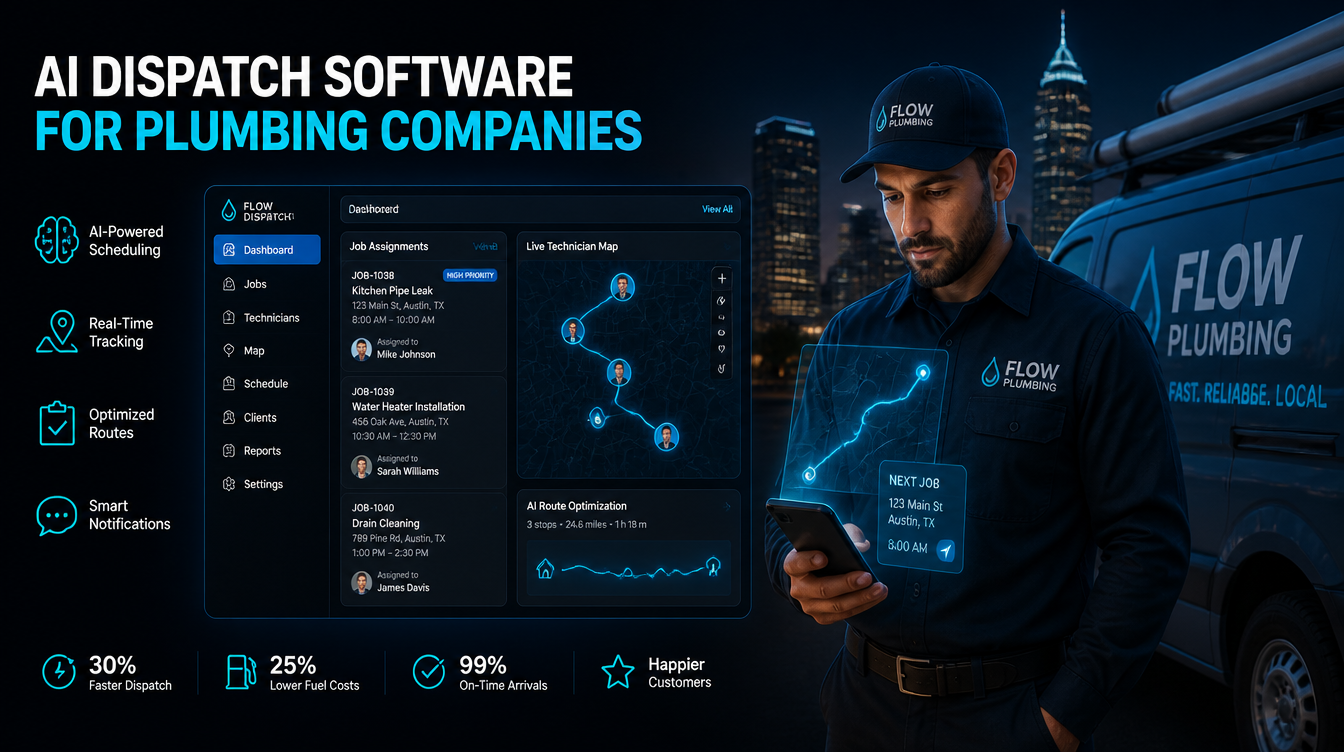
Plumbing AI Dispatch Software for Small Fleets: Run 5 Technicians Without a Full-Time Dispatcher (2026 Guide)
By Leadra.io Team · July 1, 2026 · 9 min read
A 5-tech plumbing company in Charlotte was paying a full-time dispatcher $48,000 a year. She was good at her job — but she worked 8am to 5pm, took lunch breaks, and couldn't field calls during a busy storm week without dropping others. After switching to AI dispatch software, the same company handled 40% more service calls, cut average response time from 22 minutes to 6 minutes, and reduced their dispatch cost to $389 a month. The dispatcher was reassigned to customer follow-up and upselling — a role that actually grew revenue instead of just managing logistics.
That's the shift happening across small plumbing fleets right now. If you run 3-8 technicians and you're still dispatching by phone, whiteboard, or gut feel — you're competing against companies that automated this two years ago. Here's exactly how plumbing AI dispatch software works, what it costs, and how to implement it in 14 days.
Why Dispatch Is the Hidden Bottleneck for Growing Plumbing Companies
Most plumbing owners focus on lead generation and technician hiring when they hit a growth ceiling. The bottleneck is almost always dispatch. Bad dispatch decisions compound every day: the wrong tech gets sent across town while a closer one sits idle, a callback slips through during a busy hour, a same-day slot goes unfilled because nobody called the cancellation list. According to ServiceTitan's 2025 Field Service Benchmark Report, plumbing companies lose an average of 14% of bookable revenue to dispatch inefficiency — jobs that exist but never get assigned.
Human dispatchers solve some of this. But they introduce their own constraints: they work set hours, they have cognitive limits on how many jobs they can track simultaneously, and they make routing decisions based on habit rather than data. A dispatcher with five years of experience knows your best techs — but they don't know in real time which truck is 2 miles from an emergency call versus 14 miles away.
AI dispatch software knows all of that. It processes location, availability, skill match, job priority, and estimated job duration simultaneously — and makes the call in under 60 seconds. For small plumbing fleets, that difference is the margin between a good month and a great one.
Key Stat
Plumbing companies that implement AI dispatch recover an average of 11-18% more billable hours per technician per week — without adding a single new hire. (ServiceTitan Field Service Benchmark Report, 2025)
What Plumbing AI Dispatch Software Actually Does
Plumbing AI dispatch automation is not a chatbot. It's not a scheduling widget. It's a decision engine that sits between your phone system and your technicians — pulling in live data and making routing decisions the way a veteran dispatcher would, only faster and without time constraints.
Here's what the software handles automatically:
- Inbound call triage — an AI voice agent answers calls, captures job type, address, and urgency level, and creates a dispatch ticket without human input
- Technician matching — the system matches the job to the right tech based on skill set (water heater, drain cleaning, gas line, etc.), current location, and workload
- Route optimization — instead of eyeballing a map, the AI calculates the fastest route for each technician's full day, adjusting in real time as new jobs come in
- Customer status updates — automated SMS keeps homeowners informed of arrival windows without dispatcher phone calls
- Same-day slot recovery — when a cancellation happens, the AI immediately texts the next person on the waitlist and fills the slot before the driver reaches the next job
- After-hours capture — calls received outside business hours get triaged, classified as emergency vs. next-day, and routed appropriately without waiting for a human to check messages
What it doesn't do: negotiate with difficult customers, handle complex multi-day commercial projects, or replace the judgment calls a senior tech makes on-site. AI dispatch handles the logistics layer. Your people handle the craft and the relationships.
Human Dispatcher vs. AI Dispatch Software: Side-by-Side
| Factor | Human Dispatcher | AI Dispatch Software |
|---|---|---|
| Annual Cost | $42,000–$55,000 + benefits | $2,400–$6,000/year |
| Hours Available | 40 hrs/week, M–F | 24/7/365 |
| Simultaneous Jobs | 6–10 max before errors | Unlimited |
| Routing Speed | 2–8 minutes per assignment | Under 60 seconds |
| Cancellation Recovery | Manual callback, often missed | Automatic SMS within 90 seconds |
| After-Hours Coverage | Requires on-call pay or voicemail | Full triage and routing included |
| Data & Reporting | Manual logs, often incomplete | Automatic, real-time dashboard |
| Sick Days / Turnover | High disruption risk | Zero |
The table makes the cost case obvious. But the real argument for AI dispatch isn't cost savings — it's capacity. A human dispatcher can't manage a flood of emergency calls during a pipe-burst storm while simultaneously optimizing tomorrow's schedule and following up on missed estimates. The AI can.
How Plumbing AI Dispatch Works — 5 Steps
Here's what happens from the moment a customer calls to the moment a technician arrives on-site with AI dispatch running:
Call Answer and Triage (0–90 seconds)
An AI voice agent answers every call — no hold music, no voicemail. It asks the customer for their address, describes the problem, and flags urgency level (burst pipe vs. slow drain vs. routine water heater service). A dispatch ticket is created automatically and pushed to the routing engine.
Technician Match (60 seconds)
The routing engine cross-references job type, technician skill set, current GPS location, workload, and estimated completion time on their current job. It selects the best available tech — not the most available one. If the closest tech doesn't have the right certification for the job, the system finds the next best match automatically.
Job Pushed to Technician's Phone (2 minutes)
The technician receives a push notification with job details, customer address, problem description, and turn-by-turn directions. They accept or flag a conflict with one tap. If they flag a conflict, the system reassigns in seconds — no phone tag with an office dispatcher.
Customer Gets Automated Status Updates
The customer receives an SMS confirming the tech's name, estimated arrival window, and a live tracking link — the same experience they get from Uber. When the tech is 15 minutes out, another automated text fires. No more "when will you be here" calls clogging your phone line.
Post-Job Automation
After job completion, the system triggers a review request, logs the job in your CRM, and checks if the customer has any outstanding estimates from prior visits. If they do, an automated follow-up sequence fires within 2 hours — without anyone on your team touching a keyboard.
Real-World Example: 4-Tech Charlotte Plumbing Company
(Results represent outcomes typical for Leadra.io clients in this segment.)
A residential plumbing company in south Charlotte was running 4 technicians with the owner handling dispatch himself between service calls. He was losing jobs because he couldn't answer the phone while under a sink, and he was routing by memory rather than by real-time location data. His best tech was driving past jobs that his other techs were closer to.
After implementing AI dispatch through Leadra.io:
- Calls answered: from 71% to 100% (AI voice agent handles overflow)
- Average dispatch time: 22 minutes down to under 4 minutes
- Same-day jobs completed: up 31% (better routing, faster response)
- Cancellation slots filled: 8 per month recovered on average (at $380 avg ticket = $3,040/month)
- Owner time on dispatch: from 2.5 hours/day to 15 minutes/day (review only)
- Monthly revenue increase: $6,800 (Month 1), $9,200 (Month 2), $11,400 (Month 3)
The owner didn't hire a dispatcher. He didn't hire another tech. He just stopped routing by gut and let the software do the math — and that alone added over $100,000 annualized in his second year.
“I used to dread Monday mornings.”
“Twenty calls backed up, three techs texting me at once, and I'm still on a job site. Now my phone shows me a dashboard. Everything's assigned. I just check it once an hour. That's it.”
— Plumbing company owner, south Charlotte, NC
What Plumbing AI Dispatch Software Costs in 2026
Pricing varies by call volume, number of technicians, and which integrations you need. Here's a realistic breakdown for small plumbing fleets:
| Fleet Size | Monthly Cost | What's Included |
|---|---|---|
| 1–3 Techs | $200–$350/mo | AI voice triage, basic routing, SMS updates, CRM logging |
| 4–6 Techs | $350–$550/mo | All above + real-time GPS routing, cancellation recovery, review automation |
| 7–10 Techs | $550–$900/mo | All above + multi-zone routing, commercial job prioritization, custom integrations |
Compare that to a full-time dispatcher at $42,000–$55,000/year (plus benefits, payroll taxes, and turnover costs). For a 4-tech shop, the math is simple: AI dispatch software saves $38,000–$48,000 per year. The system pays for itself within the first 10 days.
How to Implement AI Dispatch in 14 Days
This is the implementation timeline Leadra.io uses for plumbing clients. No coding required. Your techs need a smartphone and 20 minutes of onboarding.
Days 1–3: Configuration
Set up technician profiles (name, phone, skills, service zones). Import existing customer list. Connect your phone system to the AI triage layer. Map your service area and priority job types.
Days 4–7: Integration
Connect to your existing software (HouseCallPro, ServiceTitan, Jobber, or a basic Google Calendar setup). Set escalation rules: which job types always require owner review vs. which get auto-dispatched. Configure customer SMS templates.
Days 8–11: Live Testing
Run real calls through the system while you monitor assignments on the dashboard. Override when needed. Fine-tune routing logic based on how your techs actually move through the day. This is the learning period — the AI improves as it sees real patterns.
Days 12–14: Hands-Off Launch
Stop monitoring every assignment. Check the daily summary report each morning and weekly metrics on Fridays. The system runs. You focus on growing the business and handling the few judgment calls that still need you.
Your 4-Step Action Plan
- Audit your current dispatch process this week — count how many calls go unanswered, how long average dispatch takes, and how many same-day slots go unfilled. These numbers become your baseline ROI comparison.
- List your technician skill sets explicitly — before any software can dispatch intelligently, it needs to know which tech handles which job types. Write this out before you start any demo or setup call.
- Identify your integration requirements — check which field service software you already use (or whether you're still on paper). AI dispatch works best when it connects to your existing scheduling tool rather than replacing it.
- Run a 30-day pilot on one zone — don't overhaul everything at once. Pick one service area, run AI dispatch there for 30 days, measure the results, then expand.
If you want Leadra.io to handle the full setup — including AI voice triage, technician routing, cancellation recovery, and post-job review automation — we can have your system running in two weeks. See how the system works for plumbing companies or check our complete guide to plumbing AI dispatch automation for the technical breakdown.
Frequently Asked Questions
What is plumbing AI dispatch software and how does it work?
Plumbing AI dispatch software automatically assigns incoming service calls to the nearest available technician based on location, skill set, current workload, and job priority. It replaces or supplements a human dispatcher by making routing decisions in seconds rather than minutes, then sends job details directly to the technician's phone.
Can AI dispatch software replace a full-time plumbing dispatcher?
For most plumbing companies with 3-8 technicians, yes. AI dispatch handles inbound call routing, technician assignment, schedule optimization, and customer status updates automatically. Companies with 10+ technicians running complex commercial accounts may still want a human dispatcher supported by AI tools rather than fully replaced.
How much does plumbing AI dispatch software cost?
Plumbing AI dispatch software typically runs $200–$600/month for small fleets of 3-8 technicians, depending on call volume and integrations. That compares to $42,000–$55,000/year for a full-time dispatcher — a saving of $38,000–$48,000 annually for companies that make the switch.
How long does it take to set up AI dispatch for a plumbing company?
Most plumbing companies are fully operational with AI dispatch in 10-14 days. Week one covers software setup, technician profile configuration, and service area mapping. Week two is live testing on real calls with the owner monitoring assignments before going fully hands-off.
Final Thoughts
The plumbing companies adding the most revenue in 2026 are not the ones with the most technicians. They're the ones getting the most out of the technicians they already have. Bad dispatch wastes 2-3 hours of billable time per tech per day. At $180/hour average ticket value, that's $1,080 per tech per day in recovered capacity — just by routing smarter. For a 4-tech shop, that's over $4,000 a day in untapped revenue sitting in your existing workforce.
AI dispatch doesn't require a big team, a complex software stack, or a technology background. It requires a decision to stop losing jobs to logistics. That decision pays for itself within the first week.
Also see: how to close 40% more plumbing estimates with AI follow-up — the next step after dispatch is tightened up.
Ready to Stop Dispatching by Gut?
Leadra.io sets up AI dispatch for plumbing companies in Charlotte and nationwide. Full setup in 14 days. We handle the tech — you focus on the jobs.