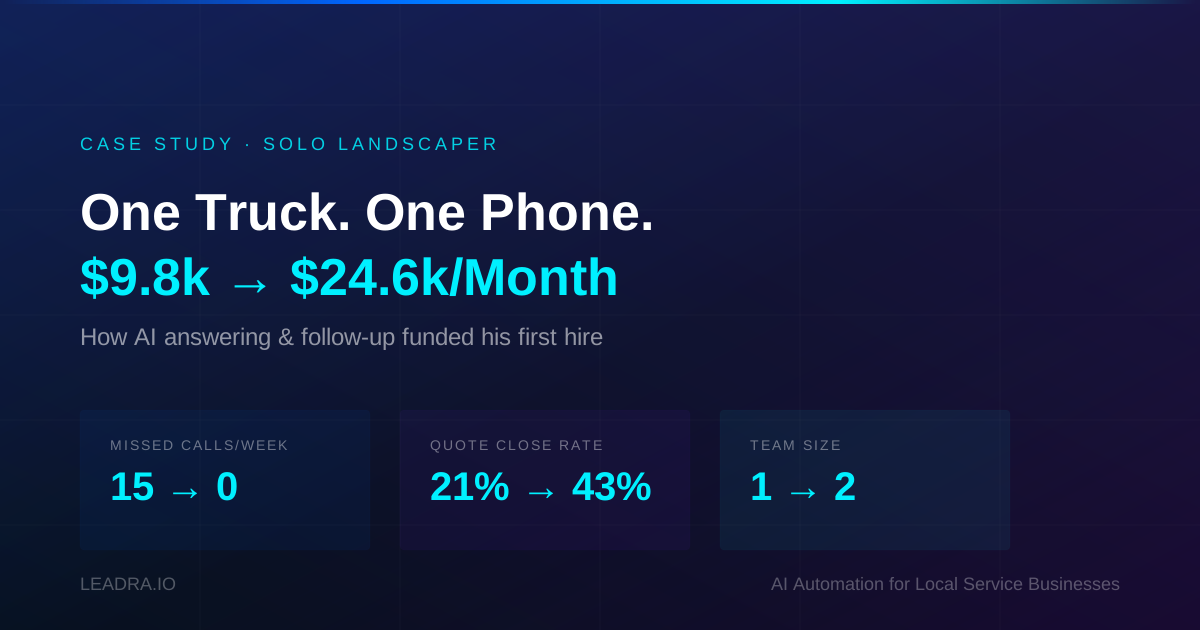
David ran his landscaping business exactly the way most solo operators do: one truck, one mower, one trailer, and a phone that rang all day while he had grass clippings up to his knees. No crew. No office. No one to answer the phone when he couldn't. He was making about $9,800 a month in the Charlotte suburbs, working six days a week, and he knew the demand was there — he just couldn't physically be in two places at once.
This is the growth stage nobody writes case studies about. Most landscaping content targets companies that already have crews and are trying to scale further. But the harder jump — arguably the most common one in the entire industry — is going from one guy with a truck to a real business with a first hire. That jump lives or dies on whether the phone gets answered and the quote gets followed up, and a solo operator has zero spare capacity to do either.
Leadra.io deployed an AI answering and follow-up system for David in March 2026. Five months later, he's at $24,600/month, has a full calendar three weeks out, and just hired his first full-time employee to run a second route. Here's exactly what changed and why.
5-Month Results at a Glance
Monthly revenue
$9.8k
$24.6k
Active clients
22
58
Quote close rate
21%
43%
Missed calls/week
15-20
0
Calendar booked out
3-4 days
3 weeks
Team size
1 (David)
2, with a truck on order
Total AI system cost: $420/month. Month-5 ROI: 35x cost. Net revenue added vs. pre-automation baseline: $14,800/month.
The Problem: There Is No Office When You're the Business
David's typical day started at 7am and ended when the light did. Somewhere in between, his phone would ring 10-15 times — new leads, existing clients asking questions, quote requests from his yard signs. He could answer maybe a third of those calls, because answering a call means shutting off a running mower, pulling off gloves, and losing five minutes he didn't have. The rest went to a voicemail box he checked, if he was lucky, once in the evening.
The quotes he did send out fared worse. He'd text a price the night he got the lead, and if the person didn't respond within a day or two, that was it — there was no system to circle back, because circling back meant remembering, and he had forty other things to remember. Homeowners requesting landscaping quotes typically contact 3-4 companies at once and hire whichever one follows up, not necessarily whichever one is best. David wasn't losing jobs because his work was worse. He was losing them because he was one person trying to be a mower, a salesman, and an office all at the same time.
That's the specific trap of the one-truck stage: you can't afford to hire help until revenue grows, but revenue can't grow because you have no time to capture the leads that are already calling you. Something has to break that loop without costing what a part-time employee would.
Manual vs. AI-Assisted: What Changed for a One-Truck Operation
None of this required David to work more hours or change how he mows a lawn. It changed what happened to every phone call and every quote the moment he couldn't personally get to it:
| Area | Manual (Solo) | With AI Automation |
|---|---|---|
| Calls answered while mowing | Goes to voicemail, most never call back | Answered live, every time, 24/7 |
| Quote follow-up | 1 touch if remembered that night | 5 touches over 10 days, automatic |
| Time spent on phone/admin per day | 90-120 minutes stolen from billable work | Under 10 minutes reviewing summaries |
| Quote close rate | 18-24% | 38-46% |
| After-hours and weekend leads | Lost entirely | Captured and booked same-day |
| Repeat client rebooking | Only if client calls first | Automated seasonal reminder texts |
For a solo operator, the biggest number on that table isn't close rate — it's the admin time recovered. Ninety to a hundred and twenty minutes a day is nearly a full extra lawn David can mow, every single day, without adding a single work hour.
The 4-Part System Built for a Team of One
Everything here was scoped for a business with no office and no admin hours to spare. There was no scheduling software migration, no CRM overhaul — just a system that plugged into the phone number and workflow David already had.
AI voice answering on his existing business line
Connected to the number already on his trucks and yard signs — no new number to advertise. Every unanswered call after 3 rings is picked up by the AI, which asks for property address, service needed, and preferred callback window, then texts David a summary in real time.
5-touch quote follow-up sequence over 10 days
Every quote David sent — by text, email, or verbally on-site — got logged and followed up automatically: a same-day confirmation, a day-3 check-in, a day-6 urgency nudge referencing seasonal timing, a day-9 offer to answer questions, and a final day-10 close attempt before the lead was marked cold.
Instant text-to-quote for simple recurring jobs
For standard mow-and-edge requests under a set square footage, the AI sent a price range instantly based on the address's estimated lot size pulled from public parcel data, letting David skip the drive-by estimate for the simplest 60% of his inbound requests.
Automated seasonal rebooking for the client list
Once he had 40+ active clients, seasonal reminder texts went out automatically for mulch refreshes, fall cleanup, and spring startup — the kind of rebooking that used to only happen if a client thought to call first.
Key Insight
The instant text-to-quote piece mattered more than expected. David assumed people would want to talk to him first. Instead, over half of his leads booked directly off the automated price range without ever needing a call — meaning the AI wasn't just answering calls he missed, it was closing jobs he wouldn't have had time to quote at all.
How the Full Calendar Became the Case for Hiring
By month three, David's close rate had roughly doubled and his active client count had grown past 40. That created a new problem — a good one. His calendar was booked two, then three weeks out. He was turning down new mow-and-edge requests not because the AI wasn't generating them, but because there was only one of him and one truck.
That's the exact signal that separates a lead problem from a capacity problem. When the AI is consistently filling the pipeline and the constraint is physically how many properties one person can mow in a week, the math on a first hire changes completely — you're not betting on future leads showing up, you already have a backlog proving they will. David hired his first employee in month four and put in an order for a second truck, confident the automated intake and follow-up would keep both routes full without him having to personally sell a second time.
For the next stage of that growth curve — what happens once a second and third crew come on and scheduling itself becomes the bottleneck — see how a 2-person landscaping company tripled revenue with AI automation and AI quote follow-up automation that closes 3x more landscaping jobs.
How to Start: 3 Steps for a Solo Landscaper
If you're a one-truck operation right now, the order of operations matters. Fix the leak before you spend anything on more advertising.
Count your missed calls for one week
Most solo landscapers have no idea how many calls they're actually missing because a missed call leaves no trace beyond a voicemail they may never check. Track it manually for seven days — every call while mowing, every call during a drive, every call after 6pm. Most one-truck operators are shocked to find they're missing 10-15 calls a week, and that number alone usually justifies the cost of an AI answering system before you look at anything else.
Deploy AI answering and quote follow-up on your existing number (week 1)
Leadra.io connects to the phone number already on your trucks and signs — nothing to reprint, nothing to re-advertise. The AI answering agent and 5-touch quote follow-up sequence go live within 48-72 hours. You provide your pricing ranges and service area, and the AI handles the rest in your voice, texting you a summary of every call so you're never out of the loop, just out of the grind of answering everything yourself.
Let your calendar tell you when to hire
Don't hire on a guess. Once the automated system is running and your calendar stays booked out 2+ weeks consistently for 60-90 days, that's real, proven demand — not a hope. At that point the case for a first employee and a second truck is made by your own booking data, not by projections, which makes it a far safer decision to fund.
Frequently Asked Questions
Can a one-person landscaping business really use AI automation, or is it only for bigger crews?
A solo landscaper is actually the business type that benefits most from AI automation, because there is no office staff to catch what the owner misses. When you're the only person and you're on a mower, every call goes to voicemail and every quote follow-up gets forgotten. AI voice answering and automated quote follow-up cost far less than hiring a part-time dispatcher and work the moment they're set up — most one-truck operations see it pay for itself from a single recovered job in the first two weeks.
How does AI answer the phone for a landscaper who is out mowing lawns all day?
An AI voice agent is connected to the landscaper's existing business phone number and answers every call that isn't picked up within a few rings — which, for someone running equipment solo, is most of them. It talks to the caller like a real scheduler: asks for the property address, service needed, and best callback window, then texts the owner a summary and books a quote slot directly on his calendar if he has open availability. The caller never hits voicemail, and the owner never has to stop the mower to find out what he missed.
How much does AI automation cost for a solo landscaping business, and when should I add it?
For a one-truck landscaping operation, an AI voice answering and quote follow-up system typically runs $250-$650/month, well under the cost of even part-time office help. The right time to add it is the moment you notice you're missing calls during work hours or forgetting to follow up on quotes you sent more than a few days ago — both are signs the business has outgrown what one person can track in their head, even if it hasn't outgrown one truck yet.
What's the first sign a solo landscaper is ready to hire their first employee?
The clearest signal isn't revenue alone — it's a full, reliable pipeline that a single person physically cannot mow through. Once quote close rate and booked jobs are consistent for 60-90 days and the calendar is regularly full 2+ weeks out, the constraint has shifted from 'not enough leads' to 'not enough hands.' At that point, hiring a second person to run a second route is the highest-return next step, because the lead flow and admin work are already handled automatically.
The Truck Wasn't the Constraint — The Phone Was
David didn't grow from $9,800 to $24,600 a month because he mowed faster or worked longer hours. He grew because every lead that called him now actually gets answered, and every quote he sends now actually gets followed up — the two things a solo operator never has enough hands or hours to do consistently on their own.
If you're running a one-truck landscaping business and you know leads are slipping through the cracks but can't justify a full-time hire yet, that's exactly the gap this system is built for. It costs less than part-time help and starts working the day it's turned on.
If your phone is ringing more than you can answer, call us and we'll show you exactly what it's costing you every month.
Free Missed-Call Audit
Find Out How Many Jobs Your Phone Is Losing
30-minute call. We'll map your current call volume, quote close rate, and follow-up gaps — then show you exactly what an AI answering system would recover at your current lead flow.
Leadra.io
AI marketing agency — Charlotte, NC · Published August 29, 2026