Most antique shop owners think AI is for tech companies and big-box retailers. It's not. The antique business has a specific set of problems that AI solves better than any hire you can make — missed calls, unanswered emails, estate sale leads that go cold, and buyers who search Google and can't find you. The cost of fixing all of that with AI is less than hiring a part-time assistant.
This post gives you the real AI cost for antique shop business in 2026. Not vendor marketing estimates — actual monthly ranges broken down by tool type, what each tool does for an antique shop specifically, and what kind of return shops are actually seeing. You'll also see the right order to buy these tools so you don't waste money on the wrong thing first.
At Leadra.io, we build AI systems for antique shops and local retail businesses and track what they generate. These numbers come from that work.
Why AI Cost for Antique Shop Business Is Different From Other Retail
Antique shops have a unique problem set. You're selling one-of-a-kind inventory that cannot be restocked. You get calls all day about item availability — and every missed call is a sale that walked to the next shop. You have estate sale leads coming in through your door, your website, and the phone simultaneously, and there's no system to capture any of it. And most antique shops in any given market are invisible on Google because no one is running local SEO.
These problems are different from a restaurant or dental office. You need AI that handles inbound calls intelligently, captures buyer intent for specific item categories, manages estate consignment leads, and shows up when someone searches "antique shops near me Charlotte NC." The tools that solve those problems are specific, and so is the cost.
According to a 2025 BrightLocal study, 76% of consumers who search for a local business on their smartphone visit that business within 24 hours. For antique shops, that window is even shorter — buyers are often browsing on the way somewhere and will stop if you show up in search. AI-driven local SEO captures that traffic at a fraction of the cost of paid advertising.
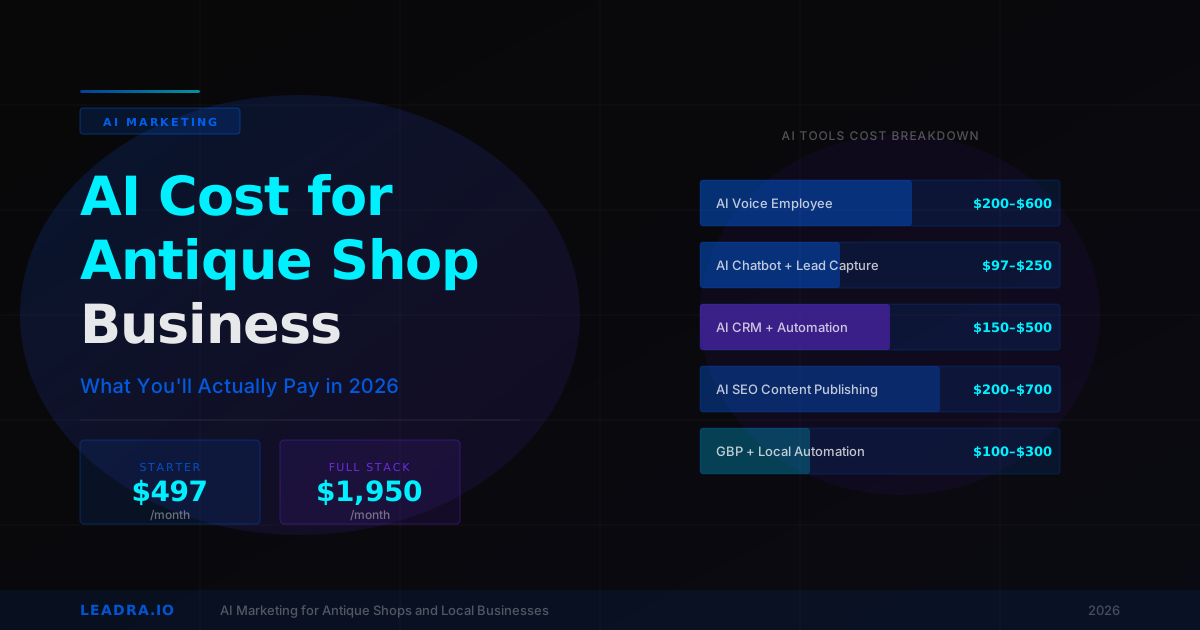
The five AI tools worth investing in for an antique shop are: an AI voice employee, a website chatbot with lead capture, a CRM with follow-up automation, local SEO content publishing, and Google Business Profile automation. Below is what each actually costs.
AI Cost Breakdown by Tool Type
1. AI Voice Employee — $200 to $600/month
This is the single highest-ROI AI investment for most antique shops, and it should come first. An AI voice employee answers every inbound call — whether you're with a customer on the floor, at an estate sale pickup, or closed for the day. It handles item availability questions, store hours, consignment intake inquiries, and directions, then routes any high-value or urgent calls directly to your cell.
Current AI voice tools (Bland.ai, Retell.ai, Vapi) charge $0.07 to $0.15 per minute. A shop receiving 80 calls per month averaging 3 minutes each spends about $25 to $40 in usage. Platform setup and management adds $175 to $400/month. Compared to the cost of missing 15 to 20 calls per month — each of which represents a potential $100 to $2,000 sale — the math is not close.
2. AI Chatbot and Website Lead Capture — $97 to $250/month
Buyers who find your antique shop on Google often visit your website before they visit your store. Most antique shop websites have no lead capture at all — a phone number, maybe an email, and nothing else. An AI chatbot changes that. It engages visitors at 11 PM when they're browsing for mid-century furniture, collects their name and email, asks about their item interests, and routes the conversation to your CRM automatically.
At $97/month, you get a rule-based chatbot that captures contact info and answers common questions. At $200 to $250/month, you get a GPT-powered assistant that can discuss specific item categories, price ranges, consignment terms, and buying criteria — then send your team a full summary of the conversation before they follow up. Shops using the higher-tier version report 4x more website leads compared to a contact form alone.
3. AI CRM and Follow-Up Automation — $150 to $500/month
Antique shops collect buyer contact information constantly — estate sale pickups, in-store purchases, website inquiries, phone calls — and almost none of it ever gets followed up with systematically. A CRM with AI automation changes that. Every contact enters a follow-up sequence based on what they expressed interest in. A buyer who asks about Victorian furniture gets a sequence about new Victorian pieces as they come in. An estate family who inquired about consignment gets a 3-touch sequence until they book an appointment.
GoHighLevel runs $97/month for the core platform and handles multi-channel follow-up (email + SMS) plus deal tracking. HubSpot Starter is $150/month with a clean interface many shop owners find easier to start with. Either works. The key is having sequences built for your two main buyer types: retail collectors and estate consignment leads. At $150 to $300/month, this tier pays for itself with a single reactivated buyer.
4. AI SEO Content Publishing — $200 to $700/month
Most antique shops are invisible on Google outside of their Google Business Profile. There are thousands of people searching "antique furniture Charlotte NC," "where to sell antiques near me," and "mid-century modern antiques Charlotte" every month. Every one of those searches is a buyer or a seller — exactly who you want. AI-assisted SEO content targets those keywords with blog posts and buyer guides that rank on page one within 60 to 90 days.
At $200/month, you get a tool like Surfer SEO that helps you write content yourself. At $500 to $700/month, a done-for-you service publishes 6 to 10 posts per month and handles technical SEO — schema markup, internal linking, image optimization, and indexing. For antique shops, this is the tool that generates compounding returns: traffic from a post published in month one is still arriving in month twelve.
5. Google Business Profile and Local Automation — $100 to $300/month
Google Business Profile is the most important marketing asset an antique shop has, and most shops manage it manually or not at all. AI tools automate GBP management: weekly photo uploads of new inventory, automated review response, Q&A management, and Google Posts that surface your latest arrivals to searchers in your area. This keeps your profile active, which is one of the top ranking signals Google uses for local map pack placement.
Tools like Broadly, BirdEye, or a custom automation stack through Zapier handle this for $100 to $300/month depending on the level of service. At the lower end, you get automated review requests and response templates. At the higher end, you get active GBP management with weekly posting and reputation monitoring. Either tier improves local map pack rankings within 30 to 60 days of consistent use.
What a Full AI Stack Costs an Antique Shop
Here is what a complete AI system costs when all five tools are running together:
| Tool | Starter | Full Stack |
|---|---|---|
| AI Voice Employee | $250 | $500 |
| AI Chatbot + Lead Capture | $97 | $250 |
| AI CRM + Automation | $150 | $400 |
| AI SEO Content | — | $600 |
| Google Business + Local AI | — | $200 |
| Monthly Total | $497 | $1,950 |
The starter setup at $497/month is the right entry point for most antique shops. It handles the two biggest revenue leaks — missed calls and zero follow-up — immediately. A single estate consignment deal or one high-ticket furniture sale covers this cost entirely.
The full stack at roughly $1,950/month makes sense for shops doing $20k or more in monthly sales. At that volume, AI-driven SEO and local optimization generate 15 to 30 additional buyer inquiries per month — and at average antique shop transaction values, that adds $5,000 to $20,000 in monthly revenue. The ROI ratio runs 3x to 10x on the monthly AI investment within six months.
Real ROI: What Antique Shops Actually See
Here is a representative pattern from antique shops using a starter AI stack. Results vary by shop size and market, but this shape is consistent:
A mid-size antique shop with a 3,000 square foot floor and a mix of furniture, collectibles, and vintage jewelry implemented AI voice answering and website chatbot. Results within 60 days:
- Captured 22 calls that would have gone to voicemail or disconnected — 8 resulted in in-store visits
- Estate consignment inquiry form on the website generated 4 qualified leads in the first month, 2 converted to active consignments
- Website lead capture went from a static contact form (2 submissions/month) to 14 qualified buyer inquiries/month via chatbot
- One estate consignment brought in $6,200 in consignment inventory that sold within 45 days
The AI stack cost $447/month. The estate consignment alone generated $6,200 in gross sales in 45 days. That is a 14x return in month two — from a single lead that previously would have sent an email, gotten no response, and called a competitor. This is the pattern we see consistently across antique shops: the revenue is already there, sitting in missed calls and unanswered inquiries. AI captures it.
AI for Antique Shops in Charlotte, NC and the Carolinas
Charlotte's antique market is competitive and growing. The Antique Kingdom on South Boulevard, the dealers along Providence Road, and the boutique shops in NoDa all serve a buyer base that increasingly starts their shopping on Google and Instagram before visiting in person. The shops showing up in local search are capturing that traffic. The shops not showing up are losing it to competitors who may have less inventory but better digital presence.
Charlotte-specific search terms like "antique furniture store Charlotte NC," "where to sell antiques in Charlotte," and "estate sale buyers Charlotte NC" get thousands of monthly searches with low to medium competition. A shop with AI-driven SEO content targeting those terms can reach page one of Google within 60 to 90 days. No shop in Charlotte is doing this systematically right now — which means the window for first-mover advantage is wide open.
Leadra.io works with antique shops and local retail businesses across Charlotte and the Carolinas to build these AI systems from scratch. If you want to know exactly what this would cost for your shop and what it would generate, the fastest path is a direct conversation. Call +1 (864) 721-8384 and we'll walk through the numbers in 15 minutes.
How to Start: The Right Order for AI Investment
The mistake most antique shop owners make is spending on the wrong thing first — a new website or social media ads — before fixing the systems that capture and follow up with leads. Here is the correct order:
Step 1
AI voice employee first
Missed calls are your biggest revenue leak. Fix that before anything else. Install an AI voice employee trained on your inventory categories, store hours, consignment process, and pricing approach. Budget: $200 to $400/month.
Step 2
Website chatbot and CRM
Once your phone is covered, capture leads from your website and set up a CRM to follow up automatically. This builds your buyer list and estate consignment pipeline. Budget: $250 to $450/month additional.
Step 3
Google Business Profile automation
Activate automated review requests, weekly GBP posting, and Q&A management. This improves local map pack ranking so more buyers find you organically. Budget: $100 to $200/month additional.
Step 4
AI SEO content
Start publishing 6 to 8 blog posts per month targeting buyer and seller keywords for your market. This compounds over 3 to 6 months and becomes your lowest-cost lead source long-term. Budget: $400 to $600/month additional.
Frequently Asked Questions
How much does AI cost for an antique shop business per month?
AI cost for an antique shop business runs from $300 to $500/month for a starter setup to $1,500 to $2,500/month for a full stack. The starter covers AI voice answering and basic chatbot lead capture. The full stack adds CRM automation, SEO content publishing, and Google Business Profile management. Most shops see ROI within 60 to 90 days from captured estate inquiries and collector leads.
What is the best AI tool to start with for an antique shop?
An AI voice employee that answers calls 24/7 is the highest-ROI starting point for most antique shops. Missed calls are the single biggest revenue leak for shops with active foot traffic and phone inquiries. An AI voice employee costs $200 to $500/month, answers every call, handles availability questions, and captures leads from callers who would otherwise hang up and call a competitor.
Is AI worth the cost for a small antique shop?
Yes. A single estate consignment or one high-value furniture sale covers 3 to 6 months of AI system costs. Shops using AI lead capture and voice answering report 4 to 8 additional qualified inquiries per month that previously went unanswered. At average antique shop margins, that generates $2,000 to $10,000 in additional monthly revenue from a $300 to $500/month AI investment.
Can AI handle calls about item availability for an antique shop?
Yes. An AI voice employee is trained on your inventory categories, price ranges, store hours, and consignment process. It answers availability questions accurately, collects caller contact details, and notifies your staff for high-value or urgent inquiries. It handles routine questions without pulling you off the sales floor — and it answers every call at 9 PM when your doors are locked.
The Bottom Line on AI Cost for Antique Shop Business
AI is not complicated for antique shops, and it is not expensive relative to what it generates. The starter cost is $497/month. It solves the two problems that cost most antique shops the most money — missed calls and zero follow-up. From there, local SEO and content publishing build the organic lead pipeline that runs permanently without paid ads.
The antique shop owners who are growing in 2026 are not the ones with the biggest ad budgets. They are the ones who answer every call, follow up with every lead, and show up on Google when buyers search for what they sell. Those three things are now fully automatable. The shops that adopt AI this year will have a compounding advantage over competitors who don't — in local search, in lead capture, and in buyer relationships that get nurtured automatically over time.
One more thing worth saying directly: the cost of missing calls and leads is much higher than the cost of AI. If your shop misses 15 calls a month and converts 20% of answered calls to sales at $300 average ticket, that is $900 in monthly revenue walking out the door. The AI to fix that costs $250/month. The math is obvious.
Want the exact cost breakdown for your antique shop?
Leadra.io builds AI lead generation and automation systems for antique shops and local retail businesses. We will map out exactly which tools your shop needs, what they will cost, and what you can realistically expect to generate — in 15 minutes.
Related reading
Written by the Leadra.io Team. Leadra.io is an AI marketing agency helping antique shops and local retail businesses grow using AI-powered automation, SEO content, and lead generation systems. Based in Charlotte, NC — serving clients nationwide.