AI Service Reminder System for Auto Repair Shops: Bring Back Customers Before They Go to a Competitor (2026 Guide)
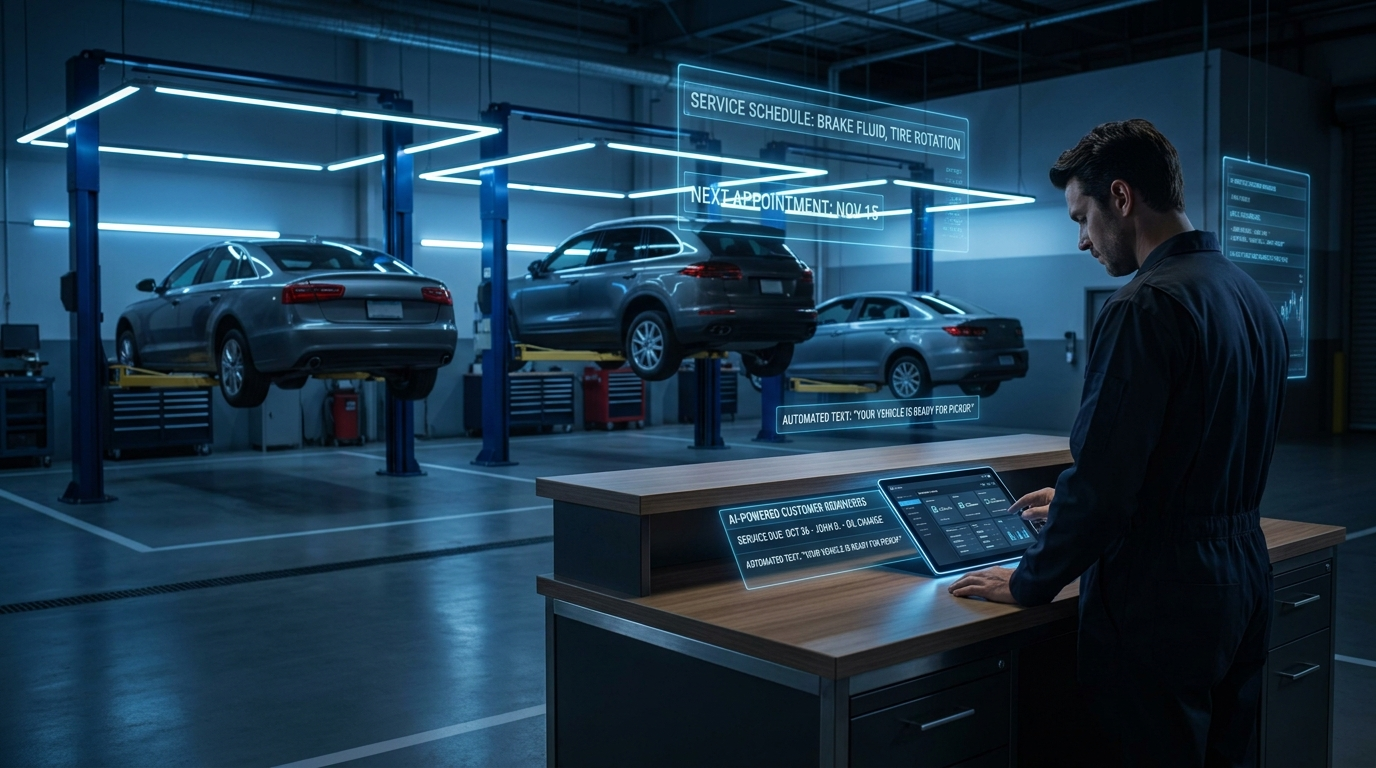
Most auto repair shops work hard to earn a customer once. Then they never contact that customer again. The car comes back in 3,000 miles for an oil change — to whoever sends the reminder first. That shop is usually not you.
The average auto repair shop loses 40-60% of first-time customers after the first visit. Not because the work was bad. Because nobody followed up. An AI service reminder system fixes this by tracking every vehicle's maintenance schedule and reaching out automatically — before the customer searches Google, before Jiffy Lube sends them a mailer, before they forget your shop existed.
This guide breaks down how AI service reminders work, what to look for when choosing a system, and what kind of revenue lift a 6-8 bay shop can realistically expect in the first 90 days.
Why Auto Repair Shops Lose Customers They Already Earned
Walk through the math. A 6-bay shop doing 100 repair orders per month at a $500 average ticket brings in roughly $50,000 in monthly revenue. If 50% of new customers never return — which is the industry average without active retention — that shop is leaving $25,000 in potential monthly recurring revenue on the table. Every month. From customers it already spent money to acquire.
The three reasons customers don't return are almost always the same:
- They forgot which shop they used. Most people don't remember the name of the shop that changed their oil 6 months ago.
- They got contacted by a competitor first. National chains and quick-lube franchises send reminders automatically. Independent shops typically don't.
- Nothing prompted them to act. When the car needs an oil change, the customer thinks about it for a day, then forgets. A single text with a booking link is enough to convert them — nobody sent it.
None of these are loyalty problems. They are communication problems. An AI service reminder system solves all three with zero manual effort from your front desk.
How an AI Service Reminder System Works for Auto Repair Shops
A modern AI service reminder system connects to your shop management software — Mitchell1, Tekmetric, ShopWare, AutoFluent, or similar — and does five things automatically.
1. Maintenance Due-Date Tracking
Every time a vehicle leaves your shop, the system logs the service performed, the mileage, and the date. It then calculates when the next service interval is due based on manufacturer recommendations — oil changes at 5,000 or 7,500 miles, tire rotations at 6,000-8,000 miles, brake inspections annually, coolant flushes every 30,000 miles, and so on.
When a vehicle approaches that interval — based on time elapsed or estimated mileage accumulation — the AI triggers an outreach sequence without anyone at your shop having to remember anything.
2. Personalized Multi-Channel Outreach
The reminder sequence isn't a generic blast. The AI personalizes each message with the customer's name, their vehicle make and model, the specific service that's due, and the last time the vehicle was in your shop. A message that says "Hi Sarah — your 2021 Honda CR-V is coming up on its 45,000 mile oil change and tire rotation. Want to grab a spot this week?" converts at 3-5x the rate of a generic coupon mailer.
The sequence typically runs across three channels in order:
- SMS (Day 1): Short, personalized text with a direct booking link
- Email (Day 3): Slightly longer message with vehicle history summary and special offer if applicable
- AI voice call (Day 7): Automated call that sounds natural, offers to schedule directly, and transfers to your front desk if the customer has questions
Customers who don't respond get a lighter follow-up 30 days later. Customers who book are removed from the sequence immediately and moved to an appointment confirmation flow.
3. Dormant Customer Reactivation
Beyond regular maintenance reminders, the AI runs a separate pass on customers who haven't visited in 12+ months. These are customers you earned but lost. The reactivation message is slightly different — it acknowledges the time gap, mentions what the vehicle might be due for, and offers a specific reason to come back (a free inspection, priority scheduling, or a small discount on the next service).
Dormant reactivation campaigns typically convert 15-25% of contacts within the first 60 days. For a shop with 500 dormant customers in its database, that's 75-125 return visits — without spending a dollar on new customer acquisition.
4. Post-Visit Review and Rebooking
Within 24-48 hours of every completed repair, the AI sends a two-part follow-up. The first part asks for a Google review — with a direct link — while the visit is still fresh. Shops that automate this step average 4.6-4.8 star ratings because they're capturing feedback at the moment of highest satisfaction.
The second part plants the seed for the next visit. For an oil change, it reminds the customer how many miles are on the car and when they'll be due again. For a bigger repair, it notes any other items the technician flagged that weren't addressed and offers to schedule a follow-up. This single step drives significant repeat business because it keeps the shop top of mind at exactly the right moment.
5. Seasonal and Recall Alerts
A well-configured AI reminder system also sends proactive alerts based on season and vehicle data. Pre-winter battery and tire checks, spring AC inspections, summer coolant service — these campaigns generate incremental jobs without the shop having to run a promotion or advertise anything. The AI identifies which customers have vehicles likely to need seasonal service based on their history and triggers the outreach automatically.
Some systems also integrate with NHTSA recall data. If a customer's vehicle has an open recall, the AI alerts them — positioning your shop as a trusted advisor, not just a vendor.
Manual vs. AI Service Reminders: What Changes
| Factor | Manual / No System | AI Service Reminder System |
|---|---|---|
| Outreach volume | 0-10 calls/month (whoever front desk has time to call) | 100% of database contacted on schedule |
| Personalization | Generic postcard or none | Name, vehicle, specific service due, mileage |
| Speed of follow-up | Days to weeks (or never) | Triggered within hours of due date |
| Customer retention rate | 35-50% (industry avg without reminders) | 65-80% with active AI reminder system |
| Google reviews/month | 2-5 organic | 15-40 from automated post-visit requests |
| Dormant reactivation | Near zero (no capacity) | 15-25% of dormant database in 60 days |
| Front desk time required | 2-4 hrs/week for manual outreach | Under 30 min/week to review reports |
| Revenue from returning customers | Baseline | +20-40% monthly recurring revenue |
Real Numbers: What a 6-Bay Charlotte Shop Gained in 90 Days
A 6-bay independent auto repair shop in the Steele Creek area of Charlotte had 847 customers in their Mitchell1 database. Of those, 412 hadn't been in the shop in over 12 months. The shop was doing $78,000/month in revenue — solid for the market, but flat for two years.
Leadra.io deployed an AI service reminder system in the first week of January. Here's what happened over 90 days:
- Month 1: Dormant reactivation campaign went out to 412 customers. 89 booked appointments (21.6% reactivation rate). Average ticket: $380. Revenue from reactivated customers: $33,820.
- Month 2: Active maintenance reminders kicked in for the full database. Return visit rate climbed from 41% to 63%. Monthly revenue hit $94,000 — up $16,000 from the previous month without adding a single new customer acquisition channel.
- Month 3: Seasonal pre-summer AC inspection campaign generated 34 appointments in 2 weeks. Google reviews increased from 47 total to 94 total. The shop's Google Maps ranking for "auto repair Steele Creek" moved from position 6 to position 2.
At the 90-day mark, the shop was running $101,000/month — a $23,000 monthly increase from a system that required zero ongoing effort from the front desk. The AI service reminder investment was $1,200/month. ROI: 19.2x.
What to Look for in an AI Service Reminder System
Not all service reminder tools are built the same. Here's what separates a system that produces real results from one that sends generic texts nobody opens.
Native Integration with Your Shop Management Software
The system needs to pull live data from Mitchell1, Tekmetric, ShopWare, or your specific platform — not require a weekly CSV export. If the integration isn't native, the data gets stale and the reminders get inaccurate. An oil change reminder that fires two weeks late because the sync was manual is worse than no reminder at all.
Vehicle-Specific Interval Logic
A good system knows the difference between a Toyota Camry with a 5,000-mile synthetic interval and a Ford F-150 that still takes conventional oil every 3,000 miles. It also knows that a diesel needs different intervals than a gas engine. Generic "come in for your oil change" messages don't convert. Messages that match the actual vehicle do.
Multi-Channel Sequencing (Not Just Text Blasts)
Single-channel reminder tools hit a ceiling fast. Some customers respond to texts, some to emails, some to calls. A proper AI reminder system runs a coordinated sequence across all three channels, stopping the moment the customer books. This is what separates a 15% response rate from a 35% response rate.
Opt-Out Management and Compliance
Any system sending automated texts needs to handle TCPA compliance automatically — opt-out requests logged immediately, suppression lists maintained, proper disclosures on the first contact. A system that doesn't manage this exposes your shop to liability.
Reporting That Shows Revenue, Not Just Open Rates
Email open rates are vanity metrics for auto repair shops. What matters is appointments booked, revenue generated, and return customer rate over time. If the system can't show you those three numbers clearly, you can't tell whether it's working.
How to Implement in 14 Days
The setup process is straightforward when the system integrates directly with your shop management software.
Days 1-3: Connect the AI system to your shop management software via API. The system pulls your full customer database, vehicle history, and last service data. No manual entry.
Days 4-5: Configure interval rules. Set oil change intervals for synthetic vs. conventional, tire rotation schedules, annual inspection reminders, and any other recurring services your shop does most. The system uses these rules to calculate when each vehicle in your database is next due.
Days 6-7: Write the message templates. The AI handles delivery and personalization, but you approve the tone. Keep them short, specific, and human. "Hi [Name] — your [Year Make Model] is coming up on its [Service]. We have openings this week. [Booking link]" outperforms anything longer.
Days 8-10: Launch dormant reactivation. Your biggest immediate revenue opportunity is customers who haven't visited in 12+ months. This campaign goes out first. Expect bookings to start coming in within 48 hours.
Days 11-14: Activate ongoing maintenance reminders for your current customer base. From this point forward, the system runs on autopilot. Your front desk sees inbound booking requests from the AI outreach and confirms them normally.
Pricing: What Does an AI Service Reminder System Cost?
Pricing varies by provider and database size, but here's a realistic range:
- Basic (SMS reminders only, limited contacts): $200-$500/month. Works for very small shops. Misses email and voice channels. Limited personalization.
- Mid-tier (multi-channel, full database, basic integrations): $600-$1,500/month. Covers most shops under 8 bays. Good for shops with 200-800 active customers.
- Full AI system (multi-channel, deep integration, dormant reactivation, analytics): $1,500-$3,000/month. Built for shops doing $80k+/month that want a complete retention engine, not just reminder texts.
For most 4-8 bay shops, the mid-tier option recovers its cost in the first week of the dormant reactivation campaign alone. The ongoing maintenance reminder ROI compounds every month as your database grows.
The Hidden Benefit: Google Rankings
There's a secondary effect most shops don't anticipate. When the post-visit review request goes out automatically to every customer after every completed job, your Google review volume increases 5-10x within 60 days. Google Maps rankings for local search terms correlate strongly with review count and recency.
A shop that was sitting at position 7 for "auto repair [city]" with 40 reviews often climbs to position 2-3 within 90 days after deploying AI review automation — not because anything else changed, but because the review count jumped from 40 to 110 and the average rating improved.
Higher Google Maps rankings bring more inbound calls. More inbound calls mean more new customers to feed into the AI reminder system. The compounding effect makes retention-focused AI one of the highest-ROI growth investments an auto repair shop can make.
FAQ: AI Service Reminders for Auto Repair Shops
What is an AI service reminder system for auto repair shops?
An AI service reminder system automatically contacts past customers when their vehicle is due for routine maintenance — oil changes, tire rotations, brake inspections, fluid flushes, and more. It pulls vehicle history from your shop management software, calculates the next service interval, and sends personalized texts, emails, or AI voice calls to bring the customer back. No manual outreach required.
How many customers does an auto repair shop lose without service reminders?
Industry data shows 40-60% of first-time auto repair customers never return for a second visit. For a shop doing 80-120 repair orders per month at a $400-$600 average ticket, that's $19,200-$43,200 in lost monthly revenue from customers who simply never heard from the shop again. Most left not because they were unhappy — but because nobody followed up.
How much revenue can AI service reminders add to an auto repair shop?
A well-configured AI service reminder system typically recovers 25-40% of lapsed customers within the first 90 days. For a 6-bay shop doing $80,000-$100,000 per month, that translates to $15,000-$30,000 in recovered monthly revenue — from customers who already trusted the shop once. Total revenue lift runs 20-35% with no increase in ad spend.
Does AI service reminder software work with Mitchell1, ShopWare, or Tekmetric?
Yes. Modern AI service reminder systems connect directly to Mitchell1, ShopWare, Tekmetric, AutoFluent, and other major shop management platforms via API. The integration pulls customer contact info, vehicle history, and last service mileage automatically. When a customer books through the reminder, the appointment syncs back into your existing system so your front desk sees everything in one place.
Bottom Line
Your existing customer database is the most underutilized asset in your shop. These are people who already paid you, trusted you with their vehicle, and left satisfied. The only reason half of them aren't coming back is that you haven't contacted them.
An AI service reminder system changes that without adding to your front desk's workload. It tracks every vehicle, triggers outreach at the right moment, books the appointment, and asks for the review — all on autopilot. The shops implementing this now are building compounding retention advantages that are hard for competitors without the system to match.
If you want to see what this looks like for your specific shop — how many dormant customers are in your database and what reactivating 25% of them would add to your monthly revenue — reach out to Leadra.io. We'll run the numbers with you before you commit to anything.
See How Many Customers Are in Your Dormant Database
Leadra.io builds AI service reminder systems for auto repair shops. We start with a free audit of your existing customer database to show you exactly what you're leaving on the table — before you spend a dollar.